

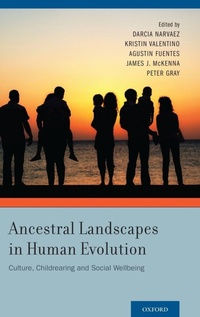
Ancestral Landscapes in Human Evolution
Culture, Childrearing and Social Wellbeing
Published on 17. April 2014
Book
Hardback
384 pages
978-0-19-996425-3 (ISBN)
Description
The social contexts in which children develop have transformed over recent decades, but also over millennia. Modern parenting practices have diverged greatly from ancestral practices, which included natural childbirth, extensive and on-demand breastfeeding, constant touch, responsiveness to the needs of the child, free play in nature with multiple-aged playmates, and multiple adult caregivers. Only recently have scientists begun to document the outcomes for the presence or absence of such parenting practices, but early results indicate that psychological wellbeing is impacted by these factors.
Ancestral Landscapes in Human Evolution addresses how a shift in the way we parent can influence child outcomes. It examines evolved contexts for mammalian development, optimal and suboptimal contexts for human evolved needs, and the effects on children's development and human wellbeing. Bringing together an interdisciplinary set of renowned contributors, this volume examines how different parenting styles and cultural personality influence one another. Chapters discuss the nature of childrearing, social relationships, the range of personalities people exhibit, the social and moral skills expected of adults, and what 'wellbeing' looks like. As a solid knowledge base regarding normal development is considered integral to understanding psychopathology, this volume also focuses on the effects of early childhood maltreatment. By increasing our understanding of basic mammalian emotional and motivational needs in contexts representative of our ancestral conditions, we may be in a better position to facilitate changes in social structures and systems that better support optimal human development. This book will be a unique resource for researchers and students in psychology, anthropology, and psychiatry, as well as professionals in public health, social work, clinical psychology, and early care and education.
Ancestral Landscapes in Human Evolution addresses how a shift in the way we parent can influence child outcomes. It examines evolved contexts for mammalian development, optimal and suboptimal contexts for human evolved needs, and the effects on children's development and human wellbeing. Bringing together an interdisciplinary set of renowned contributors, this volume examines how different parenting styles and cultural personality influence one another. Chapters discuss the nature of childrearing, social relationships, the range of personalities people exhibit, the social and moral skills expected of adults, and what 'wellbeing' looks like. As a solid knowledge base regarding normal development is considered integral to understanding psychopathology, this volume also focuses on the effects of early childhood maltreatment. By increasing our understanding of basic mammalian emotional and motivational needs in contexts representative of our ancestral conditions, we may be in a better position to facilitate changes in social structures and systems that better support optimal human development. This book will be a unique resource for researchers and students in psychology, anthropology, and psychiatry, as well as professionals in public health, social work, clinical psychology, and early care and education.
Reviews / Votes
Ancestral Landscapes in Human Evolution is a well-written, captivating book that makes the case that infant care is an immensely complex yet intrinsically natural endeavor for many species, with humans providing exquisite cases for study because of our species' astounding cultural diversity. This book is an open invitation for readers to reflect on our inherent mammalian condition and our historicity as a species... * PsycCritiques *More details
Language
English
Place of publication
New York
United States
Target group
College/higher education
Dimensions
Height: 240 mm
Width: 161 mm
Thickness: 25 mm
Weight
737 gr
ISBN-13
978-0-19-996425-3 (9780199964253)
Copyright in bibliographic data and cover images is held by Nielsen Book Services Limited or by the publishers or by their respective licensors: all rights reserved.
Schweitzer Classification
Other editions
Additional editions
Darcia Narvaez | Kristin Valentino | Agustin Fuentes
Ancestral Landscapes in Human Evolution
Culture, Childrearing and Social Wellbeing
E-Book
02/2014
1st Edition
OUP USA
€67.49
Available for download
Persons
Darcia Narvaez is Professor of Psychology at the University of Notre Dame. Dr. Narvaez's research focuses on moral development through the lifespan.
Kristin Valentino is Assistant Professor of Psychology and the William J. Shaw Center for Children and Families Collegiate Chair at the University of Notre Dame. Dr. Valentino's research interests are in developmental psychopathology.
Agustin Fuentes is Professor of Anthropology at the University of Notre Dame. Dr. Fuentes' current foci include cooperation and bonding in human evolution, ethnoprimatology and multispecies anthropology.
James McKenna is Rev. Edmund P. Joyce, C.S.C., Professor of Anthropology at the University of Notre Dame. Dr. McKenna pioneered the first behavioral and electro-physiological studies documenting differences between mothers and infants sleeping together.
Peter Gray is Research Professor of Psychology at Boston College. Dr. Gray has conducted and published research in neuroendocrinology, animal behavior, developmental psychology, anthropology, and education.
Kristin Valentino is Assistant Professor of Psychology and the William J. Shaw Center for Children and Families Collegiate Chair at the University of Notre Dame. Dr. Valentino's research interests are in developmental psychopathology.
Agustin Fuentes is Professor of Anthropology at the University of Notre Dame. Dr. Fuentes' current foci include cooperation and bonding in human evolution, ethnoprimatology and multispecies anthropology.
James McKenna is Rev. Edmund P. Joyce, C.S.C., Professor of Anthropology at the University of Notre Dame. Dr. McKenna pioneered the first behavioral and electro-physiological studies documenting differences between mothers and infants sleeping together.
Peter Gray is Research Professor of Psychology at Boston College. Dr. Gray has conducted and published research in neuroendocrinology, animal behavior, developmental psychology, anthropology, and education.
Editor
ProfessorProfessor, Department of Psychology, University of Notre Dame
Assistant ProfessorAssistant Professor, Department of Psychology, University of Notre Dame
ProfessorProfessor, Department of Anthropology, University of Notre Dame
Rev. Edmund P. Joyce, CSC, Professor of AnthropologyRev. Edmund P. Joyce, CSC, Professor of Anthropology, University of Notre Dame
Research ProfessorResearch Professor, Psychology Department, Boston College
Content
Preface ; Acknowledgments ; About the Editors ; Contributors ; SECTION ONE: Baselines For Human Mammalian Development ; Chapter 1. Children's Development in Light of Evolution and Culture ; Darcia Narvaez, Peter Gray, James J. McKenna, Agustin Fuentes, and Kristin Valentino ; Chapter 2. The Epigenetics of Mammalian Parenting ; Frances A. Champagne ; Commentary: As Time Goes By, A Touch is More Than Just a Touch ; Eric E. Nelson ; Chapter 3. Nonhuman primate models of mental health: Early life experiences affect developmental trajectories ; Amanda M. Dettmer, Stephen J. Suomi, and Katherine Hinde ; Commentary: Look how far we have come: A bit of consilience in elucidating the role of caregivers in relationship to their developing primate infants and children ; James J. McKenna ; SECTION TWO: Evolution's Baseline: Hunter Gatherer Contexts ; Chapter 4. Relationships and Resource Uncertainty: Cooperative Development of Efe Hunter-Gatherer Infants and Toddlers ; Gilda Morelli, Paula Ivey Henry, and Steffen Foerster ; Commentary: Social Connectedness vs. Mothers on Their Own: Research on Hunter-Gather Tribes Highlights the Lack of Support Mothers and Babies Receive in the U.S. ; Kathy Kendall-Tackett ; Chapter 5. Batek childrearing and morality ; Karen L. Endicott and Kirk M. Endicott ; Commentary: Parenting in the Modern Jungle ; Michael Jindra ; Chapter 6. Cosleeping Beyond Infancy: Culture, Ecology, and Evolutionary Biology of Bedsharing among Aka Foragers and Ngandu Farmers of Central Africa ; Barry Hewlett and Jennifer W. Roulette ; Commentary: Intertwining the Influences of Culture and Ecology Broadens a Definition of the Importance of Closeness in Care ; Wendy Middlemiss ; Chapter 7. The Environment of Evolutionary Adaptedness, rough-and-tumble play, and the selection of restraint in human aggression ; Douglas Fry ; Commentary: Evolutionary Adaptation and Violent Aggression: From Myths to Realities ; Riane Eisler ; Chapter 8. The Play Theory of Hunter-Gatherer Egalitarianism ; Peter Gray ; Commentary: Comparative Studies of Social Play, Fairness, and Fitness: What We Know and Where We Should be Heading ; Marc Bekoff ; SECTION THREE: Contexts for the Evolution of Families and Children ; Chapter 9. Incentives in the family I: The family firm, an evolutionary/economic theory for parent-offspring relations ; Joan Roughgarden and Zhiyuan Song ; Chapter 10. Preliminary steps towards addressing the role of non-adult individuals in human evolution ; Agustin Fuentes ; Commentary: Conflict and evolution ; Melvin Konner ; SECTION FOUR: Contexts Gone Awry ; Chapter 11. Child Maltreatment and Early Mother-Child Interactions ; Kristin Valentino, Michelle Comas, and Amy K. Nuttall ; Commentary: Ancestral attachment: How the evolutionary foundation of attachment informs our understanding of child maltreatment interventions ; Alyssa Crittenden ; Chapter 12. The Importance of the Developmental Perspective in Evolutionary Discussions of PTSD ; Robyn Bluhm and Ruth A. Lanius ; Commentary: The modeling of complex PTSD can benefit from the careful integration of evolutionary and developmental accounts ; Pierre Lienard ; Chapter 13. From the Emergent Drama of Interpretation to Enscreenment ; Eugene Halton ; Commentary: Darwinism and Children ; Jonathan Marks ; SECTION FIVE: Child Flourishing ; Chapter 14. Children's Environments and Flourishing ; Tracy Gleason and Darcia Narvaez ; Chapter 15: Postscript: Back to the Future ; James McKenna ; Index