

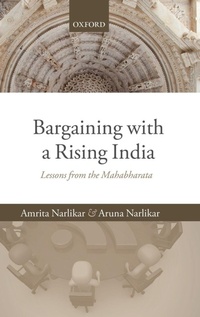
Bargaining with a Rising India
Lessons from the Mahabharata
Published on 20. March 2014
Book
Hardback
248 pages
978-0-19-969838-7 (ISBN)
Description
The need to negotiate effectively with India is only growing as its power rises. Understanding the negotiating culture wherein India's bargaining behaviour is embedded forms a crucial step to facilitate this process. In the literature on international negotiation, experimental studies point to specific behavioural characteristics of Indian negotiators. Empirical analyses confirm these findings, and many suggest that the sources of India's negotiation behaviour are deep-rooted and culture-specific, going beyond what standard explanations of interest group politics, partisan politics, or institutional politics would suggest. But there are very few works that trace these sources. Extensive sociological and anthropological, and comparative political studies remain confined to their own fields, and do not develop their implications for Indian foreign policy or negotiation. There is a conspicuous lack of works that attempt to unpack the "negotiating culture" variable using literary sources. This book aims to fill both these gaps. It focuses on India's negotiating traditions through the lens of the classical Sanskrit text, the Mahabharata, and investigates the continuities and changes in India's negotiation behaviour as a rising power.
Reviews / Votes
All of us outside India need better understandings of its policies and their drivers. This rare, creative book helps by viewing the classical Sanskrit epic partly through lenses from recent negotiation analysis. A corrective to western-centric scholarship, the book makes a remarkably original contribution to the tradition that traces negotiation behavior to national cultures. The authors lessons are relevant for todays international negotiations. * John Odell, Professor Emeritus of International Relations, University of Southern California * National cultures and international bargaining behavior are too often linked using stereotypes and anecdotes. Narlikar and Narlikar offer for the first time a comprehensive and convincing view of the traditional negotiating culture of one rising power, India, and the effects of that culture on contemporary international negotiations * Miles Kahler, University of California, San Diego * This study fills a major gap both for scholars and for policymakers by placing Indian diplomacy in a cultural context and provides a new understanding of how Indias classical traditions continue to influence Indias bargaining positions and negotiating strategies. * Gareth Price, Senior Research Fellow, Chatham House * The book should be of considerable interest to India watchers around the world looking for clues to how a rising India behaves in global negotiations on trade, climate change and reform of international institutions. * Amitav Acharya, International Affairs * I am certain international negotiators and scholars will find this book a rich resource. As the authors' conclude, successful negotiation with the emerging BRIC powers requires "more studies of the cultures of the non-Western rising powers will have to become essential reading for all those involved in the theory and practice of diplomacy and global governance" (p. 223). This is just such a work. * John D. Baker, The Negotiator Magazine *More details
Language
English
Place of publication
Oxford
United Kingdom
Target group
College/higher education
Professional and scholarly
Dimensions
Height: 240 mm
Width: 161 mm
Thickness: 18 mm
Weight
540 gr
ISBN-13
978-0-19-969838-7 (9780199698387)
Copyright in bibliographic data and cover images is held by Nielsen Book Services Limited or by the publishers or by their respective licensors: all rights reserved.
Schweitzer Classification
Other editions
Additional editions
E-Book
03/2014
1st Edition
OUP eBook
€46.99
Available for download
Persons
Dr Amrita Narlikar is Reader in International Political Economy at the Department of Politics and International Studies, and Director of the Centre for Rising Powers, University of Cambridge. She is also an Official Fellow of Darwin College, Cambridge. Her most recent works include a single-authored book, New Powers: How to Become One and How to Manage Them, London: Hurst and New York: Oxford University Press, 2010, and (co-edited with Martin Daunton and Robert Stern) The Oxford Handbook on the World Trade Organization, Oxford: Oxford University Press, 2012. She recently guest-edited a special issue of the Chatham House journal International Affairs on Negotiating the Rise of New Powers, 89: 2, May 2013.
Dr Aruna Narlikar holds a doctoral degree in Indian Writing in English and has cultivated a long-standing expertise in Sanskrit, particularly the Mahabharata. She has worked as a columnist and freelance journalist in the top Indian broadsheets in English, including The Times of India and The Hindustan Times, and also writes frequently for the vernacular press in Marathi. She has experience of over ten years in anchoring programs on Indian culture on national Indian television and has also translated books for the National Indian Academy for Literature (Sahitya Akademi).
Dr Aruna Narlikar holds a doctoral degree in Indian Writing in English and has cultivated a long-standing expertise in Sanskrit, particularly the Mahabharata. She has worked as a columnist and freelance journalist in the top Indian broadsheets in English, including The Times of India and The Hindustan Times, and also writes frequently for the vernacular press in Marathi. She has experience of over ten years in anchoring programs on Indian culture on national Indian television and has also translated books for the National Indian Academy for Literature (Sahitya Akademi).
Content
1. Playing Hard Ball?: India in International Negotiations ; 2. India's Negotiation Strategy: The Heroism of Hard Bargaining? ; 3. Framing from a Moral High Horse ; 4. Coalitions: Choosing Allies, Sustaining Friendships ; 5. Time: The Long Shadow of the Past and the Future ; 6. Conclusion ; Appendix A: The Story of the Mahabharata in brief ; Appendix B: A Note of Explanation on the Sanskrit