

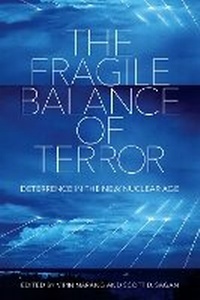
The Fragile Balance of Terror
Deterrence in the New Nuclear Age
Published on 15. January 2023
Book
Hardback
270 pages
978-1-5017-6701-2 (ISBN)
Description
In The Fragile Balance of Terror, the foremost experts on nuclear policy and strategy offer insight into an era rife with more nuclear powers. Some of these new powers suffer domestic instability, others are led by pathological personalist dictators, and many are situated in highly unstable regions of the world-a volatile mix of variables.
The increasing fragility of deterrence in the twenty-first century is created by a confluence of forces: military technologies that create vulnerable arsenals, a novel information ecosystem that rapidly transmits both information and misinformation, nuclear rivalries that include three or more nuclear powers, and dictatorial decision making that encourages rash choices. The nuclear threats posed by India, Pakistan, Iran, and North Korea are thus fraught with danger.
The Fragile Balance of Terror, edited by Vipin Narang and Scott D. Sagan, brings together a diverse collection of rigorous and creative scholars who analyze how the nuclear landscape is changing for the worse. Scholars, pundits, and policymakers who think that the spread of nuclear weapons can create stable forms of nuclear deterrence in the future will be forced to think again.
Contributors: Giles David Arceneaux, Mark S. Bell, Christopher Clary, Peter D. Feaver, Jeffrey Lewis, Rose McDermott, Nicholas L. Miller, Vipin Narang, Ankit Panda, Scott D. Sagan, Caitlin Talmadge, Heather Williams, Amy Zegart
The increasing fragility of deterrence in the twenty-first century is created by a confluence of forces: military technologies that create vulnerable arsenals, a novel information ecosystem that rapidly transmits both information and misinformation, nuclear rivalries that include three or more nuclear powers, and dictatorial decision making that encourages rash choices. The nuclear threats posed by India, Pakistan, Iran, and North Korea are thus fraught with danger.
The Fragile Balance of Terror, edited by Vipin Narang and Scott D. Sagan, brings together a diverse collection of rigorous and creative scholars who analyze how the nuclear landscape is changing for the worse. Scholars, pundits, and policymakers who think that the spread of nuclear weapons can create stable forms of nuclear deterrence in the future will be forced to think again.
Contributors: Giles David Arceneaux, Mark S. Bell, Christopher Clary, Peter D. Feaver, Jeffrey Lewis, Rose McDermott, Nicholas L. Miller, Vipin Narang, Ankit Panda, Scott D. Sagan, Caitlin Talmadge, Heather Williams, Amy Zegart
Reviews / Votes
Narang and Sagan assembled a distinguished roster of scholars to articulate a disturbing picture of nuclear uncertainty. * H- Net (H-Diplo) *More details
Series
Language
English
Place of publication
Ithaca
United States
Product notice
Paper over boards
Illustrations
1 chart - 1 Charts
Dimensions
Height: 229 mm
Width: 152 mm
Thickness: 25 mm
Weight
907 gr
ISBN-13
978-1-5017-6701-2 (9781501767012)
Copyright in bibliographic data and cover images is held by Nielsen Book Services Limited or by the publishers or by their respective licensors: all rights reserved.
Schweitzer Classification
Other editions
Additional editions
E-Book
01/2023
Cornell University Press
€0.00
Available for download
Persons
Vipin Narang is the Frank Stanton Professor of Nuclear Security and Political Science at the Massachusetts Institute of Technology. He is the author of Nuclear Strategy in the Modern Era and Seeking the Bomb. Follow him on X @narangvipin.
Scott D. Sagan is the Caroline S. G. Munro Professor of Political Science, the Mimi and Peter Haas University Fellow in Undergraduate Education, and Senior Fellow and Codirector at the Center for International Security and Cooperation (CISAC) at Stanford University. He is the author of The Limits of Safety and coauthor of The Spread of Nuclear Weapons.
Scott D. Sagan is the Caroline S. G. Munro Professor of Political Science, the Mimi and Peter Haas University Fellow in Undergraduate Education, and Senior Fellow and Codirector at the Center for International Security and Cooperation (CISAC) at Stanford University. He is the author of The Limits of Safety and coauthor of The Spread of Nuclear Weapons.