

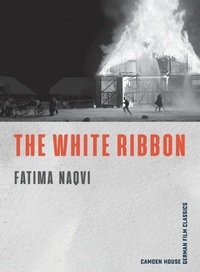
The White Ribbon
Published on 15. September 2020
Book
Paperback/Softback
98 pages
978-1-64014-044-8 (ISBN)
Description
Explores Haneke's historically complex film as a reflection on purity, ideology, violence, and child-rearing.
White ribbons and black pedagogy - Michael Haneke's award-winning film The White Ribbon (2009) is a multilayered reflection on purity, ideology, violence, and child rearing. In this tense black-and-white whodunit, mysterious events occur in a small town on the German-Polish border in 1913-14. A tripwire fells the doctor's horse; a farmhand's wife falls through the floor of a shed; a barn goes up in flames; the baron's son is terribly beaten; a girls takes claims to clairvoyance; a mentally disabled boy is tortured and maimed. While the film unfolds on the eve of the First World War, the violence evokes other historical moments: the breakup of the multi ethnic Austro-Hungarian Empire, the rise of National Socialism, the emergence of 1960s German terrorism, and religious fundamentalism post 9/11.
Fatima Naqvi's book looks at Haneke's technique of combining various histories in the digital era. It also reflects on the guise of literariness and historical authenticity in which the director clothes this fictional film. It meditates on the film's inscription techniques and its ability to appeal to international audiences. Naqvi shows that The White Ribbon bespeaks a certain historical "translatability" into historical and aesthetic contexts outside of Germany-in marked contrast to the historical specificity it conveys on a surface level.
White ribbons and black pedagogy - Michael Haneke's award-winning film The White Ribbon (2009) is a multilayered reflection on purity, ideology, violence, and child rearing. In this tense black-and-white whodunit, mysterious events occur in a small town on the German-Polish border in 1913-14. A tripwire fells the doctor's horse; a farmhand's wife falls through the floor of a shed; a barn goes up in flames; the baron's son is terribly beaten; a girls takes claims to clairvoyance; a mentally disabled boy is tortured and maimed. While the film unfolds on the eve of the First World War, the violence evokes other historical moments: the breakup of the multi ethnic Austro-Hungarian Empire, the rise of National Socialism, the emergence of 1960s German terrorism, and religious fundamentalism post 9/11.
Fatima Naqvi's book looks at Haneke's technique of combining various histories in the digital era. It also reflects on the guise of literariness and historical authenticity in which the director clothes this fictional film. It meditates on the film's inscription techniques and its ability to appeal to international audiences. Naqvi shows that The White Ribbon bespeaks a certain historical "translatability" into historical and aesthetic contexts outside of Germany-in marked contrast to the historical specificity it conveys on a surface level.
Reviews / Votes
Naqvi hopes to counter the impression some critics were left with: that . . . the film . . . argues that no one is responsible for Nazi violence. She argues convincingly that Haneke's specific indictment of Enlightenment conceptions of pedagogy and their nineteenth-century practices do in fact point to a culprit. [Those practices] "made German systems of hypocrisy, collusion, and oppression possible across generations" (78), and Haneke's specific aesthetic paradigms and film techniques make that argument clear. -- Noah Soltau * GERMAN STUDIES REVIEW *More details
Series
Language
English
Place of publication
Columbia, MD
United States
Publishing group
Boydell & Brewer Ltd
Target group
Professional and scholarly
Product notice
Paperback (trade)
Illustrations
35 s/w Abbildungen, 4 farbige Abbildungen
4 colour, 35 b/w illus.
Dimensions
Height: 191 mm
Width: 140 mm
Thickness: 6 mm
Weight
120 gr
ISBN-13
978-1-64014-044-8 (9781640140448)
Copyright in bibliographic data and cover images is held by Nielsen Book Services Limited or by the publishers or by their respective licensors: all rights reserved.
Schweitzer Classification
Other editions
Additional editions
Person
FATIMA NAQVI is Professor in the Department of Germanic Languages and Literatures and an Affiliate of the Film and Media Studies Program at Yale University.
Content
Introduction
Literariness
Inscriptions
Black Pedagogy
Working Through Working Through
Women's Meta-Commentary
Germanness
An Ecology of Images
The Unresolved Mystery
Coda
Credits
Notes
Literariness
Inscriptions
Black Pedagogy
Working Through Working Through
Women's Meta-Commentary
Germanness
An Ecology of Images
The Unresolved Mystery
Coda
Credits
Notes