

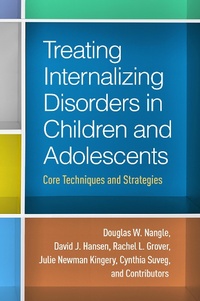
Treating Internalizing Disorders in Children and Adolescents
Core Techniques and Strategies
1st Edition
Published on 20. July 2016
Book
Hardback
358 pages
978-1-4625-2626-0 (ISBN)
Description
Identifying 13 core techniques and strategies that cut across all available evidence-based treatments for child and adolescent mood and anxiety disorders, this book provides theoretical rationales, step-by-step implementation guidelines, and rich clinical examples. Therapists can flexibly draw from these elements to tailor interventions to specific clients, or can use the book as an instructive companion to any treatment manual. Coverage includes exposure tasks, cognitive strategies, problem solving, modeling, relaxation, psychoeducation, social skills training, praise and rewards, activity scheduling, self-monitoring, goal setting, homework, and maintenance and relapse prevention.
Reviews / Votes
"If you had to refer a family member for treatment, wouldn't you pick a treatment that was known to have the preferred probability of success? The authors of this book have done a beautiful job of extracting the core elements of programs that have been supported by research and explaining their nuts and bolts. An extremely valuable guide for all mental health professionals, this volume merits a round of long and loud applause for its provision of valuable 'how-to' information along with its scholarly selection of core elements."--Philip C. Kendall, PhD, ABPP, Laura H. Carnell Professor of Psychology and Distinguished University Professor, Temple University"For anyone interested in treatment of internalizing disorders in children and adolescents, this book will be indispensable. Taking on the increasingly voluminous literature on evidence-based treatments, these authors put a new lens on understanding how the best interventions are put together, focusing on the procedures common to a diverse collection of successful approaches. Their analysis of relevant research offers a compelling picture of accumulated knowledge. This is the book I have been waiting for."--Bruce F. Chorpita, PhD, Department of Psychology, University of California, Los Angeles; President, PracticeWise
"Nangle and colleagues have crafted a beautifully written work that integrates theory, research, and clinical practice in a most inviting manner. This invaluable book is sure to propel dissemination of evidence-based procedures, since it distills core elements of the best protocols into readily applicable 'golden nuggets' that anyone who works with children and adolescents will welcome. The text boxes, task analyses, and case illustrations augment what is already robust material. An indispensable clinical resource."--Robert D. Friedberg, PhD, ABPP, Professor and Director, Center for the Study and Treatment of Anxious Youth, Palo Alto University
"Nangle et al. score big--really big--with this volume. For the first time ever, the theoretical underpinnings, evidence base, and clinical utility of the key ingredients in the treatment of internalizing disorders in children and adolescents are explored in detail. Many research articles, chapters, and manuals describe these core elements, but only in a cursory, superficial fashion. By contrast, this book brings the techniques to life by providing step-by-step suggestions for their implementation and evaluation. It will become standard fare for training programs in clinical child and adolescent psychology and psychiatry, as well as for professionals. This is a book whose time has surely come."--Thomas H. Ollendick, PhD, ABPP, University Distinguished Professor, Department of Psychology, Virginia Tech -This book can serve as an important text in many graduate programs where individuals are becoming acquainted with different treatment strategies and procedures.--Child and Family Behavior Therapy, 7/6/2017??One of the most useful CBT books for beginning counselors I have ever read. The authors are all highly qualified and experienced....This is a clearly written, easy-to-read manual for beginning therapists....Highly recommended!--BACP Children and Young People, 12/1/2016??This book is written in clinical, yet user-friendly language with clear, concise guidance for implementing each element from start to finish....By any measure it is a smashing success! This book is recognized as the standard-bearer for identifying and explaining the practical application techniques and strategies of the 13 core elements. Nowhere in journal articles, book chapters, or treatment manuals will readers find such a unique compilation. I highly recommend this timely book for all clinicians in training and seasoned mental health professionals as the go-to resource for gaining a sound understanding of the core elements in treating mood and anxiety disorders in children and adolescents. *****!--Doody's Review Service, 1/6/2017 "If you had to refer a family member for treatment, wouldn't you pick a treatment that was known to have the preferred probability of success? The authors of this book have done a beautiful job of extracting the core elements of programs that have been supported by research and explaining their nuts and bolts. An extremely valuable guide for all mental health professionals, this volume merits a round of long and loud applause for its provision of valuable 'how-to' information along with its scholarly selection of core elements."--Philip C. Kendall, PhD, ABPP, Laura H. Carnell Professor of Psychology and Distinguished University Professor, Temple University
"For anyone interested in treatment of internalizing disorders in children and adolescents, this book will be indispensable. Taking on the increasingly voluminous literature on evidence-based treatments, these authors put a new lens on understanding how the best interventions are put together, focusing on the procedures common to a diverse collection of successful approaches. Their analysis of relevant research offers a compelling picture of accumulated knowledge. This is the book I have been waiting for."--Bruce F. Chorpita, PhD, Department of Psychology, University of California, Los Angeles; President, PracticeWise
"Nangle and colleagues have crafted a beautifully written work that integrates theory, research, and clinical practice in a most inviting manner. This invaluable book is sure to propel dissemination of evidence-based procedures, since it distills core elements of the best protocols into readily applicable 'golden nuggets' that anyone who works with children and adolescents will welcome. The text boxes, task analyses, and case illustrations augment what is already robust material. An indispensable clinical resource."--Robert D. Friedberg, PhD, ABPP, Professor and Director, Center for the Study and Treatment of Anxious Youth, Palo Alto University
"Nangle et al. score big--really big--with this volume. For the first time ever, the theoretical underpinnings, evidence base, and clinical utility of the key ingredients in the treatment of internalizing disorders in children and adolescents are explored in detail. Many research articles, chapters, and manuals describe these core elements, but only in a cursory, superficial fashion. By contrast, this book brings the techniques to life by providing step-by-step suggestions for their implementation and evaluation. It will become standard fare for training programs in clinical child and adolescent psychology and psychiatry, as well as for professionals. This is a book whose time has surely come."--Thomas H. Ollendick, PhD, ABPP, University Distinguished Professor, Department of Psychology, Virginia Tech -This book can serve as an important text in many graduate programs where individuals are becoming acquainted with different treatment strategies and procedures.--Child and Family Behavior Therapy, 7/6/2017AE'AE'One of the most useful CBT books for beginning counselors I have ever read. The authors are all highly qualified and experiencedaEUR|.This is a clearly written, easy-to-read manual for beginning therapistsaEUR|.Highly recommended!--BACP Children and Young People, 12/1/2016AE'AE'This book is written in clinical, yet user-friendly language with clear, concise guidance for implementing each element from start to finishaEUR|.By any measure it is a smashing success! This book is recognized as the standard-bearer for identifying and explaining the practical application techniques and strategies of the 13 core elements. Nowhere in journal articles, book chapters, or treatment manuals will readers find such a unique compilation. I highly recommend this timely book for all clinicians in training and seasoned mental health professionals as the go-to resource for gaining a sound understanding of the core elements in treating mood and anxiety disorders in children and adolescents. *****!--Doody's Review Service, 1/6/2017
More details
Language
English
Place of publication
New York
United States
Publishing group
Guilford Publications
Target group
Professional and scholarly
Professional and Professional Practice & Development
Product notice
sewn/stitched
Cloth over boards
Dimensions
Height: 229 mm
Width: 150 mm
Thickness: 30 mm
Weight
658 gr
ISBN-13
978-1-4625-2626-0 (9781462526260)
Copyright in bibliographic data and cover images is held by Nielsen Book Services Limited or by the publishers or by their respective licensors: all rights reserved.
Schweitzer Classification
Other editions
Additional editions
Douglas W. Nangle | David J. Hansen | Rachel L. Grover
Treating Internalizing Disorders in Children and Adolescents
Core Techniques and Strategies
E-Book
06/2016
The Guilford Press
€52.99
Available for download
Persons
Douglas W. Nangle, PhD, is Professor and Director of the Doctoral Program in Clinical Psychology at the University of Maine. He has published extensively in the areas of social skills assessment and treatment, child and adolescent peer relations, and cognitive-behavioral treatments. An award-winning teacher and mentor, he has advised, taught, and provided clinical supervision for doctoral students for more than 20 years.
David J. Hansen, PhD, is Professor of Psychology, Director of the Clinical Psychology Training Program, and Director of the Center for Brain, Biology, and Behavior at the University of Nebraska-Lincoln. His primary research area is child maltreatment (sexual abuse, physical abuse, and neglect), including assessment and intervention with victims and families and the consequences and prevention of maltreatment.
Rachel L. Grover, PhD, is Associate Professor of Psychology at Loyola University Maryland, where she teaches undergraduate and graduate courses in child development, research methods, and child therapy. She conducts research on child anxiety as well as social competence in the teen and emerging adulthood years.
Julie Newman Kingery, PhD, is Associate Professor of Psychology at Hobart and William Smith Colleges in Geneva, New York. Her research examines the role of peer relationships as predictors of psychological and academic adjustment, particularly across the middle school transition, as well as the etiology and maintenance of anxiety in youth. She also has a particular interest in the developmentally sensitive implementation of cognitive-behavioral therapy with children and adolescents.
Cynthia Suveg, PhD, is Associate Professor of Psychology and Associate Director of Clinical Training in the Clinical Doctoral Program at the University of Georgia. Her research broadly examines the role of emotion-regulation processes in child adjustment.
David J. Hansen, PhD, is Professor of Psychology, Director of the Clinical Psychology Training Program, and Director of the Center for Brain, Biology, and Behavior at the University of Nebraska-Lincoln. His primary research area is child maltreatment (sexual abuse, physical abuse, and neglect), including assessment and intervention with victims and families and the consequences and prevention of maltreatment.
Rachel L. Grover, PhD, is Associate Professor of Psychology at Loyola University Maryland, where she teaches undergraduate and graduate courses in child development, research methods, and child therapy. She conducts research on child anxiety as well as social competence in the teen and emerging adulthood years.
Julie Newman Kingery, PhD, is Associate Professor of Psychology at Hobart and William Smith Colleges in Geneva, New York. Her research examines the role of peer relationships as predictors of psychological and academic adjustment, particularly across the middle school transition, as well as the etiology and maintenance of anxiety in youth. She also has a particular interest in the developmentally sensitive implementation of cognitive-behavioral therapy with children and adolescents.
Cynthia Suveg, PhD, is Associate Professor of Psychology and Associate Director of Clinical Training in the Clinical Doctoral Program at the University of Georgia. Her research broadly examines the role of emotion-regulation processes in child adjustment.
Content
1. Introduction
2. Exposure Tasks
3. Cognitive Strategies, with Matthew Mychailyszyn and Monica R. Whitehead
4. Problem Solving Training
5. Modeling, with Jennifer Sauve and Amber Martinson
6. Relaxation Training, with Tiffany West and Alayna Schreier
7. Psychoeducation, with Matthew W. Kirkhart and Jason M. Prenoveau
8. Social Skills Training
9. Praise and Rewards
10. Activity Scheduling
11. Self Monitoring, with Kristel Thomassin and Diana Morelen
12. Goal Setting
13. Homework
14. Maintenance and Relapse Prevention
References
Index
2. Exposure Tasks
3. Cognitive Strategies, with Matthew Mychailyszyn and Monica R. Whitehead
4. Problem Solving Training
5. Modeling, with Jennifer Sauve and Amber Martinson
6. Relaxation Training, with Tiffany West and Alayna Schreier
7. Psychoeducation, with Matthew W. Kirkhart and Jason M. Prenoveau
8. Social Skills Training
9. Praise and Rewards
10. Activity Scheduling
11. Self Monitoring, with Kristel Thomassin and Diana Morelen
12. Goal Setting
13. Homework
14. Maintenance and Relapse Prevention
References
Index