

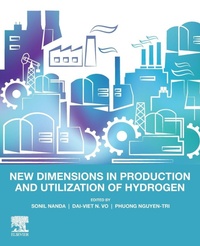
New Dimensions in Production and Utilization of Hydrogen
Published on 17. August 2020
Book
Paperback/Softback
444 pages
978-0-12-819553-6 (ISBN)
Description
The gradual increase of population and the consequential rise in the energy demands in the recent years have led to the overwhelming use of fossil fuels. Hydrogen has recently gained substantial interest because of its outstanding features to be used as clean energy carrier and energy vector. Moreover, hydrogen appears to be an effective alternative to tackle the issues of energy security and greenhouse gas emissions given that it is widely recognized as a clean fuel with high energy capacity. Hydrogen can be produced by various techniques such as thermochemical, hydrothermal, electrochemical, electrolytic, biological and photocatalytic methods as well as hybrid systems. New Dimensions in Production and Utilization of Hydrogen emphasizes on the research, development and innovations in the production and utilization of hydrogen in the industrial biorefining, hydrotreating and hydrogenation technologies, fuel cells, aerospace sector, pharmaceuticals, metallurgy, as well as bio-oil upgrading. Moreover, the supply chain analysis, lifecycle assessment, techno-economic analysis, as well as strengths and threats of global hydrogen market are covered in the book. This book provides many significant insights and scientific findings of key technologies for hydrogen production, storage and emerging applications. The book serves as a reference material for chemical and biochemical engineers, mechanical engineers, physicists, chemists, biologists, biomedical scientists and scholars working in the field of sustainable energy and materials.
Reviews / Votes
"This book is the gradual increase of population and the consequential rise in the energy demands in recent years have led to the overwhelming use of fossil fuels. Hydrogen has recently gained substantial interest because of its outstanding features to be used as a clean energy carrier and energy vector. Moreover, hydrogen appears to be an effective alternative to tackle the issues of energy security and greenhouse gas emissions given that it is widely recognized as a clean fuel with high energy capacity. Hydrogen can be produced by various techniques such as thermochemical, hydrothermal, electrochemical, electrolytic, biological, and photocatalytic methods, as well as hybrid systems." --ICPMore details
Language
English
Place of publication
United States
Target group
Professional and scholarly
Product notice
Paperback (trade)
Illustrations
Approx. 130 illustrations (80 in full color)
Dimensions
Height: 235 mm
Width: 191 mm
Thickness: 23 mm
Weight
759 gr
ISBN-13
978-0-12-819553-6 (9780128195536)
Copyright in bibliographic data and cover images is held by Nielsen Book Services Limited or by the publishers or by their respective licensors: all rights reserved.
Schweitzer Classification
Other editions
Additional editions
Sonil Nanda | Dai-Viet N. Vo | Phuong Nguyen-Tri
New Dimensions in Production and Utilization of Hydrogen
E-Book
08/2020
Elsevier
€195.00
Available for download
Persons
Dr. Sonil Nanda is an Assistant Professor and Canada Research Chair in "Clean Agricultural Technology and Energy? in the Department of Engineering, Faculty of Agriculture at Dalhousie University, Canada. He received his Ph.D. in Biology from York University, Canada; his M.Sc. in Applied Microbiology from Vellore Institute of Technology (VIT University), India; and his B.Sc. in Microbiology from the Odisha University of Agriculture and Technology, India. He was a Postdoctoral Fellow at York University and the University of Western Ontario and a Research Associate in the Department of Chemical and Biological Engineering at the University of Saskatchewan in Saskatoon, Canada. He was the Director of Research and Development at Titan Clean Energy Projects Corporation in Craik, Saskatchewan. Dr. Nanda's research areas focus on producing advanced biofuels and biochemicals through thermochemical and biochemical conversion technologies, including gasification, pyrolysis, carbonization, torrefaction, and fermentation. He has gained expertise in the hydrothermal gasification of various organic wastes and biomass, including agricultural and forestry residues, industrial effluents, municipal solid waste, cattle manure, sewage sludge, food wastes, waste tires, and petroleum residues to produce hydrogen fuel. His parallel interests are generating hydrothermal flames for treating hazardous wastes, agronomic biochar applications, phytoremediation of heavy metal-contaminated soils, and carbon capture and sequestration. Dr. Nanda has published 19 edited books, 85 book chapters, and more than 165 peer-reviewed journal articles. He is the editor of some popular books entitled "Emerging Biofuels? (Elsevier), "Biomass to Bioenergy: Modern Technological Strategies for Biorefineries? (Elsevier), "Innovations in Thermochemical Technologies for Biofuel Processing? (Elsevier), "New Dimensions in Production and Utilization of Hydrogen? (Elsevier), "Biorefinery of Alternative Resources: Targeting Green Fuels and Platform Chemicals? (Springer Nature), "Recent Advancements in Biofuels and Bioenergy Utilization? (Springer Nature), "Catalytic and Noncatalytic Upgrading of Oils? (American Chemical Society), "Fuel Processing and Energy Utilization? (CRC Press), "Bioprocessing of Biofuels? (CRC Press), "Progressive Thermochemical Biorefining Technologies? (CRC Press), "Algal Biorefinery: Developments, Challenges and Opportunities? (Routledge), "Biohydrogen: Developments and Prospects? (Apple Academic Press), and "Biomethane: Developments and Prospects? (Apple Academic Press). Dr. Nanda is a fellow member of the Society for Applied Biotechnology in India and a life member of the Indian Institute of Chemical Engineers, the Association of Microbiologists of India, the Indian Science Congress Association, and the Biotech Research Society of India. He is also a member of several chemical engineering societies across North America, such as the American Chemical Society, the American Institute of Chemical Engineers, the Chemical Institute of Canada, the Combustion Institute-Canadian Section, and Engineers Without Borders Canada. Dr. Nanda is an Assistant Subject Editor of the International Journal of Hydrogen Energy (Elsevier) as well as an Associate Editor of Environmental Chemistry Letters (Springer Nature) and Applied Nanoscience (Springer Nature). He has also edited several Special Issues in renowned journals such as the International Journal of Hydrogen Energy (Elsevier), Chemical Engineering Science (Elsevier), Catalysis Today (Elsevier), Biomass Conversion and Biorefinery (Springer Nature), Waste and Biomass Valorization (Springer Nature), Topics in Catalysis (Springer Nature), SN Applied Sciences (Springer Nature), Chemical Engineering & Technology (Wiley), and The Canadian Journal of Chemical Engineering (Wiley). Dai-Viet N. Vo is deputy director of the Institute of Applied Technology and Sustainable Development, Nguyen Tat Thanh University, in Vietnam. He worked as the principal investigator and co-investigator for 23 different funded research projects related to sustainable and alternative energy, and published two books, 15 book chapters, more than 300 peer-reviewed journals including 101 prestigious review articles, and more than 80 conference proceedings. Dr. Vo is an assistant subject editor for the International Journal of Hydrogen Energy (Elsevier) and guest editor for several special issues in high-impact factor journals such as the International Journal of Hydrogen Energy (Elsevier), Comptes Rendus Chimie (Elsevier), Chemical Engineering Science (Elsevier), and Topics in Catalysis (Springer), amongst others.
Dr. Phuong Nguyen-Tri is a Professor in the Departement de Chimie, Biochimie et Physique at the Universite du Quebec a Trois-Rivieres in Trois-Rivieres, Quebec, Canada. He is the founder of the Laboratory of Advanced Materials for Energy and Environment at the Universite du Quebec a Trois-Rivieres. He holds an M.Sc. degree from Ecole Nationale Superieure de Chimie de Mulhouse, France and a Ph.D. degree in Material Sciences from the Conservatoire National des Arts et Metiers in Paris, France in 2009. He worked for two years (2009-2011) as a non-tenure track Assistant Professor in the Department of Industrial Polymers (now Laboratoire Procedes et Ingenierie en Mecanique et Materiaux, Paris) at the Conservatoire National des Arts et Metiers in Paris. During 2011-2015, he worked in the Department of Mechanical Engineering at the Ecole de Technologie Superieure ETS, Montreal, Canada as a researcher for the Research Chair in Protective Materials and Equipment for Occupational Health and Safety. From 2015 to 2019, Dr. Nguyen-Tri worked as a Research Officer in the Department of Chemistry at the Universite de Montreal, Canada before accepting a professorship position at the Universite du Quebec a Trois-Rivieres. His main research interests are in nanomaterials, hybrid nanoparticles, smart coatings, polymer crystallization, polymer blends and composites. Dr. Nguyen-Tri has edited 11 books (including 8 books by Elsevier). He has served as an Editor of many special issues in the ISI indexed journals. Dr. Nguyen-Tri is an Editorial Board Member for journals including RSEM, PLoS One (PNAS) and SN Applied Science (Springer).
Dr. Phuong Nguyen-Tri is a Professor in the Departement de Chimie, Biochimie et Physique at the Universite du Quebec a Trois-Rivieres in Trois-Rivieres, Quebec, Canada. He is the founder of the Laboratory of Advanced Materials for Energy and Environment at the Universite du Quebec a Trois-Rivieres. He holds an M.Sc. degree from Ecole Nationale Superieure de Chimie de Mulhouse, France and a Ph.D. degree in Material Sciences from the Conservatoire National des Arts et Metiers in Paris, France in 2009. He worked for two years (2009-2011) as a non-tenure track Assistant Professor in the Department of Industrial Polymers (now Laboratoire Procedes et Ingenierie en Mecanique et Materiaux, Paris) at the Conservatoire National des Arts et Metiers in Paris. During 2011-2015, he worked in the Department of Mechanical Engineering at the Ecole de Technologie Superieure ETS, Montreal, Canada as a researcher for the Research Chair in Protective Materials and Equipment for Occupational Health and Safety. From 2015 to 2019, Dr. Nguyen-Tri worked as a Research Officer in the Department of Chemistry at the Universite de Montreal, Canada before accepting a professorship position at the Universite du Quebec a Trois-Rivieres. His main research interests are in nanomaterials, hybrid nanoparticles, smart coatings, polymer crystallization, polymer blends and composites. Dr. Nguyen-Tri has edited 11 books (including 8 books by Elsevier). He has served as an Editor of many special issues in the ISI indexed journals. Dr. Nguyen-Tri is an Editorial Board Member for journals including RSEM, PLoS One (PNAS) and SN Applied Science (Springer).
Editor
Assistant Professor and Canada Research Chair, Department of Engineering, Faculty of Agriculture, Dalhousie University, Truro, Nova Scotia, Canada.
Deputy Director, Institute of Applied Technology and Sustainable Development, Nguyen Tat Thanh University, Vietnam
Professor, Departement de Chimie, Biochimie et Physique, Universite du Quebec a Trois-Rivieres, Trois-Rivieres, Quebec, Canada
Content
1. Hydrogen: Fuel of the Near Future
2. Application of Industrial Solid Wastes in Catalyst and Chemical Sorbent Development for Hydrogen/Syngas Production by Conventional and Intensified Steam Reforming
3. Recent Progress in Ethanol Steam Reforming for Hydrogen Generation
4. Hydrogen Production from Chemical Looping Reforming: Current Status and Future Perspective
5. Intensified Processes of Steam Reforming and their Materials for Hydrogen Production
6. Water-gas shift: Effect of Na loading on Pt/m-zirconia catalysts for low temperature shift for the production and purification of hydrogen
7. An Overview of Water Electrolysis Technologies for the Production of Hydrogen
8. Photocatalytic Reforming Towards a Sustainable Hydrogen Production over Titania-based Photocatalysts
9. Current Status on the Hydrogenation of Carbon Dioxide
10. Upgrading Pyrolysis-derived Bio-oils via Catalytic Hydrodeoxygenation: An Overview of Advanced Nanocatalysts
11. New Developments in Hydrogen Fuel Cells
12. Hydrogen Utilization: Benefits of Fuel Cell-Battery Hybrid Vehicles
13. Application of Carbon-Based Smart Nanocomposites for Hydrogen Production: Current Progress, Challenges and Prospects
14. Novel Materials and Technologies for Hydrogen Storage
15. Impact of Synchrotron on Alternate Fuels Sector with Special Focus on Hydrogen Energy
2. Application of Industrial Solid Wastes in Catalyst and Chemical Sorbent Development for Hydrogen/Syngas Production by Conventional and Intensified Steam Reforming
3. Recent Progress in Ethanol Steam Reforming for Hydrogen Generation
4. Hydrogen Production from Chemical Looping Reforming: Current Status and Future Perspective
5. Intensified Processes of Steam Reforming and their Materials for Hydrogen Production
6. Water-gas shift: Effect of Na loading on Pt/m-zirconia catalysts for low temperature shift for the production and purification of hydrogen
7. An Overview of Water Electrolysis Technologies for the Production of Hydrogen
8. Photocatalytic Reforming Towards a Sustainable Hydrogen Production over Titania-based Photocatalysts
9. Current Status on the Hydrogenation of Carbon Dioxide
10. Upgrading Pyrolysis-derived Bio-oils via Catalytic Hydrodeoxygenation: An Overview of Advanced Nanocatalysts
11. New Developments in Hydrogen Fuel Cells
12. Hydrogen Utilization: Benefits of Fuel Cell-Battery Hybrid Vehicles
13. Application of Carbon-Based Smart Nanocomposites for Hydrogen Production: Current Progress, Challenges and Prospects
14. Novel Materials and Technologies for Hydrogen Storage
15. Impact of Synchrotron on Alternate Fuels Sector with Special Focus on Hydrogen Energy