

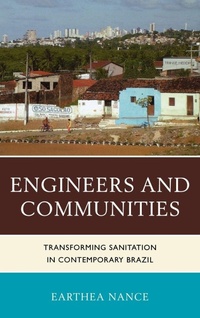
Engineers and Communities
Transforming Sanitation in Contemporary Brazil
Published on 15. November 2012
Book
Hardback
214 pages
978-0-7391-2681-3 (ISBN)
Description
Access to water and sanitation service in industrialized countries is nearly taken for granted, but in many developing countries less than half of the population has access to such services. Decades of effort on a global scale have been invested to solve this problem. One such effort-Brazil's participatory approach to water and sanitation-is Nance's subject in Engineers and Communities. In the early 1980s, Brazilian engineers created participatory sanitation (known locally as condominial sewerage) to make basic sanitation service more inclusive. Fiercely contested at first, the technology's success hinged on the formation of strong and stable coalitions of diverse actors and on the promotion of both real participation and a participation narrative. The innovations described in the book contributed to the now indispensable concepts of community participation and locally appropriate technology. Today the technology has spread across Brazil- it has been legally incorporated into sewer design norms and codes, it is counted in the national census, and the model is being transferred to other countries by The World Bank and others who are trying to make basic urban services more inclusive of the poor. Engineers and Communities sheds light on what is essential in the broader discourse of international development.
Reviews / Votes
Engineers and Communities: Transforming Sanitation in Contemporary Brazil by Professor Earthea Nance offers the reader a deep insight into one of Brazil's first and most notorious experiences of community-based sanitation services. . . .This book is certainly required reading for all those willing to be more than mere listeners to today's grand narrative of participatory development and pro-poor public policies. * Water International * Earthea Nance's innovative study of the emergence of 'participatory sanitation' artfully applies Bruno Latour's edict to 'follow the actors' to show how, rather than from participation, project success follows from strong 'project coalitions'. While the material content of these 'coalitions' is essential for success, the claim that they are participative is shown to be discursive rather than substantive in character. This timely illumination of the significance of not only the socio-material, but also narrative character of development, provides an important and insightful contribution to the literature. -- Stephen Healy, University of New South Wales This book is among a small number of empirical social studies of utility infrastructure conducted within an urban political ecology framework. By viewing infrastructure development as a socio-technical process, Nance is able to concisely identify and unpack constructs contributing to the success and failure of participatory sanitation projects in Brazil. Engineers and Communities Transforming Sanitation in Contemporary Brazil provides both surprising and practical insights that can help guide and evaluate a broad range of utility infrastructure development programs. -- Scott Miles, associate professor, Western Washington University, and director, Resilience InstituteMore details
Language
English
Place of publication
United States
Publishing group
Bloomsbury Publishing Plc
Target group
Professional and scholarly
Dimensions
Height: 235 mm
Width: 157 mm
Thickness: 17 mm
Weight
508 gr
ISBN-13
978-0-7391-2681-3 (9780739126813)
Copyright in bibliographic data and cover images is held by Nielsen Book Services Limited or by the publishers or by their respective licensors: all rights reserved.
Schweitzer Classification
Other editions
Additional editions
E-Book
11/2012
1st Edition
Lexington Books
€107.99
Available for download
E-Book
11/2012
1st Edition
Lexington Books
€107.99
Available for download
Person
Earthea Nance is assistant professor in the Department of Planning and Urban Studies at the University of New Orleans. She is also a board-licensed civil engineer with over fifteen years of professional practice. Dr. Nance's research interests are environmental hazards, urban infrastructure, and community participation in complex settings such as developing countries, vulnerable communities, high-hazard areas, and post-disaster settings. Originally from San Francisco, Dr. Nance first came to New Orleans as a Hurricane Katrina volunteer. She subsequently joined the city's recovery office as a Ford Foundation loaned-executive to provide expertise in environmental hazard management. Dr. Nance earned an interdisciplinary PhD from Stanford University in the areas of environmental planning and management, Latin American studies, and anthropology. She holds B.S. and M.S. degrees in civil and environmental engineering from the University of California-Davis. She previously taught at Massachusetts Institute of Technology and Virginia Tech.
Content
Chapter 1: The Promise and Failure of Development
Chapter 2: Institutional Change, Social Movements, and Technological Innovation in Brazil
Chapter 3: Situating Services in Two Brazilian Cities
Chapter 4: Participation and Alignment in the City of Natal
Chapter 5: Alignment and Influence in the City of Recife
Chapter 6: An Actor-Oriented Account of Condominial Sewerage
Chapter 7: Participatory Sanitation
Chapter 2: Institutional Change, Social Movements, and Technological Innovation in Brazil
Chapter 3: Situating Services in Two Brazilian Cities
Chapter 4: Participation and Alignment in the City of Natal
Chapter 5: Alignment and Influence in the City of Recife
Chapter 6: An Actor-Oriented Account of Condominial Sewerage
Chapter 7: Participatory Sanitation