

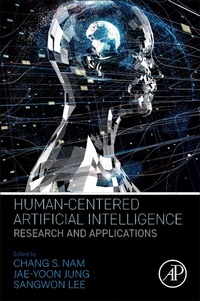
Human-Centered Artificial Intelligence
Research and Applications
Published on 18. May 2022
Book
Paperback/Softback
312 pages
978-0-323-85648-5 (ISBN)
Description
Human-Centered Artificial Intelligence: Research and Applications presents current theories, fundamentals, techniques and diverse applications of human-centered AI. Sections address the question, "are AI models explainable, interpretable and understandable?, introduce readers to the design and development process, including mind perception and human interfaces, explore various applications of human-centered AI, including human-robot interaction, healthcare and decision-making, and more. As human-centered AI aims to push the boundaries of previously limited AI solutions to bridge the gap between machine and human, this book is an ideal update on the latest advances.
More details
Language
English
Place of publication
Oxford
United Kingdom
Publishing group
Elsevier Science & Technology
Target group
Professional and scholarly
Graduate students, researchers, academics and professionals in the areas of human factors, robotics, social psychology, neuroscience, computer science, and engineering psychology.
Illustrations
85 illustrations (60 in full color); Illustrations
Dimensions
Height: 229 mm
Width: 152 mm
Weight
520 gr
ISBN-13
978-0-323-85648-5 (9780323856485)
Copyright in bibliographic data and cover images is held by Nielsen Book Services Limited or by the publishers or by their respective licensors: all rights reserved.
Schweitzer Classification
Other editions
Additional editions
Chang S. Nam | Jae-Yoon Jung | Sangwon Lee
Human-Centered Artificial Intelligence
Research and Applications
E-Book
05/2022
Academic Press
€131.00
Available for download
Persons
Chang S. Nam is currently a Professor of Industrial and Systems Engineering at North Carolina State University (NCSU), USA. He is also an associated faculty in the UNC/NCSU Joint Department of Biomedical Engineering, Department of Psychology, and Brain Research Imaging Center (BRIC) at UNC. He received a PhD at Virginia Tech. His research interests center around brain-computer interfaces, computational neuroscience, neuroergonomics, and human-AI/Robot/Automation interaction. He is the editor of "Brain-Computer Interfaces Handbook: Technological and Theoretical Advances? (with Drs. Nijholt and Lotte, CRC Press), "Neuroergonomics: Principles and Practices (Springer), "Mobile Brain-Body Imaging and the Neuroscience of Art, Innovation and Creativity (with Contreras-Vidal et al., Springer), "Trust in Human-Robot Interaction: Research and Applications? (with Lyons, Elsevier), and "Human-centered AI: Research and Applications? (with Jung & Lee, Elsevier). Currently, Nam serves as the Editor-in-Chief of the journal Brain-Computer Interfaces. Jae-Yoon Jung is a professor in the department of industrial and management systems engineering (IE) at Kyung Hee University (KHU), Korea, and also an adjunct professor of the department of the department of software convergence (SWCon), KHU. He is currently the director of Graduate Program, IE and Smart Factory Program at KHU. He is leading Industrial AI Lab at KHU. He received the Ph.D., M.S., and B.S. degrees in Industrial Engineering at Seoul National University (SNU), in 2005, 2001, and 1999, respectively. In SNU, he was supervised by prof. Suk-Ho Kang and Yeongho Kim in Intelligent Manufacturing Systems Lab.
After that, he visited the Process Mining Group at Eindhoven University of Technology (TU/e) in the Netherland, supervised by prof. Wil van der Aalst. Before joining in KHU, he worked for u-Computing Innovation Center (uCIC), directed by Prof. Jinwoo Park, and he also studied in the Information Management Lab. at SNU, supervised by prof. Jonghun Park. Sangwon Lee is an Associate Professor in Department of Interaction Science and Department of Applied Artificial Intelligence at Sugnkyunkwan University. He is also the director of ID square lab (Interaction Design and Development Laboratory). He received his BS degree from Korea University, and his MS degree and PhD degree from the Pennsylvania State University. His research interests lie in human-AI interaction, user experience, affective computing, user modelling, and explainable artificial intelligence.
After that, he visited the Process Mining Group at Eindhoven University of Technology (TU/e) in the Netherland, supervised by prof. Wil van der Aalst. Before joining in KHU, he worked for u-Computing Innovation Center (uCIC), directed by Prof. Jinwoo Park, and he also studied in the Information Management Lab. at SNU, supervised by prof. Jonghun Park. Sangwon Lee is an Associate Professor in Department of Interaction Science and Department of Applied Artificial Intelligence at Sugnkyunkwan University. He is also the director of ID square lab (Interaction Design and Development Laboratory). He received his BS degree from Korea University, and his MS degree and PhD degree from the Pennsylvania State University. His research interests lie in human-AI interaction, user experience, affective computing, user modelling, and explainable artificial intelligence.
Editor
Professor, North Carolina State University, USA
Professor, Department of Industrial and Management Systems Engineering (IE), Kyung Hee University (KHU), Korea; Adjunct professor, Department of the Department of Software Convergence (SWCon), KHU; Director, Graduate Program, IE and Smart Factory Program, KHU
Associate Professor, Department of Interaction Science and Department of Applied Artificial Intelligence, Sugnkyunkwan University, South Korea; Director, ID square lab (Interaction Design and Development Laboratory)
Content
PART I: Explainable AI
1. Are AI models Explainable, Interpretable, and Understandable?
2. Explanation Using Interpretable Models
3. Explanation Using Model-Agnostic Methods
4. Explanation Using Examples
5. Explanation of Ensemble Models
6. Explanation of Deep Learning Models
PART II: User-Centered AI Design and Development Process
7. User-centered explanation interfaces for effective communication between users and AI-based systems
8. Mind perception of human-centered AI: Effects of unfavorable social conditions on user experience of AI
9. Designing user interfaces for AI-based decision support systems
PART III: Applications in Human-AI Interaction
11. Review on recent AI/ML studies about manufacturing systems
12. AI in BCI
13. AI in Human-Robot Interaction
14. AI in Healthcare
15. AI in Decision Making
16. TBD
PART IV: Ethics, Privacy and Policy in Human-AI Interaction
17. Ethics of AI in academic and public discourse
18. Designing explainable artificial intelligence from policy perspectives
19. AI governance
20. TBD
1. Are AI models Explainable, Interpretable, and Understandable?
2. Explanation Using Interpretable Models
3. Explanation Using Model-Agnostic Methods
4. Explanation Using Examples
5. Explanation of Ensemble Models
6. Explanation of Deep Learning Models
PART II: User-Centered AI Design and Development Process
7. User-centered explanation interfaces for effective communication between users and AI-based systems
8. Mind perception of human-centered AI: Effects of unfavorable social conditions on user experience of AI
9. Designing user interfaces for AI-based decision support systems
PART III: Applications in Human-AI Interaction
11. Review on recent AI/ML studies about manufacturing systems
12. AI in BCI
13. AI in Human-Robot Interaction
14. AI in Healthcare
15. AI in Decision Making
16. TBD
PART IV: Ethics, Privacy and Policy in Human-AI Interaction
17. Ethics of AI in academic and public discourse
18. Designing explainable artificial intelligence from policy perspectives
19. AI governance
20. TBD