

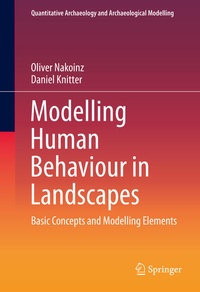
Modelling Human Behaviour in Landscapes
Basic Concepts and Modelling Elements
Published on 15. April 2016
Book
Hardback
XIX, 255 pages
978-3-319-29536-7 (ISBN)
Description
This volume is designed as a 12-lecture textbook, which can serve as a course companion, self teaching guide and handbook for basic concepts. Each lecture comprises 20 pages, in which the methods are introduced, examples shown and the code is given. All examples are computed with open source software, mainly R, and with archaeological data available from the book's website.
The book does not describe elaborated high-end models but rather very basic modelling concepts that serve as components in more complex models. The book enables the reader to construct such models by themselves and be sensitive for certain problems. In addition it gives hints for the interpretation of the results.
Students are usually quick to apply fancy methods yet fail in the proper interpretation due to a lack of understanding of the underlying principles. This problem is addressed by the proposed book through three concepts:
1. Command line software forces the students to first learn some details before they are able to produce results on their own.
2. The book is focused on principles and methods. When the students understand a few basic principles, they have far better access to a wide range of related methods.
3. Examples of poor analysis highlight common pitfalls.
The volume attempts to be an applied, minimalistic and efficient textbook and is based upon several successful courses.
The book does not describe elaborated high-end models but rather very basic modelling concepts that serve as components in more complex models. The book enables the reader to construct such models by themselves and be sensitive for certain problems. In addition it gives hints for the interpretation of the results.
Students are usually quick to apply fancy methods yet fail in the proper interpretation due to a lack of understanding of the underlying principles. This problem is addressed by the proposed book through three concepts:
1. Command line software forces the students to first learn some details before they are able to produce results on their own.
2. The book is focused on principles and methods. When the students understand a few basic principles, they have far better access to a wide range of related methods.
3. Examples of poor analysis highlight common pitfalls.
The volume attempts to be an applied, minimalistic and efficient textbook and is based upon several successful courses.
More details
Series
Edition
1st ed. 2016
Language
English
Place of publication
Cham
Switzerland
Publishing group
Springer International Publishing
Target group
Primary & secondary/elementary & high school
Illustrations
12 farbige Abbildungen, 107 s/w Abbildungen
XIX, 255 p. 119 illus., 12 illus. in color.
Dimensions
Height: 241 mm
Width: 160 mm
Thickness: 21 mm
Weight
582 gr
ISBN-13
978-3-319-29536-7 (9783319295367)
DOI
10.1007/978-3-319-29538-1
Schweitzer Classification
Other editions
Additional editions
Oliver Nakoinz | Daniel Knitter
Modelling Human Behaviour in Landscapes
Basic Concepts and Modelling Elements
Book
04/2018
Springer
€64.19
Shipment within 10-15 days
Oliver Nakoinz | Daniel Knitter
Modelling Human Behaviour in Landscapes
Basic Concepts and Modelling Elements
E-Book
04/2016
Springer
€64.19
Available for download
Persons
Oliver Nakoinz
Daniel Knitter
Daniel Knitter
Content
Chapter 1:Introduction and Mathematics.- Chapter 2: Theory of Modelling.- Chapter 3: Software.- Chapter 4: Density.- Chapter 5: Regression and Interpolation.- Chapter 6: Location and Characterisation.- Chapter 7: Point Pattern.- Chapter 8: Boundaries.- Chapter 9: Networks.- Chapter 10: Interaction.- Chapter 11: Perception of Landscapes.- Chapter 12: Simulations.