

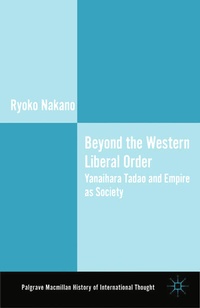
Beyond the Western Liberal Order
Yanaihara Tadao and Empire as Society
Published on 28. November 2015
Book
Paperback/Softback
XI, 202 pages
978-1-349-45058-9 (ISBN)
Description
This book introduces the political thought of Yanaihara Tadao (1893-1961), the most prominent Japanese social scientist working on empire, population migration and colonial policy, and uses it as a platform which to examine the global challenges faced by the U.S. hegemonic world order today, or what is often described as the Western liberal order.
Reviews / Votes
"Nakano sets out to intervene in at least two critical spaces in the modern history of political ideas: first, within the ever-expanding field of theory from 'beyond' the conventional regional and cultural boundaries of political thought; and second, within the deeply provocative intersection of empire and international society. In one of the few works to take his contribution seriously in English, Nakano succeeds in demonstrating how Yanaihara Tadao manages to straddle these two sites and brings valuable insight to all students of international order, politics, and justice." - Chris Goto-Jones, Professor of Comparative Philosophy and Political Thought, Leiden University
More details
Series
Edition
1st ed. 2013
Language
English
Place of publication
New York
United States
Target group
Professional and scholarly
Illustrations
XI, 202 p.
Dimensions
Height: 216 mm
Width: 140 mm
Thickness: 12 mm
Weight
279 gr
ISBN-13
978-1-349-45058-9 (9781349450589)
DOI
10.1057/9781137290519
Schweitzer Classification
Other editions
Additional editions
Book
12/2012
Palgrave MacMillan
€106.99
Shipment within 10-20 days
Person
RYOKO NAKANO is Assistant Professor in the Department of Japanese Studies at the National University of Singapore. She has published on the history of Japanese political thought and norm diffusion in Japan in journals such as
Millennium
,
International Relations
, and
Social Science Japan Journ
al.
Content
Introduction What is Society? A World of Migration Development and Dependency Autonomy under Imperial Rule Asianism vs. Internationalism? Conclusion