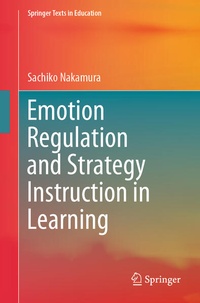
This textbook is written for teachers, practitioners, and researchers, who are interested in developing their knowledge about emotions and learning about ways of helping their learners to cultivate positive and cope with negative emotions. The book covers the topics of emotions, emotion regulation, strategies, and instruction. Each topic is discussed in the subsequent chapters, beginning with a concise summary of theories and research in the fields of psychology, education, and language learning. This is followed by its practical applications in the classroom, with suggestions and ideas based on research as well as reports from teachers in a wide range of contexts. Teachers' vignettes give readers an opportunity to compare their experiences with others. A practical guide with detailed steps for implementing strategy instruction in emotion regulation is provided at the end.
Series
Edition
Language
Place of publication
Publishing group
Springer International Publishing
Target group
Professional and scholarly
Illustrations
11 s/w Abbildungen, 1 farbige Abbildung
XI, 140 p. 12 illus., 1 illus. in color.
Dimensions
Height: 235 mm
Width: 155 mm
Thickness: 9 mm
Weight
ISBN-13
978-3-031-42115-0 (9783031421150)
DOI
10.1007/978-3-031-42116-7
Schweitzer Classification
Sachiko Nakamura is a lecturer at Tamagawa University in Japan and holds a Doctoral degree in Applied Linguistics from KMUTT in Thailand. Her research primarily focuses on language learner emotions, self-regulated learning, and engagement, and it has been published in journals such as
Studies in Second Language Acquisition
,
Language Teaching Research, International Journal of Applied Linguistics
, and
System
. She is the co-editor of the book
Innovation in language teaching: The case of Japan
, published by Palgrave Macmillan, and has contributed chapters for edited books, including the
Routledge handbook of the psychology of language learning and teaching
and
Learner engagement in the language classroom
by Multilingual Matters.
Chapter 1 Introduction.- Chapter 2 Emotions in Learning.- Chapter 3 Emotion regulation and emotion regulation strategies.- Chapter 4 Strategy Instruction.- Chapter 5 Innovating Your Own Strategy Instruction.