

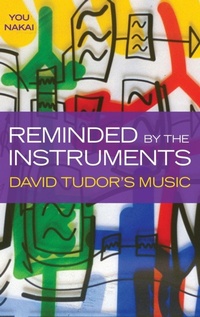
Reminded by the Instruments
David Tudor's Music
Published on 8. October 2021
Book
Hardback
768 pages
978-0-19-068676-5 (ISBN)
Description
David Tudor is remembered today in two guises: as an extraordinary pianist of post-war avant-garde music who worked closely with composers like John Cage and Karlheinz Stockhausen and as a founding figure of live-electronic music. His early realization of indeterminate graphic scores and his later performances using homemade modular instruments both inspired a whole generation of musicians. But his reticence, his unorthodox approaches, and the diversity of his creative output - which began with the organ and ended with visual art - have kept Tudor a puzzle.
Illustrated with more than 300 images of diagrams, schematics, and photographs of Tudor's instruments, Reminded by the Instruments sets out to solve the puzzle of David Tudor by applying Tudor's own methods for approaching the materials of others to the vast archive of materials that he himself left behind. You Nakai deftly patches together instruments, electronic circuits, sketches, diagrams, recordings, letters, receipts, customs declaration forms, and testimonies like modular pieces of a giant puzzle to reveal the long-hidden nature of Tudor's creative process. Rejecting the established narrative of Tudor as a performer-turned-composer, this book presents a lively portrait of an artist whose activity always merged both of these roles. In reading Tudor's electronic devices as musicological 'texts' and examining his idiosyncratic use of electronic circuits, Nakai undermines discourses on sound and illuminates our understanding of the instruments behind the sounds in post-war experimental music.
Illustrated with more than 300 images of diagrams, schematics, and photographs of Tudor's instruments, Reminded by the Instruments sets out to solve the puzzle of David Tudor by applying Tudor's own methods for approaching the materials of others to the vast archive of materials that he himself left behind. You Nakai deftly patches together instruments, electronic circuits, sketches, diagrams, recordings, letters, receipts, customs declaration forms, and testimonies like modular pieces of a giant puzzle to reveal the long-hidden nature of Tudor's creative process. Rejecting the established narrative of Tudor as a performer-turned-composer, this book presents a lively portrait of an artist whose activity always merged both of these roles. In reading Tudor's electronic devices as musicological 'texts' and examining his idiosyncratic use of electronic circuits, Nakai undermines discourses on sound and illuminates our understanding of the instruments behind the sounds in post-war experimental music.
Reviews / Votes
It is not unusual to have scholarly books written about the output of one composer, but it is rare to find one of such length written with such passion and with such complete and extensive information ... . One is presented with a creative thinker who is not just a pianist/organist, not just a composer, but also an electronics genius and an experimenter with sounds that had not previously been used in the context of classical music ... this book will convince the reader that Tudor's life was rich indeed. * D. L. Patterson, CHOICE * Nakai comes across in this book as earnest, humble, and eager to learn. His attention to detail is unflagging. In several lengthy passages, he meticulously goes through Tudor's old clippings from hobbyist magazines and matches them to electronic instruments that Tudor constructed. * Geeta Dayal, Experimental Music * There is no doubt this will be the authoritative text on David Tudor than any future publication on the subject will be held up against. It performs a great service in humanising his legacy, and by extension, that of the other great avant artists of the 20th century. * Leah Kardos, The Wire * A groundbreaking book that not only provides unique insight into the work of one of America's most influential if enigmatic electronic pioneers, but shifts the very paradigm of musical analysis in the aftermath of the transistor. * Nicolas Collins, Professor, Department of Sound, The School of the Art Institute of Chicago * You Nakai's book is a remarkable achievement that illuminates the breadth and depth of David Tudor's life and work as a composer-performer. Based on extensive analytical research and interviews with Tudor's surviving creative associates, it charts his evolution from organist and virtuoso pianist to his innovative live-electronic music, ending with his final explorations of soundand space. Engagingly written and eminently readable, this extraordinary study offers fresh insights into Tudor's reclusive personal life and elusive creative complexities. * Gordon Mumma, composer, Professor Emeritus, University of California * This book will provide virtually endless inspiration for anyone trying to find their own way as composers or performers or something else as yet to be defined until they themselves discover what that is. * Jason Kahn, Dusted Magazine * You Nakai's book on David Tudor is a masterful investigation of archival and published materials left behind by the composer and his many collaborators,students, and biographers. * Ezra J. Teboul, Computer Music Journal *More details
Language
English
Place of publication
New York
United States
Target group
Professional and scholarly
Illustrations
Over 300 illustrations
Dimensions
Height: 240 mm
Width: 161 mm
Thickness: 45 mm
Weight
1303 gr
ISBN-13
978-0-19-068676-5 (9780190686765)
Copyright in bibliographic data and cover images is held by Nielsen Book Services Limited or by the publishers or by their respective licensors: all rights reserved.
Schweitzer Classification
Person
You Nakai creates music(ians), dance(rs), haunted musical houses, nursery rhymes, and other forms of performances as a member of No Collective (nocollective.com) and Already Not Yet (alreadynotyet.org). He is Associate Professor at The University of Tokyo.
Content
Input: The Other Side
Chapter 1: Piano
Chapter 2: Amplified Piano
Chapter 3: Sound Systems
Chapter 4: Bandoneon!
Chapter 5: Pepsi Pavilion
Chapter 6: Island Eye Island Ear
Chapter 7: Natural Objects
Chapter 8: (Likeness to) Voices
Chapter 9: Reflections
Chapter 10: Neural Syntheses
Output: Maps & Fragments
Acknowledgments
Appendix A: Notable Realizations
Appendix B: Rainforest Amplifiers
Appendix C: Redrawn Matrix Maps
Bibliography
Index
Chapter 1: Piano
Chapter 2: Amplified Piano
Chapter 3: Sound Systems
Chapter 4: Bandoneon!
Chapter 5: Pepsi Pavilion
Chapter 6: Island Eye Island Ear
Chapter 7: Natural Objects
Chapter 8: (Likeness to) Voices
Chapter 9: Reflections
Chapter 10: Neural Syntheses
Output: Maps & Fragments
Acknowledgments
Appendix A: Notable Realizations
Appendix B: Rainforest Amplifiers
Appendix C: Redrawn Matrix Maps
Bibliography
Index