

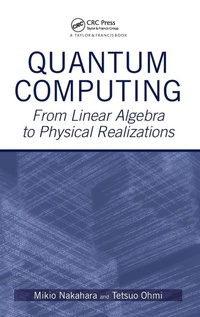
Quantum Computing
From Linear Algebra to Physical Realizations
1st Edition
Published on 11. March 2008
Book
Hardback
438 pages
978-0-7503-0983-7 (ISBN)
Description
Covering both theory and progressive experiments, Quantum Computing: From Linear Algebra to Physical Realizations explains how and why superposition and entanglement provide the enormous computational power in quantum computing. This self-contained, classroom-tested book is divided into two sections, with the first devoted to the theoretical aspects of quantum computing and the second focused on several candidates of a working quantum computer, evaluating them according to the DiVincenzo criteria.
Topics in Part I
Linear algebra
Principles of quantum mechanics
Qubit and the first application of quantum information processing-quantum key distribution
Quantum gates
Simple yet elucidating examples of quantum algorithms
Quantum circuits that implement integral transforms
Practical quantum algorithms, including Grover's database search algorithm and Shor's factorization algorithm
The disturbing issue of decoherence
Important examples of quantum error-correcting codes (QECC)
Topics in Part II
DiVincenzo criteria, which are the standards a physical system must satisfy to be a candidate as a working quantum computer
Liquid state NMR, one of the well-understood physical systems
Ionic and atomic qubits
Several types of Josephson junction qubits
The quantum dots realization of qubits
Looking at the ways in which quantum computing can become reality, this book delves into enough theoretical background and experimental research to support a thorough understanding of this promising field.
Topics in Part I
Linear algebra
Principles of quantum mechanics
Qubit and the first application of quantum information processing-quantum key distribution
Quantum gates
Simple yet elucidating examples of quantum algorithms
Quantum circuits that implement integral transforms
Practical quantum algorithms, including Grover's database search algorithm and Shor's factorization algorithm
The disturbing issue of decoherence
Important examples of quantum error-correcting codes (QECC)
Topics in Part II
DiVincenzo criteria, which are the standards a physical system must satisfy to be a candidate as a working quantum computer
Liquid state NMR, one of the well-understood physical systems
Ionic and atomic qubits
Several types of Josephson junction qubits
The quantum dots realization of qubits
Looking at the ways in which quantum computing can become reality, this book delves into enough theoretical background and experimental research to support a thorough understanding of this promising field.
Reviews / Votes
The book is very well structured and offers good theoretical explanations reinforced by examples. As the authors mention in the Preface, the book can be used for a quantum computing course. It is also recommended to advanced undergraduate students, postgraduate students and researchers in physics, mathematics and computer science.-Zentralblatt MATH 1185
More details
Language
English
Place of publication
London
United Kingdom
Publishing group
Taylor & Francis Ltd
Target group
Professional and scholarly
Professional
Illustrations
134 s/w Abbildungen, 10 s/w Tabellen
10 Tables, black and white; 134 Illustrations, black and white
Dimensions
Height: 240 mm
Width: 161 mm
Thickness: 28 mm
Weight
819 gr
ISBN-13
978-0-7503-0983-7 (9780750309837)
Copyright in bibliographic data and cover images is held by Nielsen Book Services Limited or by the publishers or by their respective licensors: all rights reserved.
Schweitzer Classification
Other editions
Additional editions
E-Book
03/2008
1st Edition
CRC Press
€264.99
Available for download
E-Book
03/2008
1st Edition
CRC Press
€265.99
Available for download
Persons
Mikio Nakahara, Tetsuo Ohmi
Content
FROM LINEAR ALGEBRA TO QUANTUM COMPUTING: Basics of Vectors and Matrices. Framework of Quantum Mechanics. Qubits and Quantum Key Distribution. Quantum Gates, Quantum Circuit, and Quantum Computer. Simple Quantum Algorithms. Quantum Integral Transforms. Grover's Search Algorithm. Shor's Factorization Algorithm. Decoherence. Quantum Error-Correcting Codes. Physical Realizations of Quantum Computing: DiVincenzo Criteria. NMR Quantum Computer. Trapped Ions. Quantum Computing with Neutral Atoms. Josephson Junction Qubits. Quantum Computing with Quantum Dots. Appendix. Index.