

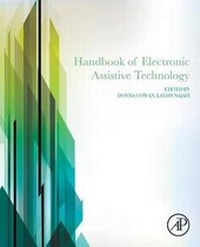
Handbook of Electronic Assistive Technology
Published on 21. November 2018
Book
Paperback/Softback
382 pages
978-0-12-812487-1 (ISBN)
Description
Electronic Assistive Technology (EAT) is a subset of a wider range of products and services known as Assistive Technology (AT). AT is designed to support and enable people with disabilities, either acquired or congenital, to participate in activities with greater independence and safety. With a global aging population, it has an important role to play in enabling and supporting those with disability and their carers.
Handbook of Electronic Assistive Technology discusses a range of commonly available or emerging electronic assistive technologies. It provides historical background, advice when assessing for these devices and references different models of provision. It includes both medical and engineering aspects of provision. It is anticipated that the book will support students, trainees, and newly qualified Assistive Technology Practitioners to develop their understanding of the field, by considering the variables that could potentially influence the decision-making process when assessing for and providing this equipment. It also provides a reference point for those already practicing in this field and offers coverage of a broader range of technologies than clinicians may be exposed to, in their daily work
This is the first reference book to focus on a comprehensive set of electronic assistive technologies and discuss their clinical application.
Handbook of Electronic Assistive Technology discusses a range of commonly available or emerging electronic assistive technologies. It provides historical background, advice when assessing for these devices and references different models of provision. It includes both medical and engineering aspects of provision. It is anticipated that the book will support students, trainees, and newly qualified Assistive Technology Practitioners to develop their understanding of the field, by considering the variables that could potentially influence the decision-making process when assessing for and providing this equipment. It also provides a reference point for those already practicing in this field and offers coverage of a broader range of technologies than clinicians may be exposed to, in their daily work
This is the first reference book to focus on a comprehensive set of electronic assistive technologies and discuss their clinical application.
More details
Language
English
Place of publication
San Diego
United States
Publishing group
Elsevier Science Publishing Co Inc
Target group
Professional and scholarly
Bioengineers, Clinical Engineers, Assistive Technology Practitioners, Clinicians, Graduate Students in Biomedical Engineering
Dimensions
Height: 235 mm
Width: 191 mm
Weight
800 gr
ISBN-13
978-0-12-812487-1 (9780128124871)
Copyright in bibliographic data and cover images is held by Nielsen Book Services Limited or by the publishers or by their respective licensors: all rights reserved.
Schweitzer Classification
Other editions
Additional editions
Ladan Najafi | Donna Cowan
Handbook of Electronic Assistive Technology
E-Book
11/2018
Academic Press
€148.00
Available for download
Persons
Ladan Najafi is a Clinical Scientist and a Chartered Engineer. She has a degree in Medical Engineering and MSc in Bio-Medical Engineering. She has specialised in Electronic Assistive Technology (EAT) and has experience of working with both adults and pediatrics. Ladan joined the East Kent Adult Communication and Assistive Technology (ACAT) Service in 2011 as the head of the service. This service is a section of the Medical Physics department of the East Kent Hospitals University Foundation Trust. She successfully expanded the ACAT service across Kent and Medway in 2015. Donna Cowan has over 25 years of clinical and research experience in the field of Electronic Assistive Technology. She is a Consultant Clinical Scientist with a degree in Electronic Engineering and a PhD in Biomedical Engineering. She has led both adult and paediatric assistive technology services. She currently heads the Rehabilitation Engineering Service at Chailey Clinical which is part of Sussex Community NHS Foundation Trust.
Content
1. Functional Posture
2. Pathologies
3. Assessment and Prescription
4. Alternative Access technologies inc.
5. Environmental control (EC) and alternative computer access
6. Alternative and Augmentative Communication (AAC)
7. Assisted living including tele health/ telecare
8. Powered mobility
9. Integration of technology
10. Robotics
2. Pathologies
3. Assessment and Prescription
4. Alternative Access technologies inc.
5. Environmental control (EC) and alternative computer access
6. Alternative and Augmentative Communication (AAC)
7. Assisted living including tele health/ telecare
8. Powered mobility
9. Integration of technology
10. Robotics