

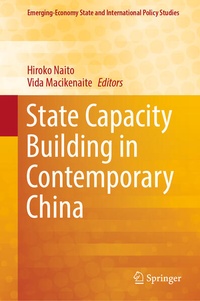
State Capacity Building in Contemporary China
Published on 27. March 2020
Book
Hardback
VII, 123 pages
978-981-13-8897-2 (ISBN)
Description
This volume explores the governing mechanism employed by the Chinese Communist Party (CCP) in the light of state capacity building. It is built on the premise that regime type notwithstanding, boosting state capacity and utilizing it in their political survival is of crucial concern for any political leader. Xi Jinping, who is no exception to this, has called for the necessity to expand state capacity while he aims to centralize the power under the party. This volume stands out as it offers a comprehensive view of Chinese party-state, especially under Xi Jinping.The research presented here is built on the analysis of authentic datasets and materials. It examines the CCP's relations with various state organs in the Chinese political system, mainly, administrative organs, legislature (the people's congresses), judicial branch (the people's court system), as well as the military (the People's Liberation Army) and state-owned enterprises. This volume attempts to bring Chinacloser to the field of comparative politics making it a more comparable case.
More details
Series
Edition
1st ed. 2020
Language
English
Place of publication
Singapore
Singapore
Target group
Professional and scholarly
Illustrations
11 s/w Abbildungen, 1 farbige Abbildung
VII, 123 p. 12 illus., 1 illus. in color.
Dimensions
Height: 241 mm
Width: 160 mm
Thickness: 14 mm
Weight
377 gr
ISBN-13
978-981-13-8897-2 (9789811388972)
DOI
10.1007/978-981-13-8898-9
Schweitzer Classification
Other editions
Additional editions
Hiroko Naito | Vida Macikenaite
State Capacity Building in Contemporary China
Book
08/2021
Springer
€53.49
Shipment within 15-20 days
Hiroko Naito | Vida Macikenaite
State Capacity Building in Contemporary China
E-Book
03/2020
Springer
€53.49
Available for download
Content
Introduction.- Chapter 1 Mobilize towards a Weberian Bureaucracy? A Case Study of ICT Driven Government Reform in Zhejiang Province.- Chapter 2 Workplace-based Connection: The
Danwei
System and Amateur Deputies in China's Municipal People's Congress.- Chapter 3 Why does the Chinese Communist Party (CCP) need "Rule of Law"?: The Case of Professionalization of Judges and the CCP's Governance of the People's Court.- Chapter 4 Dynamics of Civil-Military Relations in China.- Chapter 5 Understanding the Chinese Communist Party Regime's Resilience: Inter-System Cadre Transfers between the Party-State and the SOEs as a Tool in Governance.- Conclusion.