

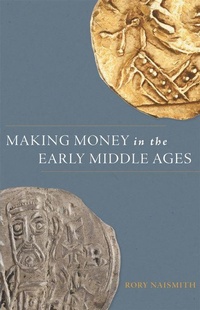
Making Money in the Early Middle Ages
Published on 11. July 2023
Book
Hardback
544 pages
978-0-691-17740-3 (ISBN)
Description
An examination of coined money and its significance to rulers, aristocrats and peasants in early medieval Europe
Between the end of the Roman Empire in the fifth century and the economic transformations of the twelfth, coined money in western Europe was scarce and high in value, difficult for the majority of the population to make use of. And yet, as Rory Naismith shows in this illuminating study, coined money was made and used throughout early medieval Europe. It was, he argues, a powerful tool for articulating people's place in economic and social structures and an important gauge for levels of economic complexity. Working from the premise that using coined money carried special significance when there was less of it around, Naismith uses detailed case studies from the Mediterranean and northern Europe to propose a new reading of early medieval money as a point of contact between economic, social, and institutional history.
Naismith examines structural issues, including the mining and circulation of metal and the use of bullion and other commodities as money, and then offers a chronological account of monetary development, discussing the post-Roman period of gold coinage, the rise of the silver penny in the seventh century and the reconfiguration of elite power in relation to coinage in the tenth and eleventh centuries. In the process, he counters the conventional view of early medieval currency as the domain only of elite gift-givers and intrepid long-distance traders. Even when there were few coins in circulation, Naismith argues, the ways they were used-to give gifts, to pay rents, to spend at markets-have much to tell us.
Between the end of the Roman Empire in the fifth century and the economic transformations of the twelfth, coined money in western Europe was scarce and high in value, difficult for the majority of the population to make use of. And yet, as Rory Naismith shows in this illuminating study, coined money was made and used throughout early medieval Europe. It was, he argues, a powerful tool for articulating people's place in economic and social structures and an important gauge for levels of economic complexity. Working from the premise that using coined money carried special significance when there was less of it around, Naismith uses detailed case studies from the Mediterranean and northern Europe to propose a new reading of early medieval money as a point of contact between economic, social, and institutional history.
Naismith examines structural issues, including the mining and circulation of metal and the use of bullion and other commodities as money, and then offers a chronological account of monetary development, discussing the post-Roman period of gold coinage, the rise of the silver penny in the seventh century and the reconfiguration of elite power in relation to coinage in the tenth and eleventh centuries. In the process, he counters the conventional view of early medieval currency as the domain only of elite gift-givers and intrepid long-distance traders. Even when there were few coins in circulation, Naismith argues, the ways they were used-to give gifts, to pay rents, to spend at markets-have much to tell us.
Reviews / Votes
"A Choice Outstanding Academic Title of the Year" "Piecing together case studies from the Mediterranean and northern Europe, as well as looking at mining, metal production and alternative forms of currency, this is a rich account of early English numismatic history." * Spear's * "Making Money in the Early Middle Ages provides a broad portrait of daily life through the lens of currency in the ninth century that makes the book a worthwhile read."---Ryne Clos, Spectrum Culture "Clearly written and boasts an extensive bibliography. Naismith's interpretations modify or supplant many standard views, indicating points that still require additional investigation. This is necessary reading for specialists." * Choice * "A joy to read, in no small part because of Naismith's vivid prose. . . .If you want to know about people's little quirks and preoccupations, their appetite for acquisition and the enduring human obsession with wealth, then Making Money in the Early Middle Ages will suit you well."---Mary Hitchman, Times Literary Supplement "There is no better overall account of the nature and chronology of the coinage and monetary arrangements of early medieval Europe available in any language than that of Rory Naismith in this volume, nor is there likely to be one in the foreseeable future."---Alan M. Stahl, Speculum "An important study with implications that go far beyond monetary history. . . . Naismith has made a strong contribution to the socio-economic history of early medieval Europe by his meticulous analysis of virtually all the available archaeological and historical numismatic evidence - an interdisciplinary achievement in itself."---Jan Lucassen, TSEG - The Low Countries Journal of Social and Economic HistoryMore details
Language
English
Place of publication
New Jersey
United States
Target group
College/higher education
Professional and scholarly
Product notice
Trade binding
Illustrations
41 b/w illus. 1 table. 11 maps.
Dimensions
Height: 237 mm
Width: 164 mm
Thickness: 37 mm
Weight
940 gr
ISBN-13
978-0-691-17740-3 (9780691177403)
Copyright in bibliographic data and cover images is held by Nielsen Book Services Limited or by the publishers or by their respective licensors: all rights reserved.
Schweitzer Classification
Other editions
Additional editions
Rory Naismith
Making Money in the Early Middle Ages
E-Book
07/2023
1st Edition
Princeton University Press
€28.99
Available for download
Person
Rory Naismith is professor of early medieval English history at the University of Cambridge and a fellow of Corpus Christi College. He is the author of Early Medieval Britain, c. 500-1000, Citadel of the Saxons: The Rise of Early London, and Money and Power in Anglo-Saxon England: The Southern English Kingdoms, 757-865.