

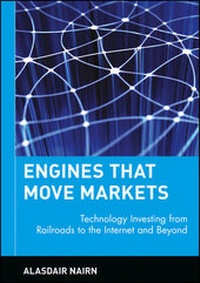
Engines that Move Markets
Technology Investing from Railroads to the Internet and Beyond
Published on 4. February 2002
Book
Hardback
XVIII, 494 pages
978-0-471-20595-1 (ISBN)
Description
A comprehensive history of market-shaping industries and their impact on how we invest today
This engaging book highlights the history of industrial development and its impact on investors. Today's investors will learn about past approaches to technological advances such as-electricity, the railroad, the telephone, the computer, and much more-while gaining insights on how to appraise the "new technology" companies of the future. This complete and well researched history of industries and investing wouldn't be complete without a look at: how Thomas Edison lost control of his company, the impact of the Standard Oil breakup, the early days of the wireless industry, and the changing face of the computer industry today. Investors looking for industry-shaping investments will undoubtedly use Engines That Move Markets as their guide.
"Engines that Move Markets" beschreibt die Geschichte der industriellen Entwicklung und ihre Auswirkung auf Investoren. Der Anleger von heute erfährt viel darüber, wie man in der Vergangenheit mit dem technologischen Fortschritt umgegangen ist, z.B. mit Eisenbahn, Elektrizität, Telefon, Computer, usw. und gewinnt einen tiefen Einblick, wie man die neuen Technologieunternehmen der Zukunft bewertet. Dieses Buch bietet einen umfassenden und hervorragend recherchierten Abriss zur Geschichte der Industriezweige und des Investment. Diskutiert wird u.a., warum Thomas Edison Schwierigkeiten bei der Kapitalbeschaffung hatte und die Kontrolle über sein Unternehmen verlor; die Folgen der Aufteilung von Standard Oil; die Anfänge der drahtlosen Kommunikation; der Wandel in der Computerbranche. "Engines that Move Markets" - ein praktischer Ratgeber für Anleger auf der Suche nach branchenbildenden Investitionen.
This engaging book highlights the history of industrial development and its impact on investors. Today's investors will learn about past approaches to technological advances such as-electricity, the railroad, the telephone, the computer, and much more-while gaining insights on how to appraise the "new technology" companies of the future. This complete and well researched history of industries and investing wouldn't be complete without a look at: how Thomas Edison lost control of his company, the impact of the Standard Oil breakup, the early days of the wireless industry, and the changing face of the computer industry today. Investors looking for industry-shaping investments will undoubtedly use Engines That Move Markets as their guide.
"Engines that Move Markets" beschreibt die Geschichte der industriellen Entwicklung und ihre Auswirkung auf Investoren. Der Anleger von heute erfährt viel darüber, wie man in der Vergangenheit mit dem technologischen Fortschritt umgegangen ist, z.B. mit Eisenbahn, Elektrizität, Telefon, Computer, usw. und gewinnt einen tiefen Einblick, wie man die neuen Technologieunternehmen der Zukunft bewertet. Dieses Buch bietet einen umfassenden und hervorragend recherchierten Abriss zur Geschichte der Industriezweige und des Investment. Diskutiert wird u.a., warum Thomas Edison Schwierigkeiten bei der Kapitalbeschaffung hatte und die Kontrolle über sein Unternehmen verlor; die Folgen der Aufteilung von Standard Oil; die Anfänge der drahtlosen Kommunikation; der Wandel in der Computerbranche. "Engines that Move Markets" - ein praktischer Ratgeber für Anleger auf der Suche nach branchenbildenden Investitionen.
Reviews / Votes
"This book has much wisdom, and much that could be learned by investors or companies plannning to back new technologies." (Financial Times, 25 March 2002)"...Nairn provides models that chart a way forward for investors, based on close study of previous bubbles and breakthroughs.... Engines that Move Markets succeeds in placing internet hysteria in context and giving guidelines to investors as their pick their way through the wreckage." (The Irish Times, 22 March 2002)
More details
Person
ALASDAIR (Sandy) NAIRN is Chief Investment Officer of the Scottish Widows Investment Partnership in Edinburgh, responsible for the management of over $130 billion in assets. Prior to this, he spent over ten years with the Templeton organization, most recently based in Ft. Lauderdale, Florida, where he was director of global equity research. Nairn holds a bachelor's degree in economics and engineering, and a PhD in economics.
Content
Foreword by: Sir John Templeton.
Author¹s Introduction.
Acknowledgments.
Chapter 1 Making Tracks: The Industrial Revolution, Canals, and Railways.
Chapter 2 Breaking Out: The Story of the U.S. Railroads.
Chapter 3 Investing at the Speed of Sound: How the Telephone Changed Everything.
Chapter 4 Lighting Up: Edison and the Electric Lamp.
Chapter 5 Digging Deep: The Search for Oil.
Chapter 6 Driving Forward: The History of the Automobile.
Chapter 7 Making Waves: The Story of Wireless, from Marconi to Baird.
Chapter 8 Making It Count: From Adding Machines to Mainframes.
Chapter 9 Processing Power for All: The Rise of the PC.
Chapter 10 The Internet: How Time-Share Computing Became a Reality.
Chapter 11 The Pathology of Technology Investing.
Notes.
Index.
Author¹s Introduction.
Acknowledgments.
Chapter 1 Making Tracks: The Industrial Revolution, Canals, and Railways.
Chapter 2 Breaking Out: The Story of the U.S. Railroads.
Chapter 3 Investing at the Speed of Sound: How the Telephone Changed Everything.
Chapter 4 Lighting Up: Edison and the Electric Lamp.
Chapter 5 Digging Deep: The Search for Oil.
Chapter 6 Driving Forward: The History of the Automobile.
Chapter 7 Making Waves: The Story of Wireless, from Marconi to Baird.
Chapter 8 Making It Count: From Adding Machines to Mainframes.
Chapter 9 Processing Power for All: The Rise of the PC.
Chapter 10 The Internet: How Time-Share Computing Became a Reality.
Chapter 11 The Pathology of Technology Investing.
Notes.
Index.