

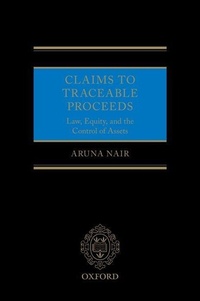
Claims to Traceable Proceeds
Law, Equity, and the Control of Assets
Published on 8. March 2018
Book
Hardback
246 pages
978-0-19-881340-8 (ISBN)
Description
In this new book, Aruna Nair sets out her arguments for a re-evaluation of the law of tracing. A new model of the law of tracing is proposed and the book demonstrates how current problems can be solved using this new model.
The rules of tracing are not shown not to be pure rules of evidence, aimed at resolving factual uncertainties; rather, they are explained as substantive rules of law, delineating the scope of a defendant's legal responsibility to a claimant. The book draws out the practical implications of this theoretical model, showing how a focus on defendant autonomy and claimant vulnerability can both explain the current state of English law and provide a critical perspective on potential future developments.
The first part of the book considers the nature of tracing, providing an overview of the analytical and doctrinal questions raised by the current law, re-framing the dominant 'value' account of tracing, and proposing a new model which can solve problems in the current law. The second part of the book focusses on circumstances in which the tracing remedy is available to a claimant, demonstrating the practical application of such claims to specific problems.
The rules of tracing are not shown not to be pure rules of evidence, aimed at resolving factual uncertainties; rather, they are explained as substantive rules of law, delineating the scope of a defendant's legal responsibility to a claimant. The book draws out the practical implications of this theoretical model, showing how a focus on defendant autonomy and claimant vulnerability can both explain the current state of English law and provide a critical perspective on potential future developments.
The first part of the book considers the nature of tracing, providing an overview of the analytical and doctrinal questions raised by the current law, re-framing the dominant 'value' account of tracing, and proposing a new model which can solve problems in the current law. The second part of the book focusses on circumstances in which the tracing remedy is available to a claimant, demonstrating the practical application of such claims to specific problems.
Reviews / Votes
Both books are interesting, thought provoking and extremely cogently argued. They are welcome additions to the stellar Oxford University press tracing collection. * Andreas Televantos, The Cambridge Law Journal [Reviewed with The Law of Tracing in Commercial Transactions by Magda Raczynska] * Nair updates the field by organizing tracing around the central idea of substitution, focusing her theoretical inquiry first on what substitution actually is, and then more practically proving why it has taken place in the context of claims to traceable proceeds. * Jacob J Meagher, Trust & Trustees *More details
Language
English
Place of publication
Oxford
United Kingdom
Target group
Professional and scholarly
Product notice
sewn/stitched
Cloth over boards
Dimensions
Height: 236 mm
Width: 157 mm
Thickness: 23 mm
Weight
540 gr
ISBN-13
978-0-19-881340-8 (9780198813408)
Copyright in bibliographic data and cover images is held by Nielsen Book Services Limited or by the publishers or by their respective licensors: all rights reserved.
Schweitzer Classification
Other editions
Additional editions
E-Book
03/2018
1st Edition
OUP eBook
€72.99
Available for download
E-Book
03/2018
1st Edition
OUP Oxford
€85.80
Available for download
Person
Aruna Nair is a Lecturer in Property Law at King's College London
Content
1: The Peculiarities of Tracing
2: Value and Other Metaphors: Tracing, Claiming, and Following
3: The Principles of Tracing
4: Rules of Tracing I: Against a Wrongdoer
5: Rules of Tracing II: Innocent Co-Contributors
6: Property Rights, Fiduciary Duties, and the Control of Assets
7: Control of Assets in Equity
8: Control of Assets at Law
2: Value and Other Metaphors: Tracing, Claiming, and Following
3: The Principles of Tracing
4: Rules of Tracing I: Against a Wrongdoer
5: Rules of Tracing II: Innocent Co-Contributors
6: Property Rights, Fiduciary Duties, and the Control of Assets
7: Control of Assets in Equity
8: Control of Assets at Law