

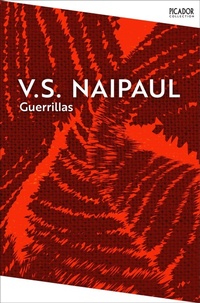
Guerrillas
Will be published approx. on 10. September 2026
Book
Paperback/Softback
272 pages
978-1-0350-9149-2 (ISBN)
Description
Set on a troubled Caribbean island - where Asians, Africans, Americans and former British colonials co-exist in a state of suppressed hysteria - Guerrillas is a novel of colonialism and revolution. A white man arrives with his mistress, an Englishwoman influenced by fantasies of native power and sexuality, unaware of the consequences of her actions.
Together with a leader of the 'revolution', they act out a gripping drama of death, sexual violence, and spiritual impotence. Guerrillas depicts a convulsion in public life, and ends in private violence. Place and people are evoked with an intensity unrivalled elsewhere. The novel comes with extraordinary force from the centre of a profound moral awareness of the world's plight.
'Remarkable . . . Guerrillas is a brilliant novel in every way, and it shimmers with artistic certainty' - The New York Times
'Impeccable prose, precise, austere . . . Guerrillas seems to me Naipaul's Heart of Darkness: a brilliant artist's anatomy of emptiness, and of despair' - Observer
Now part of the Picador Collection, a series showcasing the very best of modern literature.
Together with a leader of the 'revolution', they act out a gripping drama of death, sexual violence, and spiritual impotence. Guerrillas depicts a convulsion in public life, and ends in private violence. Place and people are evoked with an intensity unrivalled elsewhere. The novel comes with extraordinary force from the centre of a profound moral awareness of the world's plight.
'Remarkable . . . Guerrillas is a brilliant novel in every way, and it shimmers with artistic certainty' - The New York Times
'Impeccable prose, precise, austere . . . Guerrillas seems to me Naipaul's Heart of Darkness: a brilliant artist's anatomy of emptiness, and of despair' - Observer
Now part of the Picador Collection, a series showcasing the very best of modern literature.
Reviews / Votes
Impeccable . . . Guerrillas seems to me Naipaul's Heart of Darkness: a brilliant artist's anatomy of emptiness, and of despair * Observer * Remarkable . . . Guerrillas is a brilliant novel in every way, and it shimmers with artistic certainty * New York Times *More details
Series
Language
English
Place of publication
London
United Kingdom
Publishing group
Pan Macmillan
Product notice
Paperback (UK-B)
Dimensions
Height: 197 mm
Width: 130 mm
ISBN-13
978-1-0350-9149-2 (9781035091492)
Copyright in bibliographic data and cover images is held by Nielsen Book Services Limited or by the publishers or by their respective licensors: all rights reserved.
Schweitzer Classification
Person
V. S. Naipaul was born in Trinidad in 1932. He came to England on a scholarship in 1950. He spent four years at University College, Oxford, and began to write, in London, in 1954. He pursued no other profession.
His novels include A House for Mr Biswas, The Mimic Men, Guerrillas, A Bend in the River, and The Enigma of Arrival. In 1971 he was awarded the Booker Prize for In a Free State. His works of nonfiction, equally acclaimed, include Among the Believers, Beyond Belief, The Masque of Africa, and a trio of books about India: An Area of Darkness, India: A Wounded Civilization and India: A Million Mutinies Now.
In 1990, V. S. Naipaul received a knighthood for services to literature; in 1993, he was the first recipient of the David Cohen British Literature Prize. He received the Nobel Prize in Literature in 2001. He lived with his wife Nadira and cat Augustus in Wiltshire, and died in 2018.
His novels include A House for Mr Biswas, The Mimic Men, Guerrillas, A Bend in the River, and The Enigma of Arrival. In 1971 he was awarded the Booker Prize for In a Free State. His works of nonfiction, equally acclaimed, include Among the Believers, Beyond Belief, The Masque of Africa, and a trio of books about India: An Area of Darkness, India: A Wounded Civilization and India: A Million Mutinies Now.
In 1990, V. S. Naipaul received a knighthood for services to literature; in 1993, he was the first recipient of the David Cohen British Literature Prize. He received the Nobel Prize in Literature in 2001. He lived with his wife Nadira and cat Augustus in Wiltshire, and died in 2018.