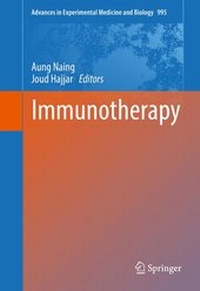
In the last decade, immunotherapy has revolutionized the practice of medicine in the field of oncology. This book, Immunotherapy, highlights the immunotherapeutic approaches currently in use and strategies to overcome the associated challenges. As comprehensive knowledge of basic immunology in the context of tumor biology is required to move further along the line of development in translational science, this book provides an overview of the cellular components of the immune system that interact with each other to provide a successful immune response.Immunotherapy offers promising antitumor activity across multiple cancer types as it does not attack the tumor but primarily revitalizes a suppressed immune system. It is beyond the scope of this book to discuss the immunotherapeutic approaches across the tumor board. However, the book features the role of immune-oncology in acute myeloid leukemia, non-small cell lung cancer, and sarcomas to showcase the recent advances in the management of cancer broadly classified as hematological malignancies, solid tumors, and tumors arising in the connective tissue. The book also discusses alternative formulations and combinatorial approaches to enhance the therapeutic index of these agents.As immunotherapeutic agents differ significantly from chemotherapeutic agents in response patterns and toxicity profiles, evaluating their safety and efficacy in clinical trials remains a challenge. In this book, we discuss the use of a variety of traditional and new immunotherapy criteria to evaluate response, their inadequacies, and clinical implications. The book also outlines how recent advances in medical imaging technology have the potential to provide high-dimensional data to improve decision support and individualize treatment selection and monitoring. Importantly, the book attempts to increase the awareness to immune related adverse events and the need for aggressive and judicious management of toxicities to improve treatment outcomes in patients on immunotherapy In short, this book provides a broad understanding of immunotherapy and ways to leverage the immune system to make inroads in the fight against cancer.
Series
Edition
Language
Place of publication
Publishing group
Springer International Publishing
Target group
Professional and scholarly
Illustrations
17 farbige Tabellen, 17 s/w Abbildungen
17 Tables, color; 17 Illustrations, black and white; V, 184 p. 17 illus.
Dimensions
Height: 23.5 cm
Width: 15.5 cm
Weight
ISBN-13
978-3-319-53155-7 (9783319531557)
DOI
10.1007/978-3-319-53156-4
Schweitzer Classification
Dr. Aung Naing is an Associate Professor in the Department of Investigational Cancer Therapeutics at MD Anderson Cancer Center and is also a Principal Investigator on immunotherapy-based clinical trials. Focusing on clinical translation of basic immunobiology, Dr. Naing's research interests are (1) identifying immunologic biomarkers of response to immunotherapy, (2) predicting primary and secondary resistance to immunotherapy, (3) developing immunotherapeutic strategies to overcome resistance, and (4) identifying predictive markers for immune-related adverse events (irAE) associated with immunotherapies.
Joud Hajjar is an Assistant Professor of Allergy and Immunology and serves as the service chief of adult allergy and immunology at Texas Children's Hospital. She is a member of the Basic and Clinical Immunology Interest group at the American Academy of Allergy Asthma and Immunology, and the Early Career Immunologist Committee at the Clinical Immunology Society.
Dr. Hajjar serves as a reviewer for the Journal of Clinical Immunology, Journal of General Internal Medicine and Allergy and Asthma Proceedings. She has received travel awards to present her research at the Clinical Immunology Society, American Academy of Allergy, Asthma and Immunology, and the American College of Allergy, Asthma and Immunology national meetings.
Dr. Hajjar's research interests are in primary immunodeficiency disorders, and cancer immunotherapy.