

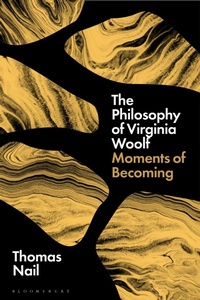
The Philosophy of Virginia Woolf
Moments of Becoming
Published on 29. May 2025
Book
Paperback/Softback
296 pages
978-1-350-52605-1 (ISBN)
Description
Towards the end of her life, Virginia Woolf defined her "philosophy"-the "constant idea" that "makes her a writer." She wrote that this idea had given her "the strongest pleasure known to [her]." She called these "exceptional moments," or "moments of being."
Thomas Nail contends that Woolf is a philosopher of being. And these "moments of being" as forming a unique process philosophy of motion. In her description of these moments Woolf gives us access to a world in motion and process; where all of nature and matter flows, ripples, and quivers. In these moments the anthropocentric division between humans and nature dissolves into metastable patterns-without essences or vital forces. Matter becomes dynamic, and what originally appeared solid is perceived as woven, porous, and fluid.
The Philosophy of Virginia Woolf begins by defining the basic idea of the moment of being, why it is important and how to understand it and its philosophical implications. It recounts a series of 14 'moments' each of which explores an aspect of Woolf's philosophy. They show how the moments evolve and articulate Woolf's process philosophy of movement. Each moment reveals unique aspects of how moments work and the kind of philosophical vision Woolf held. Nail concludes by addressing some of the ethical and political consequences of these moments in Woolf 's thinking. In the end, the book contends that Woolf offers us an absolutely unique philosophical and aesthetic understanding of phenomena, including nature, culture, desire, gender, writing/reading, consciousness, art, ecology, and sensation. It shows that Woolf is a philosopher in her own right, and held a unique philosophical position that makes a unique contribution to how to think in the world.
Thomas Nail contends that Woolf is a philosopher of being. And these "moments of being" as forming a unique process philosophy of motion. In her description of these moments Woolf gives us access to a world in motion and process; where all of nature and matter flows, ripples, and quivers. In these moments the anthropocentric division between humans and nature dissolves into metastable patterns-without essences or vital forces. Matter becomes dynamic, and what originally appeared solid is perceived as woven, porous, and fluid.
The Philosophy of Virginia Woolf begins by defining the basic idea of the moment of being, why it is important and how to understand it and its philosophical implications. It recounts a series of 14 'moments' each of which explores an aspect of Woolf's philosophy. They show how the moments evolve and articulate Woolf's process philosophy of movement. Each moment reveals unique aspects of how moments work and the kind of philosophical vision Woolf held. Nail concludes by addressing some of the ethical and political consequences of these moments in Woolf 's thinking. In the end, the book contends that Woolf offers us an absolutely unique philosophical and aesthetic understanding of phenomena, including nature, culture, desire, gender, writing/reading, consciousness, art, ecology, and sensation. It shows that Woolf is a philosopher in her own right, and held a unique philosophical position that makes a unique contribution to how to think in the world.
More details
Language
English
Place of publication
London
United Kingdom
Publishing group
Bloomsbury Publishing PLC
Target group
Professional and scholarly
College/higher education
Dimensions
Height: 229 mm
Width: 155 mm
Thickness: 19 mm
Weight
444 gr
ISBN-13
978-1-350-52605-1 (9781350526051)
Copyright in bibliographic data and cover images is held by Nielsen Book Services Limited or by the publishers or by their respective licensors: all rights reserved.
Schweitzer Classification
Person
Thomas Nail is a Distinguished Scholar and Professor of Philosophy at the University of Denver, USA. He is the author of The Figure of the Migrant, Theory of the Border, Marx in Motion, Theory of the Image, Theory of the Object, Theory of the Earth, Lucretius I, II, III, Returning to Revolution, and Being and Motion.
Content
Preface
Acknowledgements
Part I: Method and Motion
Chapter 1: Woolf's Process Materialism
Chapter 2: Let us Trace the Pattern
Part II: Moments of Becoming Brief Moments
Moments 0: The Trance into which Movement had Thrown Them
Individual Moments
Moment 1: Neither this nor That
Moment 2: Connected by Millions of Fibres
Moment 3: The Death of the Soul
Moment 4: Time Split its Husk
Moment 5: The Knotted Roots of Infinite Ages
Moment 6: She Felt Herself Everywhere
Moment 7: The Lake of Being
Moment 8: The Fluidity of Life
Moment 9: There is no Stability in this World
Nonhuman Moments
Moment 10: Part I, A Glimpse Only
Moment 10: Part II, Stars Flashing in their Hearts
Extended Moments
Moment 11: Part I, Hail! Natural Desire!
Moment 11: Part II, The Beauty of Movement
Moment 11: Part III, Everything was Partly Something Else
Collective Moments
Moment 12: The World Wavered
Moment 13: The Moment: Summer's Night
Moment 14: Now the Current Flows
Conclusion: Moments of Being Political
Acknowledgements
Part I: Method and Motion
Chapter 1: Woolf's Process Materialism
Chapter 2: Let us Trace the Pattern
Part II: Moments of Becoming Brief Moments
Moments 0: The Trance into which Movement had Thrown Them
Individual Moments
Moment 1: Neither this nor That
Moment 2: Connected by Millions of Fibres
Moment 3: The Death of the Soul
Moment 4: Time Split its Husk
Moment 5: The Knotted Roots of Infinite Ages
Moment 6: She Felt Herself Everywhere
Moment 7: The Lake of Being
Moment 8: The Fluidity of Life
Moment 9: There is no Stability in this World
Nonhuman Moments
Moment 10: Part I, A Glimpse Only
Moment 10: Part II, Stars Flashing in their Hearts
Extended Moments
Moment 11: Part I, Hail! Natural Desire!
Moment 11: Part II, The Beauty of Movement
Moment 11: Part III, Everything was Partly Something Else
Collective Moments
Moment 12: The World Wavered
Moment 13: The Moment: Summer's Night
Moment 14: Now the Current Flows
Conclusion: Moments of Being Political