

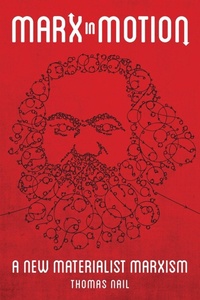
Marx in Motion
A New Materialist Marxism
Published on 17. September 2020
Book
Paperback/Softback
264 pages
978-0-19-752648-4 (ISBN)
Description
Karl Marx is the most historically foundational and systematic critic of capitalism to date, and the years since the 2008 financial crisis have witnessed a rebirth of his popular appeal. In a world of rising income inequality, right-wing nationalisms, and global climate change, people are again looking to the father of modern socialism for answers.
As this book argues, every era since Marx's death has reinvented him to fit its needs. There is not one Marx forever and for all time. There are a thousand Marxes. As Thomas Nail contends, one of the most significant contributions of Marx's work is that it treats theory itself as a historical practice. Reading Marx is not just an interpretative activity but a creative one. As our historical conditions change, so do the kinds of questions we pose and the kinds of answers we find in Marx's writing.
This book is a return to the writings of Karl Marx, including his under-appreciated dissertation, through the lens of the pressing philosophical and political problems of our time: ecological crisis, gender inequality, colonialism, and global mobility. However, the aim of this book is not to make Marxism relevant by "applying" it to contemporary issues. Instead, Marx in Motion, the first new materialist interpretation of Marx's work, treats Capital as if it were already a response to the present.
Thomas Nail argues that Marx was a new materialist avant la lettre. He argues that Marx did not believe history was determined, or that matter was passive, or that humans were separate or superior to nature. Marx did not even have a labor theory of value. Marxists argue that new materialists lack a sufficient political and economic theory, and new materialists argue that Marx's materialism is human-centric and mechanistic. This book aims to solve both problems by proposing a new materialist Marxism.
As this book argues, every era since Marx's death has reinvented him to fit its needs. There is not one Marx forever and for all time. There are a thousand Marxes. As Thomas Nail contends, one of the most significant contributions of Marx's work is that it treats theory itself as a historical practice. Reading Marx is not just an interpretative activity but a creative one. As our historical conditions change, so do the kinds of questions we pose and the kinds of answers we find in Marx's writing.
This book is a return to the writings of Karl Marx, including his under-appreciated dissertation, through the lens of the pressing philosophical and political problems of our time: ecological crisis, gender inequality, colonialism, and global mobility. However, the aim of this book is not to make Marxism relevant by "applying" it to contemporary issues. Instead, Marx in Motion, the first new materialist interpretation of Marx's work, treats Capital as if it were already a response to the present.
Thomas Nail argues that Marx was a new materialist avant la lettre. He argues that Marx did not believe history was determined, or that matter was passive, or that humans were separate or superior to nature. Marx did not even have a labor theory of value. Marxists argue that new materialists lack a sufficient political and economic theory, and new materialists argue that Marx's materialism is human-centric and mechanistic. This book aims to solve both problems by proposing a new materialist Marxism.
Reviews / Votes
Recommended. * P. Steiner, emeritus, University of Pennsylvannia, CHOICE * Marx in Motion raises many important and interesting questions. * Boris Hennig, Monthly Review * It is rare to find a genuinely novel reading of Marx and yet that is exactly what Thomas Nail provides in this remarkable book. In an ambitious, pathbreaking, and admirably lucid analysis, Nail offers us a 'new materialist' Marx that both resonates with ecological, feminist, and postcolonial Marxisms and suggests answers to some of the central political problems of our age. * Simon Choat, author of Marx Through Post-Structuralism: Lyotard, Derrida, Foucault, Deleuze * Thomas Nail's Marx in Motion is the most penetrating account of the origins of Marx's overall philosophical outlook to appear this century. Relying on his extensive background in Epicurean philosophy, Nail explores the emergence of Marx's materialist dialectics and his ecological-metabolic views as these first appeared in nascent form in Marx's 1841 doctoral thesis on Epicurus. The result is a revolutionary understanding of Marx's historical ontology of motion, a whole new starting point for the philosophy of praxis. * John Bellamy Foster, author of The Return of Nature: Socialism and Ecology * Why does Marx return in such a lively way after being banned from philosophical and political debate? Nail, who is an excellent reader of Lucretius, reminds us that Marxian thought finds its basis in the powerful ancient materialism. It is of that light that it shines. Beyond the positivist folklore of the Soviet Diamat, beyond the anthropocentric universalism of Marxist humanism after World War II, beyond the surrealist drift of post-structuralism, this book invites us to let ourselves be taken by the ancient materialist rhythm of Marxian concepts, and thus to accompany that philosophical return to political action. * Antonio Negri, co-author of Empire *More details
Language
English
Place of publication
New York
United States
Target group
College/higher education
Dimensions
Height: 234 mm
Width: 156 mm
Thickness: 16 mm
Weight
451 gr
ISBN-13
978-0-19-752648-4 (9780197526484)
Copyright in bibliographic data and cover images is held by Nielsen Book Services Limited or by the publishers or by their respective licensors: all rights reserved.
Schweitzer Classification
Other editions
Additional editions
Book
09/2020
Oxford University Press Inc
€150.00
Shipment within 15-20 days
E-Book
07/2020
OUP eBook
€25.49
Available for download
E-Book
07/2020
OUP eBook
€25.49
Available for download
Person
Thomas Nail is Professor of Philosophy at the University of Denver. He is the author of several books, including Returning to Revolution: Deleuze, Guattari and Zapatismo, The Figure of the Migrant, Theory of the Border, Lucretius I: An Ontology of Motion,Being and Motion, Theory of the Image, and co-editor of Between Deleuze and Foucault.
Content
List of Illustrations
Acknowledgments
List of Abbreviations
Introduction
1. Marx and Motion
2. Method and Critique
3. The Birth of Value
4. Devalorization
5. Metabolic Drift
6. The Patriarchy of Value
7. Kinetic Theory of Value I
8. Kinetic Theory of Value II
9. Fetishism and the Form of Motion
10. The Colonialism of Value
11. Kinetic Communism
Conclusion
Notes
Index
Acknowledgments
List of Abbreviations
Introduction
1. Marx and Motion
2. Method and Critique
3. The Birth of Value
4. Devalorization
5. Metabolic Drift
6. The Patriarchy of Value
7. Kinetic Theory of Value I
8. Kinetic Theory of Value II
9. Fetishism and the Form of Motion
10. The Colonialism of Value
11. Kinetic Communism
Conclusion
Notes
Index