

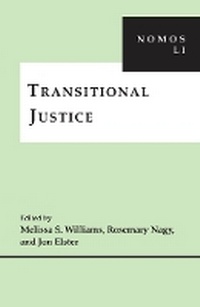
Transitional Justice
NOMOS LI
Published on 28. May 2012
Book
Hardback
384 pages
978-0-8147-9466-1 (ISBN)
Description
Criminal
tribunals, truth commissions, reparations, apologies and memorializations are
the characteristic instruments in the transitional justice toolkit that can help
societies transition from authoritarianism to democracy, from civil war to
peace, and from state-sponsored extra-legal violence to a rights-respecting
rule of law. Over the last several decades, their growing use has established
transitional justice as a body of both theory and practice whose guiding norms
and structures encompasses the range of institutional mechanisms by which
societies address the wrongs committed by past regimes in order to lay the
foundation for more legitimate political and legal order.
In Transitional
Justice, a group of leading
scholars in philosophy, law, and political science settles some of the key
theoretical debates over the meaning of transitional justice while opening up
new ones. By engaging both theorists and empirical social scientists in debates
over central categories of analysis in the study of transitional justice, it
also illuminates the challenges of making strong empirical claims about the
impact of transitional institutions.
Contributors:
Gary J. Bass, David Cohen, David Dyzenhaus, Pablo de Greiff, Leigh-Ashley
Lipscomb, Monika Nalepa, Eric A. Posner, Debra Satz, Gopal
Sreenivasan, Adrian
Vermeule, and Jeremy Webber.
tribunals, truth commissions, reparations, apologies and memorializations are
the characteristic instruments in the transitional justice toolkit that can help
societies transition from authoritarianism to democracy, from civil war to
peace, and from state-sponsored extra-legal violence to a rights-respecting
rule of law. Over the last several decades, their growing use has established
transitional justice as a body of both theory and practice whose guiding norms
and structures encompasses the range of institutional mechanisms by which
societies address the wrongs committed by past regimes in order to lay the
foundation for more legitimate political and legal order.
In Transitional
Justice, a group of leading
scholars in philosophy, law, and political science settles some of the key
theoretical debates over the meaning of transitional justice while opening up
new ones. By engaging both theorists and empirical social scientists in debates
over central categories of analysis in the study of transitional justice, it
also illuminates the challenges of making strong empirical claims about the
impact of transitional institutions.
Contributors:
Gary J. Bass, David Cohen, David Dyzenhaus, Pablo de Greiff, Leigh-Ashley
Lipscomb, Monika Nalepa, Eric A. Posner, Debra Satz, Gopal
Sreenivasan, Adrian
Vermeule, and Jeremy Webber.
More details
Series
Language
English
Place of publication
New York
United States
Target group
College/higher education
Product notice
Trade binding
Dimensions
Height: 210 mm
Width: 140 mm
Weight
544 gr
ISBN-13
978-0-8147-9466-1 (9780814794661)
Copyright in bibliographic data and cover images is held by Nielsen Book Services Limited or by the publishers or by their respective licensors: all rights reserved.
Schweitzer Classification
Other editions
Additional editions
E-Book
05/2012
1st Edition
New York University Press
€120.99
Available for download
E-Book
05/2012
New York University Press
€63.49
Available for download
Persons
Melissa S. Williams is Professor of Political Science at the University of Toronto. She is the author of Voice, Trust, and Memory and is the current editor of the NOMOS series.
Jon Elster is Professor of Rationalite et sciences sociales at College de France, and Robert K. Merton Professor of Social Sciences at Columbia University. He is author of Closing the Books: Transitional Justice in Historical Perspective.
Rosemary Nagy is Assistant Professor of Gender Equality and Social Justice at Nipissing University in Ontario, Canada.
Jon Elster is Professor of Rationalite et sciences sociales at College de France, and Robert K. Merton Professor of Social Sciences at Columbia University. He is author of Closing the Books: Transitional Justice in Historical Perspective.
Rosemary Nagy is Assistant Professor of Gender Equality and Social Justice at Nipissing University in Ontario, Canada.
Content
Preface Contributors Introduction 1. Theorizing Transitional Justice 2. Justice, Truth, Peace 3. Forms of Transitional Justice 4. Countering the Wrongs of the Past: The Role of Compensation 5. Reparations as Rough Justice 6. Reparations as a Noble Lie 7. Leviathan as a Theory of Transitional Justice 8. Transitional Prudence: A Comment on David Dyzenhaus, "Leviathan as a Theory of Transitional Justice" 9. What Is Non-Ideal Theory? 10. When More May Be Less: Transitional Justice in East Timor 11. Reconciliation, Refugee Returns, and the Impact of International Criminal Justice: The Case of Bosnia and Herzegovina Monika Nalepa Index