

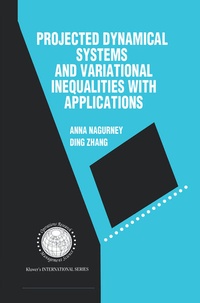
Projected Dynamical Systems and Variational Inequalities with Applications
Published on 31. December 1995
Book
Hardback
XXII, 296 pages
978-0-7923-9637-6 (ISBN)
Description
Equilibrium is a concept used in operations research and economics to understand the interplay of factors and problems arising from competitive systems in the economic world. The problems in this area are large and complex and have involved a variety of mathematical methodologies.
In this monograph, the authors have widened the scope of theoretical work with a new approach, `projected dynamical systems theory', to previous work in variational inequality theory. While most classical work in this area is static, the introduction to the theory of projected dynamical systems will allow many real-life dynamic situations and problems to be handled and modeled. This monograph includes:
In this monograph, the authors have widened the scope of theoretical work with a new approach, `projected dynamical systems theory', to previous work in variational inequality theory. While most classical work in this area is static, the introduction to the theory of projected dynamical systems will allow many real-life dynamic situations and problems to be handled and modeled. This monograph includes:
- a new theoretical approach, `projected dynamical system', which allows the researcher to model real-life situations more accurately;
- new mathematical methods allowing researchers to combine other theoretical approaches with the projected dynamical systems approach;
- a framework in which research can adequately model natural, financial and human (real life) situations in competitive equilibrium problems;
- the computational and numerical methods for the implementation of the methods and theory discussed in the book;
- stability analysis, algorithms and computational procedures are offered for each set of applications.
More details
Series
Edition
1996 ed.
Language
English
Place of publication
New York
United States
Target group
Professional and scholarly
Research
Illustrations
XXII, 296 p.
Dimensions
Height: 241 mm
Width: 160 mm
Thickness: 23 mm
Weight
653 gr
ISBN-13
978-0-7923-9637-6 (9780792396376)
DOI
10.1007/978-1-4615-2301-7
Schweitzer Classification
Other editions
Additional editions
Anna Nagurney | Ding Zhang
Projected Dynamical Systems and Variational Inequalities with Applications
Book
09/2012
Springer
€160.49
Shipment within 7-9 days
Persons
Anna Nagurney is the Eugene M. Isenberg Chair in Integrative Studies and was appointed to this endowed chaired professorship in the Department of Operations and Information Management in the Isenberg School of Management at the University of Massachusetts Amherst on April 14, 2021. Prior to that, she was the John F. Smith Memorial Professor of Operations Management, since 1998. She is also the Founding Director of the Virtual Center for Supernetworks and the Supernetworks Laboratory for Computation and Visualization at UMass Amherst. She is an Affiliated Faculty Member of the Department of Civil and Environmental Engineering and the Department of Mechanical and Industrial Engineering at UMass Amherst. She received her AB, ScB, ScM, and PhD degrees from Brown University in Providence, Rhode Island. She devotes her career to education and research that combines operations research / management science, engineering, and economics. Her focus is the applied and theoretical aspects of network systems, particularly in the areas of transportation and logistics, critical infrastructure, and in economics and finance. She has authored or co-authored 12 other books, more than 200 refereed journal articles and over 50 book chapters. In 2020, Professor Anna Nagurney was awarded the Harold Larnder Prize from the Canadian Operational Research Society and was selected to be a 2022 IFORS Distinguished Lecturer.
Content
I Theory of Projected Dynamical Systems.- 1 Introduction and Overview.- 2 Projected Dynamical Systems.- 3 Stability Analysis.- 4 Discrete Time Algorithms.- II Applications.- 5 Oligopolistic Market Equilibrium.- 6 Spatial Price Equilibrium.- 7 Elastic Demand Traffic Equilibrium.- 8 Fixed Demand Traffic Equilibrium.