


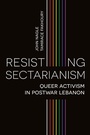
Resisting Sectarianism
Queer Activism in Postwar Lebanon
Published on 23. September 2021
Book
Hardback
208 pages
978-1-78699-799-9 (ISBN)
Description
The Middle East is often portrayed as oppressively patriarchal and homophobic. Yet, in recent years the region has become a vibrant and important arena for feminist and LGBTQ activism. This book provides an insight into this emerging politics through a unique analysis of feminist and LGBTQ social movements in the context of Lebanon's postwar sectarian system. Resisting Sectarianism argues that LGBTQ and feminists social movements are powerful agents of political and social transformation in Lebanon.
Drawing on extensive ethnographic fieldwork, the book takes the reader inside these movements to see how they attract members and construct campaigns, forge alliances, and the multiple ways in which they generate important forms of resistance to, and change within, the sectarian system. The book also traces the strong obstacles that sectarian parties and religious authorities employ to weaken LGBTQ and feminist activism.
Drawing on extensive ethnographic fieldwork, the book takes the reader inside these movements to see how they attract members and construct campaigns, forge alliances, and the multiple ways in which they generate important forms of resistance to, and change within, the sectarian system. The book also traces the strong obstacles that sectarian parties and religious authorities employ to weaken LGBTQ and feminist activism.
Reviews / Votes
A sensitive exploration of the practices of freedom deployed to resist the violence of Lebanon's sectarian system, in the process undermining its ideological and disciplinary powers one small battle at a time. * Bassel F. Salloukh, Associate Professor of Political Science, Lebanese American *More details
Language
English
Place of publication
United Kingdom
Publishing group
Bloomsbury Publishing PLC
Target group
College/higher education
Dimensions
Height: 241 mm
Width: 178 mm
Thickness: 22 mm
Weight
480 gr
ISBN-13
978-1-78699-799-9 (9781786997999)
Copyright in bibliographic data and cover images is held by Nielsen Book Services Limited or by the publishers or by their respective licensors: all rights reserved.
Schweitzer Classification
Other editions
Additional editions
E-Book
08/2021
1st Edition
Zed Books Ltd
€27.49
Available for download
Persons
John Nagle is a Reader in Sociology at the University of Aberdeen, UK.
Tamirace Fakhoury is Associate Professor at the Department of Politics and Society at Aalborg University in Copenhagen and the Scientific advisor to the Kuwait Chair at Sciences po in Paris.
Tamirace Fakhoury is Associate Professor at the Department of Politics and Society at Aalborg University in Copenhagen and the Scientific advisor to the Kuwait Chair at Sciences po in Paris.
Content
Resisting Sectarianism
Figures
Tables
Acknowledgements
Biographical Details
Preface
Chapter 1. 'No Homophobia, Racism, Sexism, Classism'
Chapter 2. 'We are Hated by Everyone': Sexuality and Sectarianism
Chapter 3. 'The Law Prosecutes the Weakest': The Rise of the LGBTQ Movement
Chapter 4. 'What Kind of Relationship can be Considered Contrary to Nature?' Contesting Criminalization
Chapter 5. 'I Exist': The Politics of Ambiguous Visibility and Pride
Chapter 6. 'LGBT is at the Bottom of Our List': International Actors and Rights
Chapter 7. 'We Have Always Been There': Tactical Alliances and Protest Spaces
Chapter 8. Conclusion: Contesting Sectarianism
Notes
Figures
Tables
Acknowledgements
Biographical Details
Preface
Chapter 1. 'No Homophobia, Racism, Sexism, Classism'
Chapter 2. 'We are Hated by Everyone': Sexuality and Sectarianism
Chapter 3. 'The Law Prosecutes the Weakest': The Rise of the LGBTQ Movement
Chapter 4. 'What Kind of Relationship can be Considered Contrary to Nature?' Contesting Criminalization
Chapter 5. 'I Exist': The Politics of Ambiguous Visibility and Pride
Chapter 6. 'LGBT is at the Bottom of Our List': International Actors and Rights
Chapter 7. 'We Have Always Been There': Tactical Alliances and Protest Spaces
Chapter 8. Conclusion: Contesting Sectarianism
Notes