

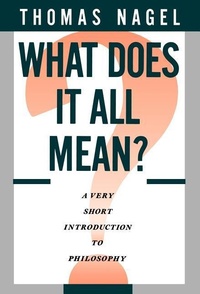
What Does It All Mean?
A Very Short Introduction to Philosophy
Published on 25. February 1988
Book
Hardback
112 pages
978-0-19-505292-3 (ISBN)
Description
Most people think about philosophical problems without realizing it: What really exists? Can we know anything? Is anything really right or wrong? Does life have any meaning? Is death the end of everything? These problems have been written about for thousands of years, but the philosophical raw material comes directly from the world and our relation to it.
In this remarkable book distinguished philosopher Thomas Nagel leads the reader into the heart of nine of these central problems of philosophy. In vivid, accessible prose, he brings the issues to life, demonstrating why they have continued to baffle and fascinate countless thinkers across the centuries. What Does It All Mean? challenges us to think hard and think clearly; to ask questions, to argue, to try out ideas and raise possible objections to them - in a word, to become philosophers ourselves.
In this remarkable book distinguished philosopher Thomas Nagel leads the reader into the heart of nine of these central problems of philosophy. In vivid, accessible prose, he brings the issues to life, demonstrating why they have continued to baffle and fascinate countless thinkers across the centuries. What Does It All Mean? challenges us to think hard and think clearly; to ask questions, to argue, to try out ideas and raise possible objections to them - in a word, to become philosophers ourselves.
Reviews / Votes
'If someone confronts you with the problem "Get me an introduction to philosophy and I have only one evening free to read it", I can recommend Thomas Nagel's introduction. If for the umpteemth time you are asked "What is philosophy all about", tell him or her to read this book... how would you go about explaining the complex relation between a determinisic world-view and the free will problem? Thomas Nagel shows how it can be done and quite impressively so.'Philosophica 'His style is clear and free of technical terms, and the book should appeal to those who know little or nothing of the discipline.' Library Journal 'Mr Nagel is well known among academic philosophers for bringng the clarity and rigor of analytic philosophy to such "large" philosophical questions.' Roger Kimball, 'The author is blessed with an ability rare in his discipline to combine rigour with good humour, and variety of approach with simplicity of expression. The most welcome thing about the book is that it presents the core questions of philosophy to the beginner without the deterrent baggage of names and -isms.'Anne McElvoy, The Times 'I don't know how many will find their way into philosophy via Nagel's Very Short Introduction, but it will be enough fully to justify the efforts of everyone involved.'
Times Literary Supplement 'His style is deceptively simple, concealing the profundity of the thought, and is luminously clear. His chatty, easy way of writing goes with a rigorous logic of argument ... Nagel has given us an admirable challenge to what the Greeks called 'the unexamined life'.'
Cogito
More details
Language
English
Place of publication
New York
United States
Target group
College/higher education
Professional and scholarly
Product notice
sewn/stitched
Cloth over boards
With dust jacket
Dimensions
Height: 219 mm
Width: 147 mm
Thickness: 16 mm
Weight
308 gr
ISBN-13
978-0-19-505292-3 (9780195052923)
Copyright in bibliographic data and cover images is held by Nielsen Book Services Limited or by the publishers or by their respective licensors: all rights reserved.
Schweitzer Classification
Other editions
Additional editions
E-Book
05/1989
1st Edition
Oxford University Press
€10.79
Available for download
E-Book
10/1987
1st Edition
Oxford University Press, USA
€24.29
Available for download
Person
Thomas Nagel is Professor of Philosophy and Law at New York University. His previous books are The View From Nowhere, Mortal Questions and The Possibility of Altruism.
Content
1. Introduction
2. How Do We Know Anything?
3. Other Minds
4. The Mind-Body Problem
5. The Meaning of Words
6. Free Will
7. Right and Wrong
8. Justice
9. Death
10. The Meaning of Life
2. How Do We Know Anything?
3. Other Minds
4. The Mind-Body Problem
5. The Meaning of Words
6. Free Will
7. Right and Wrong
8. Justice
9. Death
10. The Meaning of Life