

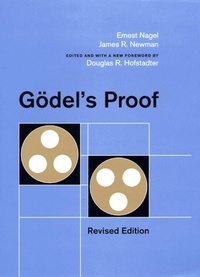
Goedel's Proof
Published on 1. October 2008
Book
Paperback/Softback
160 pages
978-0-8147-5837-3 (ISBN)
Description
An accessible explanation of Kurt Goedel's groundbreaking work in mathematical logic
In 1931 Kurt Goedel published his fundamental paper, "On Formally Undecidable Propositions of Principia Mathematica and Related Systems." This revolutionary paper challenged certain basic assumptions underlying much research in mathematics and logic. Goedel received public recognition of his work in 1951 when he was awarded the first Albert Einstein Award for achievement in the natural sciences-perhaps the highest award of its kind in the United States. The award committee described his work in mathematical logic as "one of the greatest contributions to the sciences in recent times."
However, few mathematicians of the time were equipped to understand the young scholar's complex proof. Ernest Nagel and James Newman provide a readable and accessible explanation to both scholars and non-specialists of the main ideas and broad implications of Goedel's discovery. It offers every educated person with a taste for logic and philosophy the chance to understand a previously difficult and inaccessible subject.
New York University Press is proud to publish this special edition of one of its bestselling books. With a new introduction by Douglas R. Hofstadter, this book will appeal students, scholars, and professionals in the fields of mathematics, computer science, logic and philosophy, and science.
In 1931 Kurt Goedel published his fundamental paper, "On Formally Undecidable Propositions of Principia Mathematica and Related Systems." This revolutionary paper challenged certain basic assumptions underlying much research in mathematics and logic. Goedel received public recognition of his work in 1951 when he was awarded the first Albert Einstein Award for achievement in the natural sciences-perhaps the highest award of its kind in the United States. The award committee described his work in mathematical logic as "one of the greatest contributions to the sciences in recent times."
However, few mathematicians of the time were equipped to understand the young scholar's complex proof. Ernest Nagel and James Newman provide a readable and accessible explanation to both scholars and non-specialists of the main ideas and broad implications of Goedel's discovery. It offers every educated person with a taste for logic and philosophy the chance to understand a previously difficult and inaccessible subject.
New York University Press is proud to publish this special edition of one of its bestselling books. With a new introduction by Douglas R. Hofstadter, this book will appeal students, scholars, and professionals in the fields of mathematics, computer science, logic and philosophy, and science.
Reviews / Votes
"A little masterpiece of exegesis." (Nature) "An excellent nontechnical account of the substance of Goedel's celebrated paper." - American Mathematical SocietyMore details
Language
English
Place of publication
New York
United States
Target group
College/higher education
Professional and scholarly
Product notice
Paperback (trade)
Dimensions
Height: 201 mm
Width: 128 mm
Thickness: 12 mm
Weight
181 gr
ISBN-13
978-0-8147-5837-3 (9780814758373)
Copyright in bibliographic data and cover images is held by Nielsen Book Services Limited or by the publishers or by their respective licensors: all rights reserved.
Schweitzer Classification
Other editions
Additional editions
Ernest Nagel | James R. Newman
Goedel's Proof
E-Book
10/2001
New York University Press
€14.49
Available for download
Ernest Nagel | James R. Newman
Goedel's Proof
E-Book
10/2001
1st Edition
New York University Press
€105.99
Available for download
Persons
Ernest Nagel was John Dewey Professor of Philosophy at Columbia University.
James R. Newman was the author of What is Science.
Douglas R. Hofstadter is College of Arts and Sciences Professor of computer science and cognitive science at Indiana University and author of the Pulitzer-prize winning Goedel, Escher, Bach: An Eternal Golden Braid.
James R. Newman was the author of What is Science.
Douglas R. Hofstadter is College of Arts and Sciences Professor of computer science and cognitive science at Indiana University and author of the Pulitzer-prize winning Goedel, Escher, Bach: An Eternal Golden Braid.
Content
Contents Foreword to the New Edition by Douglas R. Hofstadter ix Acknowledgments xxiii i Introduction 1 ii The Problem of Consistency 7 iii Absolute Proofs of Consistency 25 iv The Systematic Codification of Formal Logic 37 v An Example of a Successful Absolute Proof of Consistency 45 vi The Idea of Mapping and Its Use in Mathematics 57 vii Godel's Proofs 68 a Godel numbering 68 b The arithmetization of meta-mathematics 80 c The heart of Godel's argument 92 viii Concluding Reflections 109 Appendix: Notes 114 Brief Bibliography 125 Index 127