

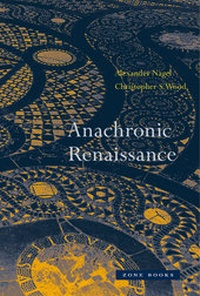
Anachronic Renaissance
1st Edition
Published on 14. May 2010
Book
Hardback
456 pages
978-1-935408-02-4 (ISBN)
Description
In this widely anticipated book, two leading contemporary art historians offer a subtle and profound reconsideration of the problem of time in the Renaissance. Alexander Nagel and Christopher Wood examine the meanings, uses, and effects of chronologies, models of temporality, and notions of originality and repetition in Renaissance images and artifacts. Anachronic Renaissance reveals a web of paths traveled by works and artists--a landscape obscured by art history's disciplinary compulsion to anchor its data securely in time.
The buildings, paintings, drawings, prints, sculptures, and medals discussed were shaped by concerns about authenticity, about reference to prestigious origins and precedents, and about the implications of transposition from one medium to another. Byzantine icons taken to be Early Christian antiquities, the acheiropoieton (or "image made without hands"), the activities of spoliation and citation, differing approaches to art restoration, legends about movable buildings, and forgeries and pastiches: all of these emerge as basic conceptual structures of Renaissance art.
Although a work of art does bear witness to the moment of ist fabrication, Nagel and Wood argue that it is equally important to understand ist temporal instability: how it points away from that moment, backward to a remote ancestral origin, to a prior artifact or image, even to an origin outside of time, in divinity. This book is not the story about the Renaissance, nor is it just a story. It imagines the infrastructure of many possible stories.
The buildings, paintings, drawings, prints, sculptures, and medals discussed were shaped by concerns about authenticity, about reference to prestigious origins and precedents, and about the implications of transposition from one medium to another. Byzantine icons taken to be Early Christian antiquities, the acheiropoieton (or "image made without hands"), the activities of spoliation and citation, differing approaches to art restoration, legends about movable buildings, and forgeries and pastiches: all of these emerge as basic conceptual structures of Renaissance art.
Although a work of art does bear witness to the moment of ist fabrication, Nagel and Wood argue that it is equally important to understand ist temporal instability: how it points away from that moment, backward to a remote ancestral origin, to a prior artifact or image, even to an origin outside of time, in divinity. This book is not the story about the Renaissance, nor is it just a story. It imagines the infrastructure of many possible stories.
More details
Series
Language
English
Place of publication
New York
United States
Target group
College/higher education
Professional and scholarly
Interest Age: From 18 years
Illustrations
115 s/w Abbildungen
120 b&w illus.
Dimensions
Height: 276 mm
Width: 184 mm
Thickness: 39 mm
Weight
1089 gr
ISBN-13
978-1-935408-02-4 (9781935408024)
Copyright in bibliographic data and cover images is held by Nielsen Book Services Limited or by the publishers or by their respective licensors: all rights reserved.
Schweitzer Classification
Other editions
Additional editions
Alexander Nagel | Christopher S. Wood
Anachronic Renaissance
Book
04/2020
Zone Books
€37.50
Shipment within 3-4 weeks
Alexander Nagel | Christopher S. Wood
Anachronic Renaissance
E-Book
05/2010
Zone Books
€35.99
Available for download
Persons
Alexander Nagel is Professor of Renaissance Art History at the Institute of Fine Arts in New York, and the author of Michelangelo and the Reform of Art. Christopher S. Wood is Professor in the Department of History of Art, Yale University. He is the author of Albrecht Altdorfer and the Origins of Landscape, and the editor of The Vienna School Reader: Politics and Art Historical Method in the 1930s (Zone Books, 2000).