

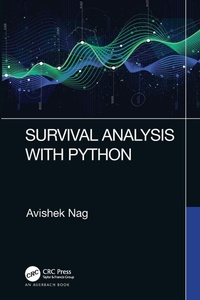
Survival Analysis with Python
1st Edition
Published on 8. October 2024
Book
Paperback/Softback
84 pages
978-1-032-07367-5 (ISBN)
Description
Survival analysis uses statistics to calculate time to failure. Survival Analysis with Python takes a fresh look at this complex subject by explaining how to use the Python programming language to perform this type of analysis. As the subject itself is very mathematical and full of expressions and formulations, the book provides detailed explanations and examines practical implications. The book begins with an overview of the concepts underpinning statistical survival analysis. It then delves into
Parametric models with coverage of
Concept of maximum likelihood estimate (MLE) of a probability distribution parameter
MLE of the survival function
Common probability distributions and their analysis
Analysis of exponential distribution as a survival function
Analysis of Weibull distribution as a survival function
Derivation of Gumbel distribution as a survival function from Weibull
Non-parametric models including
Kaplan-Meier (KM) estimator, a derivation of expression using MLE
Fitting KM estimator with an example dataset, Python code and plotting curves
Greenwood's formula and its derivation
Models with covariates explaining
The concept of time shift and the accelerated failure time (AFT) model
Weibull-AFT model and derivation of parameters by MLE
Proportional Hazard (PH) model
Cox-PH model and Breslow's method
Significance of covariates
Selection of covariates
The Python lifelines library is used for coding examples. By mapping theory to practical examples featuring datasets, this book is a hands-on tutorial as well as a handy reference.
Parametric models with coverage of
Concept of maximum likelihood estimate (MLE) of a probability distribution parameter
MLE of the survival function
Common probability distributions and their analysis
Analysis of exponential distribution as a survival function
Analysis of Weibull distribution as a survival function
Derivation of Gumbel distribution as a survival function from Weibull
Non-parametric models including
Kaplan-Meier (KM) estimator, a derivation of expression using MLE
Fitting KM estimator with an example dataset, Python code and plotting curves
Greenwood's formula and its derivation
Models with covariates explaining
The concept of time shift and the accelerated failure time (AFT) model
Weibull-AFT model and derivation of parameters by MLE
Proportional Hazard (PH) model
Cox-PH model and Breslow's method
Significance of covariates
Selection of covariates
The Python lifelines library is used for coding examples. By mapping theory to practical examples featuring datasets, this book is a hands-on tutorial as well as a handy reference.
More details
Language
English
Place of publication
London
United Kingdom
Publishing group
Taylor & Francis Ltd
Target group
Professional and scholarly
Academic and Professional
Illustrations
88 s/w Abbildungen, 88 s/w Zeichnungen
88 Line drawings, black and white; 88 Illustrations, black and white
Dimensions
Height: 229 mm
Width: 152 mm
Thickness: 5 mm
Weight
150 gr
ISBN-13
978-1-032-07367-5 (9781032073675)
Copyright in bibliographic data and cover images is held by Nielsen Book Services Limited or by the publishers or by their respective licensors: all rights reserved.
Schweitzer Classification
Other editions
Additional editions
Avishek Nag
Survival Analysis with Python
E-Book
12/2021
1st Edition
Auerbach
€25.99
Available for download
Avishek Nag
Survival Analysis with Python
E-Book
12/2021
1st Edition
Auerbach
€25.99
Available for download
Avishek Nag
Survival Analysis with Python
Book
12/2021
1st Edition
Auerbach
€86.80
Shipment within 10-20 days
Person
Avishek Nag has a Masters of Technology Degree in data analytics and machine learning from Birla Institute of Technology and Science, Pilani, India. He has more than 15 years of experience in Software Development and Architecting Systems. He also has professional experience in data science and machine learning, Java, Python, Big Data, including Spark and MongoDB. He has worked at VMWare, Cisco, Mobile Iron, and Computer Science Corporation (now called DXC). He is also the author of the book Pragmatic Machine Learning with Python, which is recommended in the ACM Education Digital Library.
Content
Chapter 1. Introduction Chapter 2. General Theory of Survival Analysis Chapter 3. Parametric Models Chapter 4. Nonparametric Models Chapter 5. Models with Covariates