

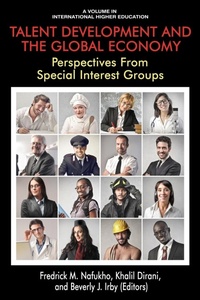
Talent Development and the Global Economy
Perspectives from Special Interest Groups
Published on 30. August 2017
Book
Paperback/Softback
192 pages
978-1-68123-997-2 (ISBN)
Description
Talent has been identified as the only differentiator for an organization's, nations' or any region's success in this uncertain, complex, competitive and global environment. Ulrich (2008) defined talent as the equation of 3Cs: Talent = Competence x Commitment x Contribution. Malaeb and Chanaron (2010, p. 2), noted "Competence means that employees have the skills and abilities today and in the future for required business results. ... Commitment means that employees are involved and engaged ... while Contribution means that employees find personal abundance at occupation ..." While Ulrich (2008) observed that commitment focused on meaning and identity and other restraints that tap employee's heart. This book is unique in many ways, which makes it extraordinary. First, unlike other books that have examined issues of change facing the global economy no book has examined the issue of talent development from the perspective of special interest groups including management international students, women refugees, refugees, non-governmental organizations, for profit, for benefit and nonprofit organizations. Thus, talent development world over has become one of the most important issues when it comes to developing human resources especially through education and training. The book presents pertinent research and practice on talent development management and argues that the term talent development broadly refers to management and development of high performing and high potential individuals in society required to carry out critical organizational and society roles aimed at improving human development. The contributors of the book chapters include individuals actively involved in research, teaching and practice in higher education and in business and industry. The chapters are based on empirical data, including review of relevant literature. The book also recognizes that talent development is more than just crisis management and includes best talent management practices, shared governance, meaningful reforms, strategic planning, transparency and accountability, social justice and respect for human life and the need to develop humane organizations and humane communities. The contributions take cognizance of the fact that talent development as a concept is facing fundamental changes in the global knowledge economy, and especially with political changes taking place world over. Contributors also take cognizance of the fact that one important source of change in society has been the accelerating speed of scientific and technological advancement driven by the power of the Internet hence the need to develop talent for the 21st century and beyond. The book is basically an academic book for use by undergraduates and graduate students at universities, for-profit, for-benefit, and non-profit organizations, policy makers and formulators in ministries of Education; supra national organizations, foreign organizations multilateral organizations, non-governmental organizations, community based organizations as well as development stakeholders, and community organizers.
More details
Series
Language
English
Place of publication
Charlotte
United States
Publishing group
Emerald Publishing Inc
Target group
College/higher education
Dimensions
Height: 234 mm
Width: 156 mm
Thickness: 11 mm
Weight
301 gr
ISBN-13
978-1-68123-997-2 (9781681239972)
Copyright in bibliographic data and cover images is held by Nielsen Book Services Limited or by the publishers or by their respective licensors: all rights reserved.
Schweitzer Classification
Other editions
Additional editions
Fredrick. M. Nafukho
Talent Development and the Global Economy
Perspectives from Special Interest Groups
E-Book
01/2017
1st Edition
Information Age Publishing
from
€62.33
Available for download
Content
Chapter 1. Why Focus on Talent Development? Fredrick M. Nafukho, Beverly J. Irby and Khalil Dirani.
Chapter 2. Global Talent Flow: International Graduate Students' Career Decisions after Graduation; Sehoon Kim and Soo Jeoung Han.
Chapter 3. Leveraging Talent Development in the United States: The African-American Perspective; Tomika Greer.
Chapter 4. Talent Development and Refugee Women in the United States; Minerva Tuliao, Kathy Najjar, and Rich Torraco.
Chapter 5. Talent Development: Asian Pacific Islanders Perspective; Hae Na Kim and Hsu Yun-Hsiang.
Chapter 6. Maximizing Motivation: Talent Development in Nongovernmental Organizations; Jill Zarestky and Shannon Deer.
Chapter 7. Talent Development of Global Virtual Team Leaders: Challenges and Strategies; Soo Jeoung Han and Michael Beyerlien.
Chapter 8. Training Development and Working Poor Families in the United States; Rich Torraco.
Chapter 9. Talent Development in the 21st Century and Social Media; Fatemeh Rezaei and Misha Chakraborty.
Chapter 10. Talent Development via Cognitive Mediation; Heidi Flavian.
Chapter 2. Global Talent Flow: International Graduate Students' Career Decisions after Graduation; Sehoon Kim and Soo Jeoung Han.
Chapter 3. Leveraging Talent Development in the United States: The African-American Perspective; Tomika Greer.
Chapter 4. Talent Development and Refugee Women in the United States; Minerva Tuliao, Kathy Najjar, and Rich Torraco.
Chapter 5. Talent Development: Asian Pacific Islanders Perspective; Hae Na Kim and Hsu Yun-Hsiang.
Chapter 6. Maximizing Motivation: Talent Development in Nongovernmental Organizations; Jill Zarestky and Shannon Deer.
Chapter 7. Talent Development of Global Virtual Team Leaders: Challenges and Strategies; Soo Jeoung Han and Michael Beyerlien.
Chapter 8. Training Development and Working Poor Families in the United States; Rich Torraco.
Chapter 9. Talent Development in the 21st Century and Social Media; Fatemeh Rezaei and Misha Chakraborty.
Chapter 10. Talent Development via Cognitive Mediation; Heidi Flavian.