

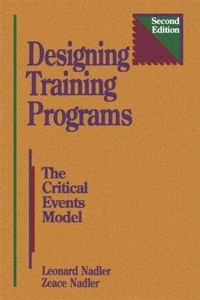
Designing Training Programs
The Critical Events Model
2nd Edition
Published on 8. August 1994
Book
Hardback
290 pages
978-0-88415-100-5 (ISBN)
Description
First published in 1994. This new edition could be the single most important tool HRD professionals can have to create cost-effective, productivity-oriented training programs. It updates the unique training model, called the Critical Events Model, which HRD professionals can adapt to their particular training situation. The model is presented in a series of steps called events that provide the designer with a straightforward system for designing training programs to improve performance and efficiency in the workplace.
More details
Edition
2nd edition
Language
English
Place of publication
Houston
United States
Publishing group
Taylor & Francis Inc
Target group
Professional and scholarly
Professional Practice & Development
Product notice
sewn/stitched
Cloth over boards
With dust jacket
Dimensions
Height: 237 mm
Width: 160 mm
Thickness: 25 mm
Weight
662 gr
ISBN-13
978-0-88415-100-5 (9780884151005)
Copyright in bibliographic data and cover images is held by Nielsen Book Services Limited or by the publishers or by their respective licensors: all rights reserved.
Schweitzer Classification
Other editions
Additional editions
Zeace Nadler | Leonard Nadler
Designing Training Programs
E-Book
08/2012
2nd Edition
Routledge
€86.99
Available for download
Zeace Nadler | Leonard Nadler
Designing Training Programs
E-Book
08/2012
2nd Edition
Routledge
€86.99
Available for download
Persons
Leonard Nadler, Zeace Nadler
Content
Chapter 1 Designing and Using Models; Chapter 2 Evaluation and Feedback; Chapter 3 Identify the Needs of the Organization; Chapter 4 Specify Job Performance; Chapter 5 Identify the Needs of the Learner; Chapter 6 Determine Objectives; Chapter 7 Build Curriculum; Chapter 8 Select Instructional Strategies; Chapter 9 Obtain Instructional Resources; Chapter 10 Conduct Training; Chapter 11 Support Systems for Training; Chapter 12 Education; Chapter 13 Using the CEM for Education;