

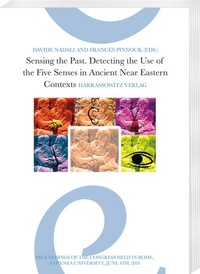
Sensing the Past
Detecting the Use of the Five Senses in Ancient Near Eastern Contexts. Proceedings of the Conference Held in Rome, Sapienza University June 4th, 2018
1st Edition
Published on 18. March 2020
Book
Paperback/Softback
VIII, 254 pages
978-3-447-11411-0 (ISBN)
Description
The Archaeology of Senses and the Archaeology of Emotions are two most interesting recent trends in the modern studies about the past, aiming at enlightening the human experience of the archaeological remains and artefacts, which are usually studied per se or in their (inter)connections. Scholars of the ancient Near East from different disciplines - archaeology, history and philology - try to understand how people were presumed to react, or how they reacted in reality, using spaces, and looking at or using artefacts.
The volume presents the proceedings of a congress focusing mainly on the use of the five traditional senses, and trying to analyze how each of them might have played a role in specific ancient contexts: The use of sight was common in the rituals of kingship at Ebla and in the choice of specific places for settlements in the southern Levant. The use of hearing was an important aspect in the rites taking place in one of the main 3rd millennium BC temples of Ebla or in the open air sanctuaries of Anatolia, whereas specific words for the definition of sounds are detectable in Sumerian and Akkadian texts. Special foods and beverages were used during ceremonies involving taste and smell - at the same time smell affects both private and public spaces - and archaeological evidence (e.g. sewage systems) shows how this issue has been managed and controlled. Small every-day use objects might have had also tactile properties; senses convey emotions and this aspect can be reconstructed from Mesopotamian texts. A peculiar perspective is provided by the analysis of the relation between public and artefacts in museums.
The volume presents the proceedings of a congress focusing mainly on the use of the five traditional senses, and trying to analyze how each of them might have played a role in specific ancient contexts: The use of sight was common in the rituals of kingship at Ebla and in the choice of specific places for settlements in the southern Levant. The use of hearing was an important aspect in the rites taking place in one of the main 3rd millennium BC temples of Ebla or in the open air sanctuaries of Anatolia, whereas specific words for the definition of sounds are detectable in Sumerian and Akkadian texts. Special foods and beverages were used during ceremonies involving taste and smell - at the same time smell affects both private and public spaces - and archaeological evidence (e.g. sewage systems) shows how this issue has been managed and controlled. Small every-day use objects might have had also tactile properties; senses convey emotions and this aspect can be reconstructed from Mesopotamian texts. A peculiar perspective is provided by the analysis of the relation between public and artefacts in museums.
More details
Other editions
Additional editions
Davide Nadali | Frances Pinnock
Sensing the Past
Detecting the Use of the Five Senses in Ancient Near Eastern Contexts. Proceedings of the Conference Held in Rome, Sapienza University June 4th, 2018
E-Book
03/2020
1st Edition
Harrassowitz Verlag
from
€68.00
Available for download