

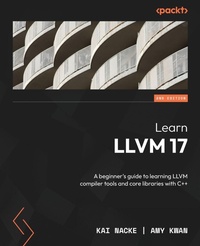
Learn LLVM 17
A beginner's guide to learning LLVM compiler tools and core libraries with C++
2nd Edition
Published on 12. January 2024
Book
Paperback/Softback
416 pages
978-1-83763-134-6 (ISBN)
Description
Learn how to build and use the complete spectrum of real-world compilers, including the frontend, optimization pipeline, and a new backend by leveraging the power of LLVM core libraries
Key Features
Get to grips with using LLVM libraries step by step
Understand the high-level design of LLVM compilers and apply these principles to your own compiler
Add a new backend to target an unsupported CPU architecture
Purchase of the print or Kindle book includes a free PDF eBook
Book DescriptionLLVM was built to bridge the gap between the theoretical knowledge found in compiler textbooks and the practical demands of compiler development. With a modular codebase and advanced tools, LLVM empowers developers to build compilers with ease. This book serves as a practical introduction to LLVM, guiding you progressively through complex scenarios and ensuring that you navigate the challenges of building and working with compilers like a pro.
The book starts by showing you how to configure, build, and install LLVM libraries, tools, and external projects. You'll then be introduced to LLVM's design, unraveling its applications in each compiler stage: frontend, optimizer, and backend. Using a real programming language subset, you'll build a frontend, generate LLVM IR, optimize it through the pipeline, and generate machine code. Advanced chapters extend your expertise, covering topics such as extending LLVM with a new pass, using LLVM tools for debugging, and enhancing the quality of your code. You'll also focus on just-in-time compilation issues and the current state of JIT-compilation support with LLVM. Finally, you'll develop a new backend for LLVM, gaining insights into target description and how instruction selection works.
By the end of this book, you'll have hands-on experience with the LLVM compiler development framework through real-world examples and source code snippets.What you will learn
Configure, compile, and install the LLVM framework
Understand how the LLVM source is organized
Discover what you need to do to use LLVM in your own projects
Explore how a compiler is structured, and implement a tiny compiler
Generate LLVM IR for common source language constructs
Set up an optimization pipeline and tailor it for your own needs
Extend LLVM with transformation passes and clang tooling
Add new machine instructions and a complete backend
Who this book is forThis book is for compiler developers, enthusiasts, and engineers new to LLVM. C++ software engineers looking to use compiler-based tools for code analysis and improvement, as well as casual users of LLVM libraries who want to gain more knowledge of LLVM essentials will also find this book useful. Intermediate-level experience with C++ programming is necessary to understand the concepts covered in this book.
Key Features
Get to grips with using LLVM libraries step by step
Understand the high-level design of LLVM compilers and apply these principles to your own compiler
Add a new backend to target an unsupported CPU architecture
Purchase of the print or Kindle book includes a free PDF eBook
Book DescriptionLLVM was built to bridge the gap between the theoretical knowledge found in compiler textbooks and the practical demands of compiler development. With a modular codebase and advanced tools, LLVM empowers developers to build compilers with ease. This book serves as a practical introduction to LLVM, guiding you progressively through complex scenarios and ensuring that you navigate the challenges of building and working with compilers like a pro.
The book starts by showing you how to configure, build, and install LLVM libraries, tools, and external projects. You'll then be introduced to LLVM's design, unraveling its applications in each compiler stage: frontend, optimizer, and backend. Using a real programming language subset, you'll build a frontend, generate LLVM IR, optimize it through the pipeline, and generate machine code. Advanced chapters extend your expertise, covering topics such as extending LLVM with a new pass, using LLVM tools for debugging, and enhancing the quality of your code. You'll also focus on just-in-time compilation issues and the current state of JIT-compilation support with LLVM. Finally, you'll develop a new backend for LLVM, gaining insights into target description and how instruction selection works.
By the end of this book, you'll have hands-on experience with the LLVM compiler development framework through real-world examples and source code snippets.What you will learn
Configure, compile, and install the LLVM framework
Understand how the LLVM source is organized
Discover what you need to do to use LLVM in your own projects
Explore how a compiler is structured, and implement a tiny compiler
Generate LLVM IR for common source language constructs
Set up an optimization pipeline and tailor it for your own needs
Extend LLVM with transformation passes and clang tooling
Add new machine instructions and a complete backend
Who this book is forThis book is for compiler developers, enthusiasts, and engineers new to LLVM. C++ software engineers looking to use compiler-based tools for code analysis and improvement, as well as casual users of LLVM libraries who want to gain more knowledge of LLVM essentials will also find this book useful. Intermediate-level experience with C++ programming is necessary to understand the concepts covered in this book.
More details
Edition
2nd Revised edition
Language
English
Place of publication
Birmingham
United Kingdom
Target group
Professional and scholarly
US School Grade: College Graduate Student
Edition type
Revised edition
Dimensions
Height: 235 mm
Width: 191 mm
Thickness: 23 mm
Weight
773 gr
ISBN-13
978-1-83763-134-6 (9781837631346)
Copyright in bibliographic data and cover images is held by Nielsen Book Services Limited or by the publishers or by their respective licensors: all rights reserved.
Schweitzer Classification
Other editions
Additional editions

Kai Nacke | Amy Kwan
Learn LLVM 17
A beginner's guide to learning LLVM compiler tools and core libraries with C++
E-Book
09/2024
2nd Edition
Packt Publishing
from
€29.99
Available for download
Persons
Kai Nacke is a professional IT architect currently residing in Toronto, Canada. He holds a diploma in computer science from the Technical University of Dortmund, Germany. and his diploma thesis on universal hash functions was recognized as the best of the semester.
With over 20 years of experience in the IT industry, Kai has extensive expertise in the development and architecture of business and enterprise applications. In his current role, he evolves an LLVM/clang-based compiler.
For several years, Kai served as the maintainer of LDC, the LLVM-based D compiler. He is the author of D Web Development and Learn LLVM 12, both published by Packt. In the past, he was a speaker in the LLVM developer room at the Free and Open Source Software Developers' European Meeting (FOSDEM). Amy Kwan is a compiler developer currently residing in Toronto, Canada. Originally, from the Canadian prairies, Amy holds a Bachelor of Science in Computer Science from the University of Saskatchewan. In her current role, she leverages LLVM technology as a backend compiler developer. Previously, Amy has been a speaker at the LLVM Developer Conference in 2022 alongside Kai Nacke.
With over 20 years of experience in the IT industry, Kai has extensive expertise in the development and architecture of business and enterprise applications. In his current role, he evolves an LLVM/clang-based compiler.
For several years, Kai served as the maintainer of LDC, the LLVM-based D compiler. He is the author of D Web Development and Learn LLVM 12, both published by Packt. In the past, he was a speaker in the LLVM developer room at the Free and Open Source Software Developers' European Meeting (FOSDEM). Amy Kwan is a compiler developer currently residing in Toronto, Canada. Originally, from the Canadian prairies, Amy holds a Bachelor of Science in Computer Science from the University of Saskatchewan. In her current role, she leverages LLVM technology as a backend compiler developer. Previously, Amy has been a speaker at the LLVM Developer Conference in 2022 alongside Kai Nacke.
Content
Table of Contents
Installing LLVM
The Structure of a Compiler
Turning the Source File into an Abstract Syntax Tree
Basics of IR Code Generation
IR Generation for High-Level Language Constructs
Advanced IR Generation
Optimizing IR
The TableGen Language
JIT Compilation
Debugging Using LLVM Tools
The Target Description
Instruction Selection
Beyond Instruction Selection
Installing LLVM
The Structure of a Compiler
Turning the Source File into an Abstract Syntax Tree
Basics of IR Code Generation
IR Generation for High-Level Language Constructs
Advanced IR Generation
Optimizing IR
The TableGen Language
JIT Compilation
Debugging Using LLVM Tools
The Target Description
Instruction Selection
Beyond Instruction Selection