

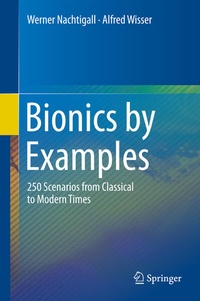
Bionics by Examples
250 Scenarios from Classical to Modern Times
Published on 8. October 2014
Book
Hardback
XIX, 325 pages
978-3-319-05857-3 (ISBN)
Description
Bionics means learning from the nature for the development of technology. The science of "bionics" itself is classified into several sections, from materials and structures over procedures and processes until evolution and optimization. Not all these areas, or only a few, are really known in the public and also in scientific literature. This includes the Lotus-effect, converted to the contamination-reduction of fassades and the shark-shed-effect, converted to the resistance-reduction of airplanes. However, there are hundreds of highly interesting examples that contain the transformation of principles of the nature into technology. From the large number of these examples, 250 were selected for the present book according to "prehistory", "early-history", "classic" and "modern time". Most examples are new. Every example includes a printed page in a homogeneous arrangement. The examples from the field "modern time" are joint in blocks corresponding to the sub-disciplines of bionics.
More details
Edition
2015 ed.
Language
English
Place of publication
Cham
Switzerland
Publishing group
Springer International Publishing
Target group
Professional and scholarly
Professional/practitioner
Illustrations
263 s/w Abbildungen, 5 farbige Abbildungen
XIX, 325 p. 268 illus., 5 illus. in color.
Dimensions
Height: 241 mm
Width: 160 mm
Thickness: 25 mm
Weight
688 gr
ISBN-13
978-3-319-05857-3 (9783319058573)
DOI
10.1007/978-3-319-05858-0
Schweitzer Classification
Other editions
Additional editions
Book
08/2016
Springer
€123.04
Shipment within 10-15 days
E-Book
09/2014
1st Edition
Springer
€117.69
Available for download
Persons
Georg Glaeser is a Professor of Mathematics and Geometry at the University of Applied Arts Vienna. He is also a passionate wildlife photographer.
Werner Nachtigall was, until his retirement, Director of the Institute of Zoology at Saarland University. He has conducted extensive research e.g. in the field of physiology and biomechanics.
Content
Prehistory.- Early History.- Classical Period.- Modern.- Materials and Structures.- Styling and Design.- Constructions and Devices.- Building and Climate Control.- Robotics and Locomotion.- Sensors and Neural Control.- Anthropo- and Biomedical Technology.- Procedures and Expiries.- Evolution and Optimization.- Systemic and Organization.- Concepts and Documentation.- Main Focuses and Education.