

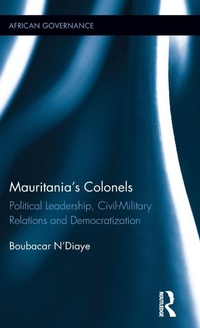
Mauritania's Colonels
Political Leadership, Civil-Military Relations and Democratization
1st Edition
Published on 8. August 2017
Book
Hardback
140 pages
978-1-138-05948-1 (ISBN)
Description
This book, the result of more than a decade of research, focuses on the socio-political dynamics and civil-military relations in a little studied country: Mauritania, located in the troubled North-western part of Africa. Boubacar N'Diaye brings into light the political evolution of this country which holds lessons for African politics, and could affect the future of the West African sub-region.
Mauritania's Colonels examines the personalities and policy of five military officers turned heads of state who ruled Mauritania for nearly forty years. After comparing and contrasting the personal traits, social origins, itineraries, and evolution as military officers, it critically evaluates the policies they enacted to address four key challenges their country faces. These are, namely, the difficult cohabitation between the country's ethno-cultural communities, the illusive democratization and military withdrawal from politics, the judicious management of the country's abundant natural resources to meet the socioeconomic needs of their people, and the prudent conduct of foreign policy given Mauritania's location, straddling Arab North Africa and Sub-Saharan Africa.
Showing the impact that each Colonel has had on the evolution of Mauritania, this book will be of interest to students and scholars of West Africa, African politics, civil-military relations and democratization processes.
Mauritania's Colonels examines the personalities and policy of five military officers turned heads of state who ruled Mauritania for nearly forty years. After comparing and contrasting the personal traits, social origins, itineraries, and evolution as military officers, it critically evaluates the policies they enacted to address four key challenges their country faces. These are, namely, the difficult cohabitation between the country's ethno-cultural communities, the illusive democratization and military withdrawal from politics, the judicious management of the country's abundant natural resources to meet the socioeconomic needs of their people, and the prudent conduct of foreign policy given Mauritania's location, straddling Arab North Africa and Sub-Saharan Africa.
Showing the impact that each Colonel has had on the evolution of Mauritania, this book will be of interest to students and scholars of West Africa, African politics, civil-military relations and democratization processes.
More details
Series
Language
English
Place of publication
London
United Kingdom
Publishing group
Taylor & Francis Ltd
Target group
College/higher education
Dimensions
Height: 222 mm
Width: 145 mm
Thickness: 12 mm
Weight
334 gr
ISBN-13
978-1-138-05948-1 (9781138059481)
Copyright in bibliographic data and cover images is held by Nielsen Book Services Limited or by the publishers or by their respective licensors: all rights reserved.
Schweitzer Classification
Other editions
Additional editions
Boubacar N'Diaye
Mauritania's Colonels
Political Leadership, Civil-Military Relations and Democratization
Book
03/2020
1st Edition
Routledge
€67.50
Shipment within 15-20 days
Boubacar N'Diaye
Mauritania's Colonels
Political Leadership, Civil-Military Relations and Democratization
E-Book
08/2017
Routledge
€61.99
Available for download
Boubacar N'Diaye
Mauritania's Colonels
Political Leadership, Civil-Military Relations and Democratization
E-Book
08/2017
Routledge
€61.99
Available for download
Person
Boubacar N'Diaye is a professor of Africana Studies and Political Science at The College of Wooster, USA.
Content
Introduction
Theoretical and Methodological Considerations
Mauritania's Colonels: A Portrayal
Unworkable Co-Habitation: The 'National Question'
Democratization and Military Withdrawal
The Challenge of Socioeconomic Development
The Colonels' Foreign Policy: An Extension of the 'National Question'?
Conclusions
Theoretical and Methodological Considerations
Mauritania's Colonels: A Portrayal
Unworkable Co-Habitation: The 'National Question'
Democratization and Military Withdrawal
The Challenge of Socioeconomic Development
The Colonels' Foreign Policy: An Extension of the 'National Question'?
Conclusions