

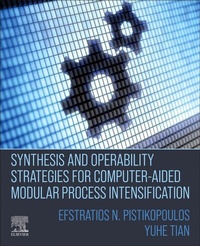
Synthesis and Operability Strategies for Computer-Aided Modular Process Intensification
Published on 7. April 2022
Book
Paperback/Softback
336 pages
978-0-323-85587-7 (ISBN)
Description
Synthesis and Operability Strategies for Computer-Aided Modular Process intensification presents state-of-the-art methodological developments and real-world applications for computer-aided process modeling, optimization and control, with a particular interest on process intensification systems. Each chapter consists of basic principles, model formulation, solution algorithm, and step-by-step implementation guidance on key procedures. Sections cover an overview on the current status of process intensification technologies, including challenges and opportunities, detail process synthesis, design and optimization, the operation of intensified processes under uncertainty, and the integration of design, operability and control.
Advanced operability analysis, inherent safety analysis, and model-based control strategies developed in the community of process systems engineering are also introduced to assess process operational performance at the early design stage.
Advanced operability analysis, inherent safety analysis, and model-based control strategies developed in the community of process systems engineering are also introduced to assess process operational performance at the early design stage.
More details
Language
English
Place of publication
Philadelphia
United States
Target group
Professional and scholarly
Dimensions
Height: 235 mm
Width: 191 mm
Weight
700 gr
ISBN-13
978-0-323-85587-7 (9780323855877)
Copyright in bibliographic data and cover images is held by Nielsen Book Services Limited or by the publishers or by their respective licensors: all rights reserved.
Schweitzer Classification
Other editions
Additional editions
Efstratios N Pistikopoulos | Yuhe Tian
Synthesis and Operability Strategies for Computer-Aided Modular Process Intensification
E-Book
04/2022
Elsevier
€170.00
Available for download
Persons
Efstratios N. Pistikopoulos is a distinguished chemical engineer and academic leader, currently serving as Director of the Texas A&M Energy Institute and holding the Dow Chemical Chair Professorship in the Artie McFerrin Department of Chemical Engineering at Texas A&M University. He holds a PhD in Chemical Engineering from Carnegie Mellon University in the USA. He has been working at Shell Chemicals in Amsterdam. He has served as Professor of Chemical Engineering at Imperial College London, directing the Centre for Process Systems Engineering. His research focuses on process systems engineering, particularly multi-parametric programming, model predictive control, and integrated frameworks for designing, optimizing, and scheduling complex systems with applications in energy, manufacturing, and biomedical engineering.
Dr. Pistikopoulos is the lead developer of the PAROC framework and has authored hundreds of publications and several books. Professor Pistikopoulos is a Fellow of the Royal Academy of Engineering, IChemE, and AIChE, and has received numerous honors, including the AIChE Computing in Chemical Engineering Award, the IChemE Sargent Medal, and the Royal Academy of Engineering's MacRobert Award. He also serves as Editor-in-Chief of Computers & Chemical Engineering, underscoring his global leadership in advancing process systems engineering. Dr. Yuhe Tian is Assistant Professor in the Department of Chemical and Biomedical Engineering at West Virginia University. Prior to joining WVU, she received her Ph.D. degree in Chemical Engineering from Texas A&M University under the supervision of Prof. Efstratios N. Pistikopoulos (2016-2021). She holds Bachelor's degrees in Chemical Engineering and Applied Mathematics from Tsinghua University, China (2012-2016). Her research focuses on the development and application of multi-scale systems engineering tools for modular process intensification, clean energy innovation, systems integration, and sustainable supply chain optimization.
Dr. Pistikopoulos is the lead developer of the PAROC framework and has authored hundreds of publications and several books. Professor Pistikopoulos is a Fellow of the Royal Academy of Engineering, IChemE, and AIChE, and has received numerous honors, including the AIChE Computing in Chemical Engineering Award, the IChemE Sargent Medal, and the Royal Academy of Engineering's MacRobert Award. He also serves as Editor-in-Chief of Computers & Chemical Engineering, underscoring his global leadership in advancing process systems engineering. Dr. Yuhe Tian is Assistant Professor in the Department of Chemical and Biomedical Engineering at West Virginia University. Prior to joining WVU, she received her Ph.D. degree in Chemical Engineering from Texas A&M University under the supervision of Prof. Efstratios N. Pistikopoulos (2016-2021). She holds Bachelor's degrees in Chemical Engineering and Applied Mathematics from Tsinghua University, China (2012-2016). Her research focuses on the development and application of multi-scale systems engineering tools for modular process intensification, clean energy innovation, systems integration, and sustainable supply chain optimization.
Author
Texas A&M Energy Institute, Texas A&M University, College Station, Texas, United StatesArtie McFerrin Department of Chemical Engineering, Texas A&M University, College Station, Texas, United States
Department of Chemical and Biomedical Engineering, West Virginia University, Morgantown, West Virginia, United States
Content
1. Introduction to process intensification
2. Towards computer-aided process intensification
3. Phenomena-based synthesis for process intensification
4. Process synthesis, optimization and intensification
5. Process synthesis, intensification and heat integration
6. Material selection, process synthesis and intensification
7. Operability and control challenges in process intensification
8. Steady-state and dynamic flexibility analysis
9. Inherent safety analysis
10. Advanced model-based control
11. Synthesis and optimization of operable process intensification systems
12. Identification of performance limits for olefin metathesis reactive separation process
13. Synthesis of ethanol-water extractive separation systems with ionic liquid solvents selection
14. Process design and intensification of an industrial dividing wall column for methyl methacrylate separation
15. Steady-state synthesis and design of methyl tert-butyl ether production process with safety and operability considerations
16. Simultaneous design and control of a methyl tert-butyl ether reactive distillation system
17. A framework for synthesis of operable and intensified systems
2. Towards computer-aided process intensification
3. Phenomena-based synthesis for process intensification
4. Process synthesis, optimization and intensification
5. Process synthesis, intensification and heat integration
6. Material selection, process synthesis and intensification
7. Operability and control challenges in process intensification
8. Steady-state and dynamic flexibility analysis
9. Inherent safety analysis
10. Advanced model-based control
11. Synthesis and optimization of operable process intensification systems
12. Identification of performance limits for olefin metathesis reactive separation process
13. Synthesis of ethanol-water extractive separation systems with ionic liquid solvents selection
14. Process design and intensification of an industrial dividing wall column for methyl methacrylate separation
15. Steady-state synthesis and design of methyl tert-butyl ether production process with safety and operability considerations
16. Simultaneous design and control of a methyl tert-butyl ether reactive distillation system
17. A framework for synthesis of operable and intensified systems