

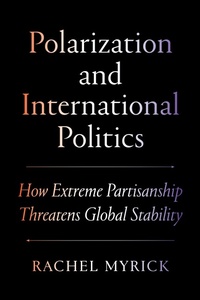
Polarization and International Politics
How Extreme Partisanship Threatens Global Stability
Published on 16. September 2025
Book
Paperback/Softback
376 pages
978-0-691-27462-1 (ISBN)
Description
How extreme polarization undermines the advantages that democracies have when formulating foreign policy
Polarization is a defining feature of politics in the United States and many other democracies. Yet although there is much research focusing on the effects of polarization on domestic politics, little is known about how polarization influences international cooperation and conflict. Democracies are thought to have advantages over nondemocratic nations in international relations, including the ability to keep foreign policy stable across time, credibly signal information to adversaries, and maintain commitments to allies. Does domestic polarization affect these "democratic advantages"? In this timely book, Rachel Myrick argues that polarization reshapes the nature of constraints on democratic leaders, which in turn erodes the advantages democracies have in foreign affairs.
Drawing on a range of evidence, including cross-national analyses, observational and experimental public opinion research, descriptive data on the behavior of politicians, and interviews with policymakers, Myrick develops metrics that explain the effect of extreme polarization on international politics and traces the pathways by which polarization undermines each of the democratic advantages. Turning to the case of contemporary US foreign policy, Myrick shows that as its political leaders become less responsive to the public and less accountable to political opposition, the United States loses both reliability as an ally and credibility as an adversary. Myrick's account links the effects of polarization on democratic governance to theories of international relations, integrating work across the fields of international relations, comparative politics, and American politics to explore how patterns of domestic polarization shape the international system.
Polarization is a defining feature of politics in the United States and many other democracies. Yet although there is much research focusing on the effects of polarization on domestic politics, little is known about how polarization influences international cooperation and conflict. Democracies are thought to have advantages over nondemocratic nations in international relations, including the ability to keep foreign policy stable across time, credibly signal information to adversaries, and maintain commitments to allies. Does domestic polarization affect these "democratic advantages"? In this timely book, Rachel Myrick argues that polarization reshapes the nature of constraints on democratic leaders, which in turn erodes the advantages democracies have in foreign affairs.
Drawing on a range of evidence, including cross-national analyses, observational and experimental public opinion research, descriptive data on the behavior of politicians, and interviews with policymakers, Myrick develops metrics that explain the effect of extreme polarization on international politics and traces the pathways by which polarization undermines each of the democratic advantages. Turning to the case of contemporary US foreign policy, Myrick shows that as its political leaders become less responsive to the public and less accountable to political opposition, the United States loses both reliability as an ally and credibility as an adversary. Myrick's account links the effects of polarization on democratic governance to theories of international relations, integrating work across the fields of international relations, comparative politics, and American politics to explore how patterns of domestic polarization shape the international system.
Reviews / Votes
"Winner of the Best Book Award, Conflict Processes Section of the American Political Science Association" "Myrick marshals an impressive array of empirical data to document patterns of extreme polarization within democracies and its impact on international relations. She makes clear that as long as deep divisions persist in the United States, the country's foreign policy will suffer."---G. John Ikenberry, Foreign Affairs "A timely, well-researched analysis of an increasingly problematic aspect of international politics. . . . Highly recommended." * Choice *More details
Series
Language
English
Place of publication
New Jersey
United States
Target group
College/higher education
Professional and scholarly
Product notice
Paperback (trade)
Illustrations
33 b/w illus. 20 tables.
Dimensions
Height: 232 mm
Width: 154 mm
Thickness: 24 mm
Weight
564 gr
ISBN-13
978-0-691-27462-1 (9780691274621)
Copyright in bibliographic data and cover images is held by Nielsen Book Services Limited or by the publishers or by their respective licensors: all rights reserved.
Schweitzer Classification
Other editions
Additional editions
Rachel Myrick
Polarization and International Politics
How Extreme Partisanship Threatens Global Stability
E-Book
09/2025
1st Edition
Princeton University Press
€34.49
Available for download
Person
Rachel Myrick is the Douglas and Ellen Lowey Assistant Professor of Political Science at Duke University.