

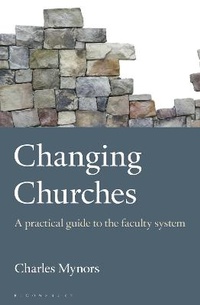
Changing Churches
A practical guide to the faculty system
Published on 2. June 2016
Book
Paperback/Softback
464 pages
978-1-4411-5643-3 (ISBN)
Description
This book de-mystifies the whole process of carrying out works to churches.
It explains what consents are needed; how they can be applied for; and on what basis applications are decided. The author explores many of the detailed issues that may arise in practice - whether the proposal is to move a shelf in the vestry or to embark on a major refurbishment of the whole church. Topics covered include heating, lighting, access for the less mobile, toilets, kitchens, security, storage, repairs and maintenance. The impact of change on the congregation is considered, as well as the particular problems that may arise where new facilities or new uses are introduced. This indispensable guide highlights issues to consider when contemplating changes and helps the reader to navigate the complex legal and practical processes involved in carrying out works to churches.
It explains what consents are needed; how they can be applied for; and on what basis applications are decided. The author explores many of the detailed issues that may arise in practice - whether the proposal is to move a shelf in the vestry or to embark on a major refurbishment of the whole church. Topics covered include heating, lighting, access for the less mobile, toilets, kitchens, security, storage, repairs and maintenance. The impact of change on the congregation is considered, as well as the particular problems that may arise where new facilities or new uses are introduced. This indispensable guide highlights issues to consider when contemplating changes and helps the reader to navigate the complex legal and practical processes involved in carrying out works to churches.
Reviews / Votes
Just occasionally it is possible to read a book and wish that it had been available before now. This is such a book. Charles Mynors offers us a thorough, well written and comprehensive survey of the functions of churches and the permissions needed to make them suitable for mission in the current age. This is a work which should find its way onto the easy reference shelves of everyone engaged in this task - clergy, churchwardens, architects, conservation bodies, members of diocesan advisory committees (DACs) and archdeacons. -- Norman Boakes, Archdeacons' National Executive Officer * Ecclesiastical Law Journal * What is a faculty? What is meant by the ecclesiastical exemption? ... This book unravels the mystery of these strange and perplexing words ... [It] is well-indexed and a good read from cover to cover, as well as an excellent practical reference book for clergy, churchwardens, and many others. David Walker's cartoons are a delightful addition, and remind us that a little humour does no harm as we struggle to change our churches within the constraints of the law. -- Sheila Cameron, QC, former Dean of the Arches * Church Times * Charles Mynors writes ... as among the most distinguished of ecclesiastical lawyers ... The book is certainly not just for his fellow lawyers but for anybody interested in how the law circumscribes but also stimulates carefully considered development. And it comes at a price considerably less than many equivalent textbooks. -- Matthew Saunders * Ancient Monuments Society Newsletter * The book provides a detailed exposition for all those involved at whatever level in the management of church buildings, and for others who have an interest in the processes which lead up to the granting of faculties authorising works to be carried out within churches. As well as providing practical guidance and good sense, there is a feeling of great sensitivity about the greater part of the book ...[Changing Churches] will undoubtedly become the standard work for practitioners and others in this important field -- John Cowdall, secretary of the historic churches committee of five RC dioceses * Context * Charles Mynors provides a user's guide to the process, which will be invaluable for those wanting to chop down a tree in the churchyard, place a new radiator in the vestry, or overhaul the entire edifice. The goal is "demystification", but for all the technical information, this book might, in its way, serve as a useful document of social history for future scholars. * Catholic Herald *More details
Language
English
Place of publication
London
United Kingdom
Publishing group
Bloomsbury Publishing PLC
Target group
Professional and scholarly
Product notice
Paperback (UK-trade)
Illustrations
No illustrations
Dimensions
Height: 234 mm
Width: 153 mm
Weight
702 gr
ISBN-13
978-1-4411-5643-3 (9781441156433)
DOI
CBID157710
Copyright in bibliographic data and cover images is held by Nielsen Book Services Limited or by the publishers or by their respective licensors: all rights reserved.
Schweitzer Classification
Other editions
Additional editions
E-Book
06/2016
1st Edition
Bloomsbury Academic USA
€44.49
Available for download
E-Book
06/2016
1st Edition
Continuum Publishing Corporation
€44.49
Available for download
Person
After studying architecture at university, Dr Charles Mynors worked as a town planner in local government and qualified as a chartered surveyor, before being called to the Bar. He has been Chancellor of the Diocese of Worcester for fifteen years, and is now on the Legal Advisory Commission of the General Synod. He has also been fund-raiser and project manager of an award-winning re-ordering scheme at his own church in London, where he is now a churchwarden.
He lectures widely; and his other books include Listed Buildings, Conservation Areas and Monuments (now in its fourth edition); The Law of Trees, Forests and Hedgerows (in its second edition) and The Control of Outdoor Advertising and Graffiti.
He lectures widely; and his other books include Listed Buildings, Conservation Areas and Monuments (now in its fourth edition); The Law of Trees, Forests and Hedgerows (in its second edition) and The Control of Outdoor Advertising and Graffiti.
Content
1. Introduction \ 1.1 Consecration of churches and churchyards \ 1.2 The church as a local centre of worship and mission \ 1.3 The churchyard \ 1.4 Financial and practical constraints \ 1.5 The management of change \ 1.6 Buildings of denominations other than the Church of England \ 2 The need for consent \ 2.1 General principles \ 2.2 Introduction \ 2.3 The need for a faculty \ 2.4 The administration of the faculty system \ 2.5 The need for permission from the local planning authority \ 2.6 Other permissions and consents \ 3 Seeking a faculty \ 3.1 General principles \ 3.2 Consulting the DAC \ 3.3 Consulting the amenity bodies and others \ 3.4 The faculty petition \ 3.5 Publication \ 3.6 Faculties involving partial demolition \ 3.7 Objections and representations\ 3.8 Fees and costs \ 4 The decision on a faculty petition \ 4.1 General principles \ 4.2 Decision by the Archdeacon \ 4.3 Decision by the Chancellor on written representations \ 4.4 Oral hearings: preliminary procedure \ 4.5 Procedure at a hearing \ 4.6 Decision of the Chancellor following a hearing \ 4.7 Appeals \ 5 The planning system and churches \ 5.1 General principles \ 5.2 Planning permission \ 5.3 Listed building consent \ 5.4 Conservation area consent \ 5.5 Scheduled monument consent \ 5.6 Control of advertisements consent \ 5.7 Works to trees \ 6 The existing features of a church \ 6.1 General principles \ 6.2 Understanding the potential of a church building \ 6.3 First impressions \ 6.4 The main worship area \ 6.5 The chancel \ 6.6 Heating and lighting \ 6.7 Balconies, upper floors, galleries \ 6.8 Fonts, lecterns and other furniture \ 6.9 Sound and music \ 6.10 Memorials and banners \ 6.11 Art works \ 6.12 Bells and bell frames \ 7 General issues \ 7.1 General principles \ 7.2 Toilets \ 7.3 Kitchens, catering, flowers \ 7.4 Space for administration, preparation \ 7.5 Furniture \ 7.6 Unwanted items \ 7.7 Storage \ 7.8 Security \ 7.9 Repairs \ 7.10 Cleaning; maintenance \ 7.11 Unconsecrated buildings and land \ 8 New facilities \ 8.1 General principles \ 8.2 Seating \ 8.3 Worship \ 8.4 Baptisms \ 8.5 Use by specific groups \ 8.6 Large gatherings \ 8.7 Miscellaneous items \ 9 New uses \ 9.1 General principles \ 9.2 Worship \ 9.3 Shared worship with other denominations / religions \ 9.4 Midweek use \ 9.5 Secular uses \ 9.6 Leases and licences \ 10 Works affecting the exterior of the church \ 10.1 General principles \ 10.2 Repairs \ 10.3 Alterations \ 10.4 Extensions \ 10.5 Floodlighting \ 11 Reordering \ 11.1 General principles \ 11.2 Uses \ 11.3 Worship \ 11.4 Overall impression \ 11.5 Seating \ 11.6 Lighting \ 11.7 Heating, cooling \ 11.8 Sound system \ 11.9 Facilities for the young \ 11.10 Staff accommodation \ 11.11 Miscellaneous points \ 12 Burial and exhumation \ 12.1 General principles \ 12.2 Burial rights \ 12.3 Introduction of new monuments \ 12.4 Cremated remains \ 12.5 Exhumation \ 12.6 Re-use of burial spaces \ 13 Other works affecting the churchyard \ 13.1 General principles \ 13.2 Paths and car parks \ 13.3 Trees and bushes \ 13.4 Re-ordering of churchyards \ 13.5 Secular uses, wayleaves, leases and licences \ 13.6 Closed churchyards \ 13.7 Boundaries, walls and railings \ 13.8 Deterring unauthorised activity \ 14 Unauthorised works \ 14.1 General principles \ 14.2 Enforcement by the consistory court \ 14.3 Enforcement by the local planning authority \ 15 Redundancy \ 15.1 General principles \ 15.2 Redundancy \ 15.3 Total demolition \ 16 Cathedrals and ecclesiastical peculiars \ 16.1 Cathedrals \ 16.2 Ecclesiastical peculiars \ 17 Special cases \ 17.1 The Channel Islands \ 17.2 The Isle of Man \ 17.3 The Diocese in Europe \ 17.4 Wales \ Appendices \ A. Categories of works not requiring a faculty \ B. Conditions on faculties \ C. Guidelines for monuments in churchyards \ D. Instrument delegating authority to incumbent \ E. Other sources of information \ Table of references \ Statutes and statutory instruments \ Cases \ Index