

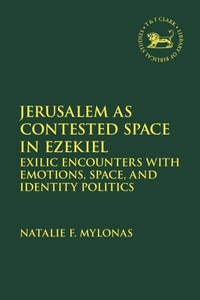
Jerusalem as Contested Space in Ezekiel
Exilic Encounters with Emotions, Space, and Identity Politics
Published on 15. June 2023
Book
Hardback
206 pages
978-0-567-70642-3 (ISBN)
Description
Natalie Mylonas uses Ezekiel 16 as a case study in order to reveal the critical relationship between space, emotion, and identity politics in the Hebrew Bible. Drawing on interdisciplinary research that emphasises how space and emotions are inextricably linked in human experience, Mylonas explores the portrayal of Yhwh's wife, Jerusalem, in Ezekiel 16 as a personified city who feels emotion. She foregrounds purity and gender issues, as well as debates on emotions in the Hebrew Bible, emphasising that spatiality is a key component of how these issues are conceptualised in ancient Israel.
This book argues that the power struggle between Jerusalem and Yhwh in Ezekiel 16 is a struggle over the contested space of Jerusalem's body and the city space. Jerusalem's emotions are in a dynamic relationship with the spaces in the text - they are signified by these spaces, shift as the constitution of the spaces shifts, and are shaped by Jerusalem's use of space. Her desire, pride, and shamelessness are communicated spatially through her use of city space, while her representation as disgusting is underscored by her "uncontrollable" female body.
Mylonas concludes by showing how Ezekiel's vision of the new Jerusalem in Ezekiel 40-48 re-establishes sacred space through the erasure of the feminine city metaphor coupled with strict boundary policing, which is a far cry from the assault on Jerusalem's boundaries described in Ezekiel 16.
This book argues that the power struggle between Jerusalem and Yhwh in Ezekiel 16 is a struggle over the contested space of Jerusalem's body and the city space. Jerusalem's emotions are in a dynamic relationship with the spaces in the text - they are signified by these spaces, shift as the constitution of the spaces shifts, and are shaped by Jerusalem's use of space. Her desire, pride, and shamelessness are communicated spatially through her use of city space, while her representation as disgusting is underscored by her "uncontrollable" female body.
Mylonas concludes by showing how Ezekiel's vision of the new Jerusalem in Ezekiel 40-48 re-establishes sacred space through the erasure of the feminine city metaphor coupled with strict boundary policing, which is a far cry from the assault on Jerusalem's boundaries described in Ezekiel 16.
More details
Series
Language
English
Place of publication
Edinburgh
United Kingdom
Publishing group
Bloomsbury Publishing PLC
Target group
Professional and scholarly
Dimensions
Height: 240 mm
Width: 161 mm
Thickness: 16 mm
Weight
479 gr
ISBN-13
978-0-567-70642-3 (9780567706423)
Copyright in bibliographic data and cover images is held by Nielsen Book Services Limited or by the publishers or by their respective licensors: all rights reserved.
Schweitzer Classification
Other editions
Additional editions
Natalie Mylonas
Jerusalem as Contested Space in Ezekiel
Exilic Encounters with Emotions, Space, and Identity Politics
E-Book
05/2023
1st Edition
T.& T.Clark Ltd
€31.99
Available for download
Person
Natalie Mylonas is Sessional Academic at the Australian Catholic University and Honorary Researcher at Macquarie University, Australia. She is Fellow of the Higher Education Academy and a member of the Macquarie University node of the Australian Research Council Centre of Excellence for the History of Emotions.
Content
Preface
Acknowledgments
Abbreviations
1. Ezekiel, Displacement, and Trauma
2. Approaching Emotions
3. The Inextricable Link Between Emotions, Spatiality and Gender
4. Abandoned in an Open Field
5. Clean and Unclean, Sacred and Profane: The Spatiality of Holiness in Ezekiel
6. Jerusalem's Changing Body: From Infant to Reproductive Female
7. Jerusalem's Transformation of City Space
8. The Destruction of Jerusalem's Spaces and Body
9. Sacred Space Re-established: Boundary Policing and the Disappearance of the Feminine
Conclusion
Bibliography
Index
Acknowledgments
Abbreviations
1. Ezekiel, Displacement, and Trauma
2. Approaching Emotions
3. The Inextricable Link Between Emotions, Spatiality and Gender
4. Abandoned in an Open Field
5. Clean and Unclean, Sacred and Profane: The Spatiality of Holiness in Ezekiel
6. Jerusalem's Changing Body: From Infant to Reproductive Female
7. Jerusalem's Transformation of City Space
8. The Destruction of Jerusalem's Spaces and Body
9. Sacred Space Re-established: Boundary Policing and the Disappearance of the Feminine
Conclusion
Bibliography
Index