

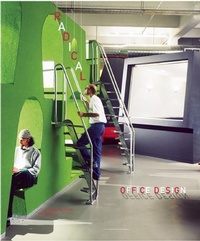
Radical Office Design
Published on 21. September 2006
Book
Hardback
192 pages
978-0-7892-0886-6 (ISBN)
Description
Traditional office work, characterized by repetitive clerical tasks, is rapidly giving way to "knowledge work," characterized by the creative application and exchange of information. In response, architects around the world are leaving aside the old cubicle grid to design innovative, high-tech offices that foster knowledge work and, at the same time, help workers balance the competing demands of colleagues, customers, and family. The forty-three exceptional workplaces profiled in this timely volume were all completed within the last six years and serve a wide variety of organizations both private and public, small and large. Examples range from the headquarters of an advertising firm where one enormous table seats all two hundred employees, facilitating communication, to a BMW plant where the factory production line runs through and above the administrative offices, unifying the corporate community.
The authors skillfully distinguish the primary trends in contemporary office design by dividing their engagingly written case studies among four chapters, each dedicated to a particular type of workplace: "Academics" encourage the sharing of knowledge within a corporate structure; "Guilds" allow the members of a profession to interact as peers; "Agoras" bring the workplace closer to the marketplace, and to civic life; and "Lodges" combine the home and the office. Two hundred vivid color photographs and fifty architectural drawings show how the featured architects have configured public areas, meeting rooms, and private work spaces to meet the needs of today's increasingly versatile and mobile workers. The inclusion of an informative introduction, which outlines the economic and technological factors driving the rapid evolution of contemporary workplace architecture, further ensures that this attractive book will be an essential reference for everybody who has a hand in designing offices, and thought-provoking reading for everybody who works in one.
The authors skillfully distinguish the primary trends in contemporary office design by dividing their engagingly written case studies among four chapters, each dedicated to a particular type of workplace: "Academics" encourage the sharing of knowledge within a corporate structure; "Guilds" allow the members of a profession to interact as peers; "Agoras" bring the workplace closer to the marketplace, and to civic life; and "Lodges" combine the home and the office. Two hundred vivid color photographs and fifty architectural drawings show how the featured architects have configured public areas, meeting rooms, and private work spaces to meet the needs of today's increasingly versatile and mobile workers. The inclusion of an informative introduction, which outlines the economic and technological factors driving the rapid evolution of contemporary workplace architecture, further ensures that this attractive book will be an essential reference for everybody who has a hand in designing offices, and thought-provoking reading for everybody who works in one.
More details
Language
English
Place of publication
New York
United States
Publishing group
Abbeville Press Inc.,U.S.
Product notice
Cloth over boards
Dimensions
Height: 286 mm
Width: 235 mm
Weight
1469 gr
ISBN-13
978-0-7892-0886-6 (9780789208866)
Copyright in bibliographic data and cover images is held by Nielsen Book Services Limited or by the publishers or by their respective licensors: all rights reserved.
Schweitzer Classification
Persons
JEREMY MYERSON is a professor of design studies and the director of InnovationRCA at the Royal College of Art, London. He is a former editor of Design Week and World Architecture PHILIP ROSS is a commentator, writer, and consultant on technology in the workplace. His previous publications include The Cordless Office and, with Jeremy Myerson, The Creative Office and The 21st Century Office.
Content
Introduction page 8 Academy: the learning campus 14 Guild: the professional cluster 74 Agora: the public workplace 114 Lodge: the live-work setting 156 Credits page 185 Index page 191