

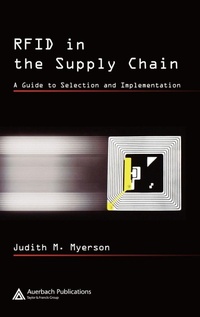
RFID in the Supply Chain
A Guide to Selection and Implementation
1st Edition
Published on 20. November 2006
Book
Hardback
456 pages
978-0-8493-3018-6 (ISBN)
Description
Giving organizations the ability to track, secure, and manage items from the time they are raw materials through the life-cycle of the product, radio frequency identification (RFID) makes internal processes more efficient and improves overall supply chain responsiveness. Helping you bring your organization into the future, RFID in the Supply Chain: A Guide to Selection and Implementation explains RFID technology, its applications in SCM, data storage and retrieval, business processes, operational and implementation problems, risks, security and privacy, facility layout, handling systems and methods, and transportation costs. In short, with its soup-to-nuts coverage, the book ensures that your RFID implementation is successful and that you get the most from your investment.
The book discusses the major paradigm shift in product traceability that began with transitioning to RFID technology from bar code technology. It examines the economic feasibility of rolling out RFID and the challenges in supply chain synchronization, customer privacy, security, operations and IT, logistics, program management, education and training, and implementation, as well as what lessons have been learned. The author addresses the RFID business processes needed to analyze and resolve problems the suppliers face when they deal with multiple customers, each with a different mandate, and with their own set of suppliers.
Going beyond the technology and how it has changed supply chain processes, the book includes selection guidelines and implementation examples, such as speed of tag reads versus quality of computer inputs and optimal tag location. The author discusses the implementation of a business process model and the separate but equal concerns that business and IT executives have about the implementation of RFID applications. The book also covers security, integrated control management linked to the corporate strategy, and laws and regulations.
The book discusses the major paradigm shift in product traceability that began with transitioning to RFID technology from bar code technology. It examines the economic feasibility of rolling out RFID and the challenges in supply chain synchronization, customer privacy, security, operations and IT, logistics, program management, education and training, and implementation, as well as what lessons have been learned. The author addresses the RFID business processes needed to analyze and resolve problems the suppliers face when they deal with multiple customers, each with a different mandate, and with their own set of suppliers.
Going beyond the technology and how it has changed supply chain processes, the book includes selection guidelines and implementation examples, such as speed of tag reads versus quality of computer inputs and optimal tag location. The author discusses the implementation of a business process model and the separate but equal concerns that business and IT executives have about the implementation of RFID applications. The book also covers security, integrated control management linked to the corporate strategy, and laws and regulations.
More details
Language
English
Place of publication
London
United Kingdom
Publishing group
Taylor & Francis Ltd
Target group
Professional and scholarly
Professional Practice & Development
Illustrations
22 s/w Abbildungen, 51 s/w Tabellen
51 Tables, black and white; 22 Illustrations, black and white
Dimensions
Height: 240 mm
Width: 161 mm
Thickness: 29 mm
Weight
840 gr
ISBN-13
978-0-8493-3018-6 (9780849330186)
Copyright in bibliographic data and cover images is held by Nielsen Book Services Limited or by the publishers or by their respective licensors: all rights reserved.
Schweitzer Classification
Other editions
Additional editions
E-Book
11/2006
Auerbach
€165.99
Available for download
E-Book
11/2006
Auerbach
€165.99
Available for download
Person
Judith M. Myerson
Content
Supply Chain Overview. Paradigm Shift in Product Traceability. RFID Markets. Economic Feasibility of Rolling out RFID. RFID Technology Infrastructure. Web-Centric Supply Chain Management challenges. RFID Technology. Primary Drivers. Selection Guideline on Tags, Servers and Middleware. RFID Implementation Examples. RFID applications in Supply Chain Management. Logistics. Management. Storing and retrieving data. Two Big Questions. EPC Technology in Functional Areas. Perceptions of Retail Product Benefits. Database CD on Local Workstation. Remote Database Servers. Databases in Company Merger Processes. Hybrid Databases. Web Services. RFID Business Processes. Implementation Approaches. Business Process Reengineering. Organizational Maturity. Basic Multi-Layer Business Process Model. Adaptive Multi-Layer Business Process Model. Predictive Multi-Layer Business Process Model. RFID Business Processes Strategies. RFID Enterprise Supply Chain Systems. RFID Business Process Life Cycle. RFID Security, Privacy and Risk Assessment. Security Policy. Security of RFID Query. Attacks on RFID Technology. Defense in Depth. Risk Assessment. Appendices.