

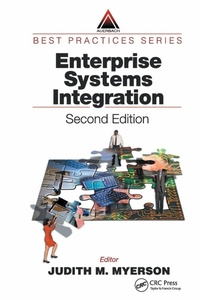
Enterprise Systems Integration
2nd Edition
Published on 7. October 2019
Book
Paperback/Softback
832 pages
978-0-367-39694-7 (ISBN)
Description
The convergence of knowledge, technology, and human performance which comprises today's enterprise allows creative business process design. Thus, an organization can create new and innovative ways to service customers or to do business with suppliers and make itself a leader in its field. This capability relies on a successful strategy that integrates the enterprise. Enterprise Systems Integration, Second Edition continues to provide you with the business insight and the technical know-how that ensures successful systems integration.
The book combines the perspectives, knowledge, and experience of more than 70 experts in the various areas that involve enterprise integration. Their expertise ranges from hands-on experience with technology and project management to the higher-level issues of business and management strategy. Each chapter examines an issue or technology relevant to today's enterprise. Collectively, these chapters span the range of enterprise computing and systems integration.
Once armed with the strategy and technologies, you must successfully deploy ERP systems within budget and on time. In addition, you must be able to integrate them into the rest of the enterprise. Still, ERP software does not make up the full picture of today's enterprise. Legacy systems, e-commerce and other Web-based systems, client/server applications, networks and communications systems, data warehousing, and integrated databases enter into the mix. Enterprise Systems Integration, Second Edition paints a comprehensive picture of the technologies that comprise today's enterprise and shows you how to make them work together.
The book combines the perspectives, knowledge, and experience of more than 70 experts in the various areas that involve enterprise integration. Their expertise ranges from hands-on experience with technology and project management to the higher-level issues of business and management strategy. Each chapter examines an issue or technology relevant to today's enterprise. Collectively, these chapters span the range of enterprise computing and systems integration.
Once armed with the strategy and technologies, you must successfully deploy ERP systems within budget and on time. In addition, you must be able to integrate them into the rest of the enterprise. Still, ERP software does not make up the full picture of today's enterprise. Legacy systems, e-commerce and other Web-based systems, client/server applications, networks and communications systems, data warehousing, and integrated databases enter into the mix. Enterprise Systems Integration, Second Edition paints a comprehensive picture of the technologies that comprise today's enterprise and shows you how to make them work together.
More details
Edition
2nd edition
Language
English
Place of publication
London
United Kingdom
Publishing group
Taylor & Francis Ltd
Target group
College/higher education
Professional and scholarly
Professional Practice & Development
Dimensions
Height: 234 mm
Width: 156 mm
Thickness: 44 mm
Weight
1238 gr
ISBN-13
978-0-367-39694-7 (9780367396947)
Copyright in bibliographic data and cover images is held by Nielsen Book Services Limited or by the publishers or by their respective licensors: all rights reserved.
Schweitzer Classification
Other editions
Additional editions
Judith M. Myerson
Enterprise Systems Integration
Book
09/2001
2nd Edition
Auerbach
€210.50
Shipment within 15-20 days
Judith M. Myerson
Enterprise Systems Integration
E-Book
09/2001
2nd Edition
Auerbach
€81.99
Available for download
Judith M. Myerson
Enterprise Systems Integration
E-Book
09/2001
2nd Edition
Auerbach
€81.99
Available for download
Person
Myerson, Judith M.
Content
Integration Drivers. Enterprise Architectures. Enabling Technologies. Enabling Technologies. Component-Based Development. Database Servers in an Integrated Environment. Database Servers in an Integrated Environment. Data Warehousing. Enterprise Resource Planning. Enterprise Networking. Enterprise Messaging. Internet Commerce. Project and Systems Management.