

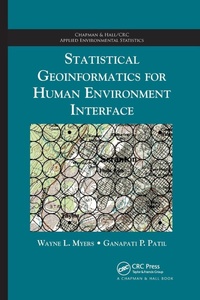
Statistical Geoinformatics for Human Environment Interface
1st Edition
Published on 10. September 2018
Book
Paperback/Softback
223 pages
978-1-138-37272-6 (ISBN)
Description
Statistical Geoinformatics for Human Environment Interface presents two paradigms for studying both space and interface with regard to human/environment: localization and multiple indicators.
The first approach localizes thematic targets by treating space as a pattern of vicinities, with the pattern being a square grid and the placement of vicinities centrically referenced. The second approach explores human/environment interface as an abstraction through indicators, neutralizing the common conundrum of how to reconcile disparate spatial structures such as points, lines, and polygons. These paired paradigms enable:
The capacity to cope with complexity
Systematic surveillance
Visualization and communication
Preliminary prioritization
Coupling of GIS and statistical software
Avenues for automation
Illustrating the interdisciplinary nature of geoinformatics, this book offers a novel approach to the spatial analysis of human influences and environmental resources. It includes practical strategies for statistical and spatial analysis.
The first approach localizes thematic targets by treating space as a pattern of vicinities, with the pattern being a square grid and the placement of vicinities centrically referenced. The second approach explores human/environment interface as an abstraction through indicators, neutralizing the common conundrum of how to reconcile disparate spatial structures such as points, lines, and polygons. These paired paradigms enable:
The capacity to cope with complexity
Systematic surveillance
Visualization and communication
Preliminary prioritization
Coupling of GIS and statistical software
Avenues for automation
Illustrating the interdisciplinary nature of geoinformatics, this book offers a novel approach to the spatial analysis of human influences and environmental resources. It includes practical strategies for statistical and spatial analysis.
Reviews / Votes
"... a refreshingly different approach to geospatial analysis, which has the potential to unify the disparate worlds of raster and vector GIS and to provide an integrated treatment of space and time. Readers accustomed to more traditional approaches to geoinformatics may find the book particularly thought provoking."-Sally E. Goldin, Photogrammetric Engineering and Remote Sensing, December 2013
More details
Series
Language
English
Place of publication
London
United Kingdom
Publishing group
Taylor & Francis Ltd
Target group
Professional and scholarly
Professional
Illustrations
19 s/w Tabellen, 148 s/w Abbildungen
19 Tables, black and white; 148 Illustrations, black and white
Dimensions
Height: 234 mm
Width: 156 mm
Thickness: 12 mm
Weight
354 gr
ISBN-13
978-1-138-37272-6 (9781138372726)
Copyright in bibliographic data and cover images is held by Nielsen Book Services Limited or by the publishers or by their respective licensors: all rights reserved.
Schweitzer Classification
Other editions
Additional editions
Wayne L. Myers | Ganapati P. Patil
Statistical Geoinformatics for Human Environment Interface
E-Book
07/2012
1st Edition
Chapman & Hall/CRC
€89.49
Available for download
Wayne L. Myers | Ganapati P. Patil
Statistical Geoinformatics for Human Environment Interface
Book
07/2012
1st Edition
Chapman & Hall/CRC
€136.66
Article not available at the moment
Wayne L. Myers | Ganapati P. Patil
Statistical Geoinformatics for Human Environment Interface
E-Book
07/2012
Chapman and Hall
€89.99
Available for download
Persons
Wayne L. Myers is Professor Emeritus of Forest Biometrics at the Pennsylvania State University. He is a Certified Forester of the Society of American Foresters, an Emeritus Member of the American Society of Photogrammetry and Remote Sensing, and a 40-year member of the American Statistical Association. Dr. Myers specializes in landscape analysis using GIS and remote sensing in conjunction with multivariate approaches to analysis and prioritization.
Ganapati P. Patil is Director of the Center for Statistical Ecology and Environmental Statistics and Distinguished Professor Emeritus of Mathematical and Environmental Statistics at the Pennsylvania State University. He is a fellow of the American Statistical Association, American Association of Advancement of Science, Institute of Mathematical Statistics, International Statistical Institute, Royal Statistical Society, International Association for Ecology, International Indian Statistical Association, Indian National Institute of Ecology, and Indian Society for Medical Statistics. Dr. Patil has served on panels for numerous international organizations, including the United Nations Environment Programme, U.S. National Science Foundation, U.S. Environmental Protection Agency, U.S. Forest Service, and U.S. National Marine Fisheries Service. He has authored/coauthored more than 300 research papers and more than 30 cross-disciplinary volumes.
Ganapati P. Patil is Director of the Center for Statistical Ecology and Environmental Statistics and Distinguished Professor Emeritus of Mathematical and Environmental Statistics at the Pennsylvania State University. He is a fellow of the American Statistical Association, American Association of Advancement of Science, Institute of Mathematical Statistics, International Statistical Institute, Royal Statistical Society, International Association for Ecology, International Indian Statistical Association, Indian National Institute of Ecology, and Indian Society for Medical Statistics. Dr. Patil has served on panels for numerous international organizations, including the United Nations Environment Programme, U.S. National Science Foundation, U.S. Environmental Protection Agency, U.S. Forest Service, and U.S. National Marine Fisheries Service. He has authored/coauthored more than 300 research papers and more than 30 cross-disciplinary volumes.
Content
Statistical Geoinformatics of Human Linkage with Environment. Localizing Fixed-Form Features. Precedence and Patterns of Propensity. Raster-Referenced Cellular Codings and Map Modeling. Similar Settings as Clustered Components. Intensity Images and Map Multimodels. High Spots, Hot Spots, and Scan Statistics. Shape, Support, and Partial Polygons. Semisynchronous Signals and Variant Vicinities. Auto-Association: Local Likeness and Distance Decline. Regression Relations for Spatial Stations. Spatial Stations as Surface Samples. Shifting Spatial Structure. Synthesis and Synopsis with Allegheny Application. Index.