

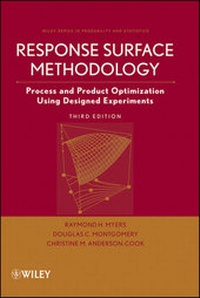
Response Surface Methodology
Process and Product Optimization Using Designed Experiments
3rd Edition
Published on 27. January 2009
Book
Hardback
704 pages
978-0-470-17446-3 (ISBN)
Description
Praise for the Second Edition:
"This book [is for] anyone who would like a good, solid understanding of response surface methodology. The book is easy to read, easy to understand, and very applicable. The examples are excellent and facilitate learning of the concepts and methods."
-Journal of Quality Technology
Complete with updates that capture the important advances in the field of experimental design, Response Surface Methodology, Third Edition successfully provides a basic foundation for understanding and implementing response surface methodology (RSM) in modern applications. The book continues to outline the essential statistical experimental design fundamentals, regression modeling techniques, and elementary optimization methods that are needed to fit a response surface model from experimental data. With its wealth of new examples and use of the most up-to-date software packages, this book serves as a complete and modern introduction to RSM and its uses across scientific and industrial research.
This new edition maintains its accessible approach to RSM, with coverage of classical and modern response surface designs. Numerous new developments in RSM are also treated in full, including optimal designs for RSM, robust design, methods for design evaluation, and experiments with restrictions on randomization as well as the expanded integration of these concepts into computer software. Additional features of the Third Edition include:
* Inclusion of split-plot designs in discussion of two-level factorial designs, two-level fractional factorial designs, steepest ascent, and second-order models
* A new section on the Hoke design for second-order response surfaces
* New material on experiments with computer models
* Updated optimization techniques useful in RSM, including multiple responses
* Thorough treatment of presented examples and experiments using JMP(r) 7, Design-Expert(r) Version 7, and SAS(r) software packages
* Revised and new exercises at the end of each chapter
* An extensive references section, directing the reader to the most current RSM research
Assuming only a fundamental background in statistical models and matrix algebra, Response Surface Methodology, Third Edition is an ideal book for statistics, engineering, and physical sciences courses at the upper-undergraduate and graduate levels. It is also a valuable reference for applied statisticians and practicing engineers.
"This book [is for] anyone who would like a good, solid understanding of response surface methodology. The book is easy to read, easy to understand, and very applicable. The examples are excellent and facilitate learning of the concepts and methods."
-Journal of Quality Technology
Complete with updates that capture the important advances in the field of experimental design, Response Surface Methodology, Third Edition successfully provides a basic foundation for understanding and implementing response surface methodology (RSM) in modern applications. The book continues to outline the essential statistical experimental design fundamentals, regression modeling techniques, and elementary optimization methods that are needed to fit a response surface model from experimental data. With its wealth of new examples and use of the most up-to-date software packages, this book serves as a complete and modern introduction to RSM and its uses across scientific and industrial research.
This new edition maintains its accessible approach to RSM, with coverage of classical and modern response surface designs. Numerous new developments in RSM are also treated in full, including optimal designs for RSM, robust design, methods for design evaluation, and experiments with restrictions on randomization as well as the expanded integration of these concepts into computer software. Additional features of the Third Edition include:
* Inclusion of split-plot designs in discussion of two-level factorial designs, two-level fractional factorial designs, steepest ascent, and second-order models
* A new section on the Hoke design for second-order response surfaces
* New material on experiments with computer models
* Updated optimization techniques useful in RSM, including multiple responses
* Thorough treatment of presented examples and experiments using JMP(r) 7, Design-Expert(r) Version 7, and SAS(r) software packages
* Revised and new exercises at the end of each chapter
* An extensive references section, directing the reader to the most current RSM research
Assuming only a fundamental background in statistical models and matrix algebra, Response Surface Methodology, Third Edition is an ideal book for statistics, engineering, and physical sciences courses at the upper-undergraduate and graduate levels. It is also a valuable reference for applied statisticians and practicing engineers.
Reviews / Votes
"This new third edition has been substantially rewritten and updated with new topics and material, new examples and exercises, and to more fully illustrate modern applications of RSM.Working with the most useful software packages, the authors bring an applied focus that emphasizes models useful in industry for product and process design and development." ( Zentralblatt Math , 1 October 2013) "The third edition of a well-regarded text on response surface methodology. Christine M. Anderson-Cook, has been added ... [bringing] an applied perspective to the material." ( Mathematical Reviews , December 2009)More details
Series
Edition
3. Auflage
Language
English
Place of publication
Hoboken
United Kingdom
Publishing group
John Wiley and Sons Ltd
Target group
Professional and scholarly
Edition type
Revised edition
Illustrations
Illustrations
Dimensions
Height: 25.5 cm
Width: 18.5 cm
Thickness: 3.9 cm
Weight
1309 gr
ISBN-13
978-0-470-17446-3 (9780470174463)
Schweitzer Classification
Other editions
New editions
Raymond H. Myers | Douglas C. Montgomery | Christine M. Anderson-Cook
Response Surface Methodology
Process and Product Optimization Using Designed Experiments
Book
03/2016
4th Edition
Wiley
€188.60
Shipment within 15-20 days
Previous edition

Raymond H. Myers | Douglas C. Montgomery
Response Surface Methodology
Process and Product Optimization Using Designed Experiments
Book
02/2002
2nd Edition
Wiley
€119.00
Article exhausted; check for reprint
Persons
Raymond H. Myers, PhD, is Professor Emeritus in the Department of Statistics at Virginia Polytechnic Institute and State University. He has over forty years of academic experience in the areas of experimental design and analysis, response surface analysis, and designs for nonlinear models. A Fellow of the American Statistical Society, Dr. Myers has authored or coauthored numerous journal articles and books, including Generalized Linear Models: With Applications in Engineering and the Sciences, also published by Wiley.
Douglas C. Montgomery, PhD, is Regents' Professor of Industrial Engineering and Statistics at Arizona State University. Dr. Montgomery has over thirty years of academic and consulting experience and has devoted his research to engineering statistics, specifically the design and analysis of experiments. He has authored or coauthored numerous journal articles and twelve books, including Generalized Linear Models: With Applications in Engineering and the Sciences; Introduction to Linear Regression Analysis, Fourth Edition; and Introduction to Time Series Analysis and Forecasting, all published by Wiley.
Christine M. Anderson-Cook, PhD, is Project Leader a t the Los Alamos National Laboratory, New Mexico. Dr. Anderson-Cook has over ten years of academic and consulting experience and has written numerous journal articles on the topics of design of experiments and response surface methodology.
Douglas C. Montgomery, PhD, is Regents' Professor of Industrial Engineering and Statistics at Arizona State University. Dr. Montgomery has over thirty years of academic and consulting experience and has devoted his research to engineering statistics, specifically the design and analysis of experiments. He has authored or coauthored numerous journal articles and twelve books, including Generalized Linear Models: With Applications in Engineering and the Sciences; Introduction to Linear Regression Analysis, Fourth Edition; and Introduction to Time Series Analysis and Forecasting, all published by Wiley.
Christine M. Anderson-Cook, PhD, is Project Leader a t the Los Alamos National Laboratory, New Mexico. Dr. Anderson-Cook has over ten years of academic and consulting experience and has written numerous journal articles on the topics of design of experiments and response surface methodology.
Content
Preface.
1. Introduction.
1.1 Response Surface Methodology.
1.2 Product Design and Formulation (Mixture Problems).
1.3 Robust Design and Process Robustness Studies.
1.4 Useful References on RSM.
2. Building Empirical Models.
2.1 Linear Regression Models.
2.2 Estimation of the Parameters in Linear Regression Models.
2.3 Properties of the Least Squares Estimators and Estimation of.
2.4 Hypothesis Testing in Multiple Regression.
2.5 Confidence Intervals in Multiple Regression.
2.6 Prediction of New Response Observations.
2.7 Model Adequacy Checking.
2.8 Fitting a Second-Order Model.
2.9 Qualitative Regressor Variables.
2.10 Transformation of the Response Variable.
Exercises.
3. Two-Level Factorial Designs.
3.1 Introduction.
3.2 The Design.
3.3 The Design, 1.
3.4 The General Design.
3.5 A Single Replicate of the Design.
3.6 The Addition of Center Points to the Design.
3.7 Blocking in the Factorial Design.
3.8 Split-Plot Designs,.
Exercises.
4. Two-Level Fractional Factorial Designs.
4.1 Introduction.
4.2 The One-Half Fraction of the Design.
4.3 The One-Quarter Fraction of the Design.
4.4 The General Fractional Factorial Design.
4.5 Resolution III Designs.
4.6 Resolution IV and V Designs.
4.7 Fractional Factorial Split-Plot Designs.
4.8 Summary.
Exercises.
5. Process Improvement with Steepest Ascent.
5.1 Determining the Path of Steepest Ascent.
5.2 Consideration of Interaction and Curvature,.
5.3 Effect of Scale (Choosing Range of Factors).
5.4 Confidence Region for Direction of Steepest Ascent.
5.5 Steepest Ascent Subject to a Linear Constraint.
5.6 Steepest Ascent in a Split-Plot Experiment.
Exercises.
6. The Analysis of Second-Order Response Surfaces.
6.1 Second-Order Response Surface.
6.2 Second-Order Approximating Function.
6.3 A Formal Analytical Approach to the Second-Order Model.
6.4 Ridge Analysis of the Response Surface.
6.5 Sampling Properties of Response Surface Results.
6.6 Multiple Response Optimization.
6.7 Further Comments Concerning Response Surface Analysis.
Exercises.
7. Experimental Designs for Fitting Response Surfaces--I.
7.1 Desirable Properties of Response Surface Designs.
7.2 Operability Region, Region of Interest, and Model Inadequacy.
7.3 Design of Experiments for First-Order Models.
7.4 Designs for Fitting Second-Order Models.
Exercises.
8. Experimental Designs for Fitting Response Surfaces--II.
8.1 Designs That Require a Relatively Small Run Size.
8.2 General Criteria for Constructing, Evaluating, and Comparing Experimental Designs.
8.3 Computer-Generated Designs in RSM.
8.4 Some Final Comments Concerning Design Optimality and Computer-Generated Design.
Exercises.
9. Advanced Topics in Response Surface Methodology.
9.1 Effects of Model Bias on the Fitted Model and Design.
9.2 A Design Criterion Involving Bias and Variance.
9.3 Errors in Control of Design Levels.
9.4 Experiments with Computer Models.
9.5 Minimum Bias Estimation of Response Surface Models.
9.6 Neural Networks,.
9.7 RSM for Nonnormal Responses - Generalized Linear Models.
9.8 Split-Plot Designs for Second-Order Models.
Exercises.
10. Robust Parameter Design and Process Robustness Studies.
10.1 Introduction.
10.2 What Is Parameter Design?.
10.3 The Taguchi Approach.
10.4 The Response Surface Approach.
10.5 Experimental Designs for RPD and Process Robustness Studies.
10.6 Dispersion Effects in Highly Fractionated Designs.
Exercises.
11. Experiments with Mixtures.
11.1 Introduction.
11.2 Simplex Designs and Canonical Mixture Polynomials,.
11.3 Response Trace Plots.
11.4 Reparameterizing Canonical Mixture Models to Contain a Constant Term,.
Exercises.
12. Other Mixture Design and Analysis Techniques.
12.1 Constraints on the Component Proportions.
12.2 Mixture Experiments Using Ratios of Components.
12.3 Process Variables in Mixture Experiments.
12.4 Screening Mixture Components.
Exercises.
References.
Appendix 1. Moment Matrix of a Rotatable Design.
Appendix 2. Rotatability of a Second-Order Equiradial Design.
Index.
1. Introduction.
1.1 Response Surface Methodology.
1.2 Product Design and Formulation (Mixture Problems).
1.3 Robust Design and Process Robustness Studies.
1.4 Useful References on RSM.
2. Building Empirical Models.
2.1 Linear Regression Models.
2.2 Estimation of the Parameters in Linear Regression Models.
2.3 Properties of the Least Squares Estimators and Estimation of.
2.4 Hypothesis Testing in Multiple Regression.
2.5 Confidence Intervals in Multiple Regression.
2.6 Prediction of New Response Observations.
2.7 Model Adequacy Checking.
2.8 Fitting a Second-Order Model.
2.9 Qualitative Regressor Variables.
2.10 Transformation of the Response Variable.
Exercises.
3. Two-Level Factorial Designs.
3.1 Introduction.
3.2 The Design.
3.3 The Design, 1.
3.4 The General Design.
3.5 A Single Replicate of the Design.
3.6 The Addition of Center Points to the Design.
3.7 Blocking in the Factorial Design.
3.8 Split-Plot Designs,.
Exercises.
4. Two-Level Fractional Factorial Designs.
4.1 Introduction.
4.2 The One-Half Fraction of the Design.
4.3 The One-Quarter Fraction of the Design.
4.4 The General Fractional Factorial Design.
4.5 Resolution III Designs.
4.6 Resolution IV and V Designs.
4.7 Fractional Factorial Split-Plot Designs.
4.8 Summary.
Exercises.
5. Process Improvement with Steepest Ascent.
5.1 Determining the Path of Steepest Ascent.
5.2 Consideration of Interaction and Curvature,.
5.3 Effect of Scale (Choosing Range of Factors).
5.4 Confidence Region for Direction of Steepest Ascent.
5.5 Steepest Ascent Subject to a Linear Constraint.
5.6 Steepest Ascent in a Split-Plot Experiment.
Exercises.
6. The Analysis of Second-Order Response Surfaces.
6.1 Second-Order Response Surface.
6.2 Second-Order Approximating Function.
6.3 A Formal Analytical Approach to the Second-Order Model.
6.4 Ridge Analysis of the Response Surface.
6.5 Sampling Properties of Response Surface Results.
6.6 Multiple Response Optimization.
6.7 Further Comments Concerning Response Surface Analysis.
Exercises.
7. Experimental Designs for Fitting Response Surfaces--I.
7.1 Desirable Properties of Response Surface Designs.
7.2 Operability Region, Region of Interest, and Model Inadequacy.
7.3 Design of Experiments for First-Order Models.
7.4 Designs for Fitting Second-Order Models.
Exercises.
8. Experimental Designs for Fitting Response Surfaces--II.
8.1 Designs That Require a Relatively Small Run Size.
8.2 General Criteria for Constructing, Evaluating, and Comparing Experimental Designs.
8.3 Computer-Generated Designs in RSM.
8.4 Some Final Comments Concerning Design Optimality and Computer-Generated Design.
Exercises.
9. Advanced Topics in Response Surface Methodology.
9.1 Effects of Model Bias on the Fitted Model and Design.
9.2 A Design Criterion Involving Bias and Variance.
9.3 Errors in Control of Design Levels.
9.4 Experiments with Computer Models.
9.5 Minimum Bias Estimation of Response Surface Models.
9.6 Neural Networks,.
9.7 RSM for Nonnormal Responses - Generalized Linear Models.
9.8 Split-Plot Designs for Second-Order Models.
Exercises.
10. Robust Parameter Design and Process Robustness Studies.
10.1 Introduction.
10.2 What Is Parameter Design?.
10.3 The Taguchi Approach.
10.4 The Response Surface Approach.
10.5 Experimental Designs for RPD and Process Robustness Studies.
10.6 Dispersion Effects in Highly Fractionated Designs.
Exercises.
11. Experiments with Mixtures.
11.1 Introduction.
11.2 Simplex Designs and Canonical Mixture Polynomials,.
11.3 Response Trace Plots.
11.4 Reparameterizing Canonical Mixture Models to Contain a Constant Term,.
Exercises.
12. Other Mixture Design and Analysis Techniques.
12.1 Constraints on the Component Proportions.
12.2 Mixture Experiments Using Ratios of Components.
12.3 Process Variables in Mixture Experiments.
12.4 Screening Mixture Components.
Exercises.
References.
Appendix 1. Moment Matrix of a Rotatable Design.
Appendix 2. Rotatability of a Second-Order Equiradial Design.
Index.