

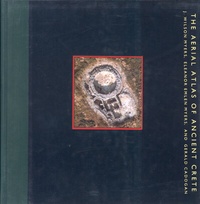
An Aerial Atlas of Ancient Crete
Published on 3. June 1992
Book
Hardback
348 pages
978-0-520-07382-1 (ISBN)
Description
This book marks an astonishing achievement in ancient Greek archaeology. Using twin cameras suspended from a 33-foot, four-finned balloon, Wilson and Ellie Myers have been able to photograph 44 archaeological sites on Crete from a much lower altitude than is possible from helicopters or airplanes. The result is stunning. The breathtaking high-resolution photographs reveal new information and correct mistaken assumptions about these ancient sites. The Atlas will cause scholars to rethink their notions about the Minoan culture of Crete, which with its linear A writing, widespread sea trade, elaborate palaces, and unique art was crucial to the development of western civilization. For archaeologists of the future, the Atlas photographs preserve important information that is being lost each year through gradual erosion of the sites. For each site entry there are aerial views and a corresponding drawn plan, each shedding light on the other; a detailed description of the site (its significance, relationship to the local topography and geology, and excavation history); and a comprehensive research bibliography.
The descriptions prepared by the international community of Cretan archaeologists under the guidance of regional specialist Gerald Cadogan reflect the latest available information on the sites of the Minoans and those who succeeded them. Indeed, the text entries and the chapter on Crete by Cadogan are in themselves a major contribution to scholarship. Together, text and photographs, which offer a unique grouping of related sites for comparative study, provide a significant advance in archaeological method. The work will be welcomed by archaeologists in the field as well as by scholars of ancient Greek civilization. With its introductory chapters, accessible style, and magnificent photographs, the Atlas will also appeal to the archaeological tourist and the armchair traveler.
The descriptions prepared by the international community of Cretan archaeologists under the guidance of regional specialist Gerald Cadogan reflect the latest available information on the sites of the Minoans and those who succeeded them. Indeed, the text entries and the chapter on Crete by Cadogan are in themselves a major contribution to scholarship. Together, text and photographs, which offer a unique grouping of related sites for comparative study, provide a significant advance in archaeological method. The work will be welcomed by archaeologists in the field as well as by scholars of ancient Greek civilization. With its introductory chapters, accessible style, and magnificent photographs, the Atlas will also appeal to the archaeological tourist and the armchair traveler.
More details
Language
English
Place of publication
Berkerley
United States
Target group
College/higher education
Professional and scholarly
Product notice
Cloth over boards
Illustrations
200 full-color photographs, 80 b/w illustrations
Dimensions
Height: 279 mm
Width: 305 mm
Thickness: 0 mm
Weight
3175 gr
ISBN-13
978-0-520-07382-1 (9780520073821)
Copyright in bibliographic data and cover images is held by Nielsen Book Services Limited or by the publishers or by their respective licensors: all rights reserved.
Schweitzer Classification
Persons
J. Wilson Myers, Emeritus Professor of Humanities, Michigan State University, is now Research Professor in the Department of Archaeology at Boston University, where Eleanor E. Myers is Research Fellow. Gerald Cadogan, Research Professor of Classical Archaeology at the University of Cincinnati, is Director of Excavations & Study at Myrtos-Pyrgos in Crete and Maroni in Cyprus. He is the author of Palaces of Minoan Crete (Methuen, 1980) and the editor of The End of the Early Bronze Age in the Aegean (Brill, 1986).