

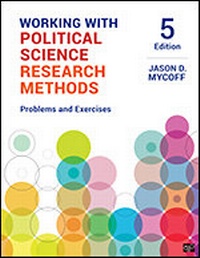
Working with Political Science Research Methods
Problems and Exercises
5th Edition
Published on 15. October 2019
Book
Paperback/Softback
160 pages
978-1-5443-3144-7 (ISBN)
Description
Practice makes perfect. This new, Fifth Edition of Working with Political Science Research Methods continues to support student learning by offering the perfect opportunity to practice each of the methods presented in the core text. Designed to be paired with the #em/em#olitical Science Research Methods 9th edition chapter-for-chapter, the workbook breaks out each aspect of the research process into manageable parts and features new exercises and updated data sets. More than half of the book's exercises are new or updated and feature more international examples, greater focus on qualitative research methods, and directly correlates with the text's more condensed layout. A solutions manual with answers to the workbook is available to adopters.
Reviews / Votes
"This workbook provides innovative exercises for students to practice applying the lessons of a standard research methods course to political science questions. The activities are useful in class, as assignments, or as the basis for an exam, and can launch great discussions on how and why we do research in the field. I highly recommend this text to all political science research methods instructors." -- Amanda M. Rosen "The textbook does a great job of translating theory into practice. It is an essential supplement to the textbook that gives students hands-on opportunities to test their understanding of the concepts discussed in the book." -- Ewa GolebiowskaMore details
Edition
5th Revised edition
Language
English
Place of publication
Washington
United States
Publishing group
SAGE Publications Inc
Target group
College/higher education
Edition type
Revised edition
Dimensions
Height: 279 mm
Width: 216 mm
Weight
390 gr
ISBN-13
978-1-5443-3144-7 (9781544331447)
Copyright in bibliographic data and cover images is held by Nielsen Book Services Limited or by the publishers or by their respective licensors: all rights reserved.
Schweitzer Classification
Other editions
Previous edition
Book
12/2015
4th Edition
CQ Press
€67.03
Article exhausted; check for reprint
Person
Jason Mycoff is associate professor of political science and international relations at the University of Delaware. His research is on American political institutions, in particular the US Congress, congressional committees, and parties.
Content
About the Author
Acknowledgments
Chapter 1 * Introduction: Practice Makes Perfect
Chapter 2 * The Empirical Approach to Political Science
Chapter 3 * Beginning the Research Process: Identifying a Research Topic, Developing Research Questions, and Reviewing the Literature
Chapter 4 * The Building Blocks of Social Scientific Research: Hypotheses, Concepts, Variables, and Measurements
Chapter 5 * Sampling
Chapter 6 * Research Design: Establishing Causation: Making Causal Inferences
Chapter 7 * Qualitative Research: Case Study Designs
Chapter 8 * Making Empirical Observations: Qualitative Analysis
Chapter 9 * Quantitative Research Designs
Chapter 10 * Quantitative Methods
Chapter 11 * Making Sense of Data: First Steps
Chapter 12 * Testing Relationships
Chapter 13 * Analyzing Relationships for Categorical Data
Chapter 14 * Regression
Acknowledgments
Chapter 1 * Introduction: Practice Makes Perfect
Chapter 2 * The Empirical Approach to Political Science
Chapter 3 * Beginning the Research Process: Identifying a Research Topic, Developing Research Questions, and Reviewing the Literature
Chapter 4 * The Building Blocks of Social Scientific Research: Hypotheses, Concepts, Variables, and Measurements
Chapter 5 * Sampling
Chapter 6 * Research Design: Establishing Causation: Making Causal Inferences
Chapter 7 * Qualitative Research: Case Study Designs
Chapter 8 * Making Empirical Observations: Qualitative Analysis
Chapter 9 * Quantitative Research Designs
Chapter 10 * Quantitative Methods
Chapter 11 * Making Sense of Data: First Steps
Chapter 12 * Testing Relationships
Chapter 13 * Analyzing Relationships for Categorical Data
Chapter 14 * Regression