

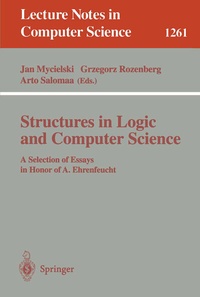
Structures in Logic and Computer Science
A Selection of Essays in Honor of A. Ehrenfeucht
Published on 23. July 1997
Book
Paperback/Softback
XII, 376 pages
978-3-540-63246-7 (ISBN)
Description
This book is dedicated to Andrzej Ehrenfeucht on the occasion of his 65th birthday. On personal invitation by the volume editors, 22 internationally well-known scientists from mathematical logics and theoretical computer science participated in this project honoring an excellent scientist with excellent papers centered around his scientific work.
The 22 invited papers are presented in topical sections on model theory, games and logic, graphs and algorithms, pattern matching and learning, combinatorics of words, algebra of languages, formal language theory, and computational molecular biology.
The 22 invited papers are presented in topical sections on model theory, games and logic, graphs and algorithms, pattern matching and learning, combinatorics of words, algebra of languages, formal language theory, and computational molecular biology.
More details
Series
Edition
1997 ed.
Language
English
Place of publication
Berlin
Germany
Publishing group
Springer Berlin
Target group
Professional and scholarly
Research
Illustrations
XII, 376 p.
Dimensions
Height: 235 mm
Width: 155 mm
Thickness: 21 mm
Weight
587 gr
ISBN-13
978-3-540-63246-7 (9783540632467)
DOI
10.1007/3-540-63246-8
Schweitzer Classification
Content
On the work of Andrzej Ehrenfeucht in model theory.- Syntax vs. semantics on finite structures.- Expressive power of unary counters.- Some strange quantifiers.- Pebble games in model theory.- An interpretive isomorphism between binary and ternary relations.- Vagueness - A rough set view.- Ehrenfeucht games, the composition method, and the monadic theory of ordinal words.- Monadic second order logic and node relations on graphs and trees.- Approximating the volume of general Pfaffian bodies.- Complement-equivalence classes on graphs.- On compact directed acyclic word graphs.- Metric entropy and minimax risk in classification.- Of periods, quasiperiods, repetitions and covers.- Combinatorics of standard Sturmian words.- Compactness of systems of equations on completely regular semigroups.- Decision problems concerning algebraic series with noncommuting variables.- Associative shuffle of infinite words.- Constructing sequential bijections.- Rewriting rules for synchronization languages.- DNA sequence classification using DAWGs.- DNA computing: Distributed splicing systems.