

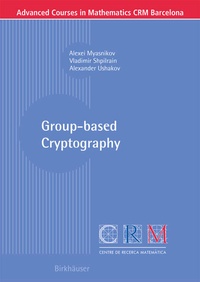
Group-based Cryptography
Published on 17. July 2008
Book
Paperback/Softback
XV, 183 pages
978-3-7643-8826-3 (ISBN)
Description
This book is about relations between three di?erent areas of mathematics and theoreticalcomputer science: combinatorialgroup theory, cryptography,and c- plexity theory. We explorehownon-commutative(in?nite) groups,which arety- callystudiedincombinatorialgrouptheory,canbeusedinpublickeycryptography. We also show that there is a remarkable feedback from cryptography to com- natorial group theory because some of the problems motivated by cryptography appear to be new to group theory, and they open many interesting research - enues within group theory. Then, we employ complexity theory, notably generic case complexity of algorithms,for cryptanalysisof various cryptographicprotocols based on in?nite groups. We also use the ideas and machinery from the theory of generic case complexity to study asymptotically dominant properties of some in?nite groups that have been used in public key cryptography so far. It turns out that for a relevant cryptographic scheme to be secure, it is essential that keys are selected from a "very small" (relative to the whole group, say) subset rather than from the whole group.
Detecting these subsets ("black holes") for a part- ular cryptographic scheme is usually a very challenging problem, but it holds the keyto creatingsecurecryptographicprimitives basedonin?nite non-commutative groups. The book isbased onlecture notesfor the Advanced Courseon Group-Based CryptographyheldattheCRM,BarcelonainMay2007. Itisagreatpleasureforus to thank Manuel Castellet, the HonoraryDirector of the CRM, for supporting the idea of this Advanced Course. We are also grateful to the current CRM Director, JoaquimBruna,and to the friendly CRM sta?,especially Mrs. N. PortetandMrs. N. Hern' andez, for their help in running the Advanced Course and in preparing the lecture notes.
Detecting these subsets ("black holes") for a part- ular cryptographic scheme is usually a very challenging problem, but it holds the keyto creatingsecurecryptographicprimitives basedonin?nite non-commutative groups. The book isbased onlecture notesfor the Advanced Courseon Group-Based CryptographyheldattheCRM,BarcelonainMay2007. Itisagreatpleasureforus to thank Manuel Castellet, the HonoraryDirector of the CRM, for supporting the idea of this Advanced Course. We are also grateful to the current CRM Director, JoaquimBruna,and to the friendly CRM sta?,especially Mrs. N. PortetandMrs. N. Hern' andez, for their help in running the Advanced Course and in preparing the lecture notes.
Reviews / Votes
From the reviews:
"The book at hand has the aim to introduce the reader into the rich world of group-based asymmetric encryption. . The basics necessary for the understanding are given in introducing chapters. Many hints for further reading are given. So, the book might be useful for the beginner, who wants to get a clear introduction, as well as for the expert, who gets an elaborate survey as well as much stimulation for proceeding research." (Michael Wüstner, Zentralblatt MATH, Vol. 1248, 2012)
More details
Series
Edition
2008 ed.
Language
English
Place of publication
Basel
Switzerland
Publishing group
Springer Basel
Target group
Primary & secondary/elementary & high school
Graduate
Illustrations
XV, 183 p.
Dimensions
Height: 240 mm
Width: 170 mm
Thickness: 12 mm
Weight
356 gr
ISBN-13
978-3-7643-8826-3 (9783764388263)
DOI
10.1007/978-3-7643-8827-0
Schweitzer Classification
Other editions
Additional editions
Alexei Myasnikov | Vladimir Shpilrain | Alexander Ushakov
Group-based Cryptography
E-Book
11/2008
Birkhäuser
€28.88
Available for download
Content
Background on Groups, Complexity, and Cryptography.- Background on Public Key Cryptography.- Background on Combinatorial Group Theory.- Background on Computational Complexity.- Non-commutative Cryptography.- Canonical Non-commutative Cryptography.- Platform Groups.- Using Decision Problems in Public Key Cryptography.- Generic Complexity and Cryptanalysis.- Distributional Problems and the Average-Case Complexity.- Generic Case Complexity.- Generic Complexity of NP-complete Problems.- Asymptotically Dominant Properties and Cryptanalysis.- Asymptotically Dominant Properties.- Length-Based and Quotient Attacks.