

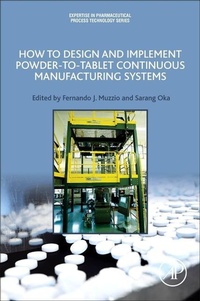
How to Design and Implement Powder-to-Tablet Continuous Manufacturing Systems
Published on 1. April 2022
Book
Paperback/Softback
442 pages
978-0-12-813479-5 (ISBN)
Description
How to Design and Implement Powder-to-Tablet Continuous Manufacturing Systems provides a comprehensive overview on the considerations necessary for the design of continuous pharmaceutical manufacturing processes. The book covers both the theory and design of continuous processing of associated unit operations, along with their characterization and control. In addition, it discusses practical insights and strategies that the editor and chapter authors have learned. Chapters cover Process Analytical Technology (PAT) tools and the application of PAT data to enable distributed process control.
With numerous case studies throughout, this valuable guide is ideal for those engaged in, or learning about, continuous processing in pharmaceutical manufacturing.
With numerous case studies throughout, this valuable guide is ideal for those engaged in, or learning about, continuous processing in pharmaceutical manufacturing.
More details
Series
Language
English
Place of publication
San Diego
United States
Publishing group
Elsevier Science Publishing Co Inc
Target group
Professional and scholarly
Pharmaceutical industry professionals engaged or planning to engage in the continuous manufacturing process; graduate students in the pharmaceutical sciences or chemical engineering who are pursuing advanced courses in pharmaceutical process design
Product notice
Paperback (trade)
Unsewn / adhesive bound
Dimensions
Height: 225 mm
Width: 149 mm
Thickness: 21 mm
Weight
684 gr
ISBN-13
978-0-12-813479-5 (9780128134795)
Copyright in bibliographic data and cover images is held by Nielsen Book Services Limited or by the publishers or by their respective licensors: all rights reserved.
Schweitzer Classification
Other editions
Additional editions
Fernando Muzzio | Sarang Oka
How to Design and Implement Powder-to-Tablet Continuous Manufacturing Systems
E-Book
03/2022
Academic Press
€109.00
Available for download
Persons
Fernando Muzzio is a Distinguished Professor at Rutgers University. For the last 22 years, pharmaceutical product and process design has been Professor Muzzio's main research and educational focus. His research interests comprise continuous manufacturing, powder mixing, powder flow, segregation, compression, mixing and flow of liquids and suspensions, capsule filling, tablet dissolution, and tablet coating. Dr. Muzzio has published more than 260 research papers in this area and his h-index is currently 45. He is a frequent advisor and lecturer at FDA events, and in 2010 he was appointed a voting member of the FDA committee on Pharmaceutical Sciences and Clinical Pharmacology.
Professor Fernando Muzzio is also the director of the National Science Foundation Engineering Research Center on Structured Organic Particulate Systems. The center, which has a total budget in excess of $8 million per year, focuses on pharmaceutical product and process design, with special emphasis on continuous manufacturing, particle engineering, and personalized medicine. The FDA and 45 companies, including Amgen, Vertex, Lilly, Pfizer, Merck, Bristol-Myers Squibb and more, are currently members of the center. Dr. Sarang Oka is a Senior Manager at Hovione where he heads the continuous drug product manufacturing area at Hovione's site in East Windsor, New Jersey, overseeing all technical functions including manufacturing, process development, and process analytical technology (PAT).
Dr. Oka received his PhD in Chemical Engineering from Rutgers University. His thesis focused on continuous powder mixing and granulation, and examined the role of continuous manufacturing in enabling direct compression of otherwise directly incompressible formulations. He was also part of the team at Rutgers University and NSF ERC-SOPS that helped develop Prezista, the first FDA approval for a batch-to-continuous conversion of a drug product. Dr. Oka holds a BS in chemical engineering from Mumbai University.
Professor Fernando Muzzio is also the director of the National Science Foundation Engineering Research Center on Structured Organic Particulate Systems. The center, which has a total budget in excess of $8 million per year, focuses on pharmaceutical product and process design, with special emphasis on continuous manufacturing, particle engineering, and personalized medicine. The FDA and 45 companies, including Amgen, Vertex, Lilly, Pfizer, Merck, Bristol-Myers Squibb and more, are currently members of the center. Dr. Sarang Oka is a Senior Manager at Hovione where he heads the continuous drug product manufacturing area at Hovione's site in East Windsor, New Jersey, overseeing all technical functions including manufacturing, process development, and process analytical technology (PAT).
Dr. Oka received his PhD in Chemical Engineering from Rutgers University. His thesis focused on continuous powder mixing and granulation, and examined the role of continuous manufacturing in enabling direct compression of otherwise directly incompressible formulations. He was also part of the team at Rutgers University and NSF ERC-SOPS that helped develop Prezista, the first FDA approval for a batch-to-continuous conversion of a drug product. Dr. Oka holds a BS in chemical engineering from Mumbai University.
Editor
Distinguished Professor, Pharmaceutical Engineering Training Program, Department of Chemical and Biochemical Engineering, Director, NSF ERC on Structured Organic Particulate Systems PhD, Rutgers University, Piscataway, NJ, USA
Senior Manager, Drug Product Continuous Manufacturing, Hovione, East Windsor, New Jersey, USA
Content
1. Introduction - Current State of the Technology
2. Conceptual Design
3. Material Characterization
4. Loss-in-weight feeding
5. Continuous powder mixing
6. Roller compaction
7. Wet granulation
8. Continuous Drying
9. Continuous tableting and coating
10. Role of Process Analytical Technology in Continuous Manufacturing
11. Process modeling
12. Integrated process control
13. Real Time Release and Testing
14. Risk Analysis, Sensitivity, and Optimization
15. Regulatory Expectations
16. The future of continuous processing
2. Conceptual Design
3. Material Characterization
4. Loss-in-weight feeding
5. Continuous powder mixing
6. Roller compaction
7. Wet granulation
8. Continuous Drying
9. Continuous tableting and coating
10. Role of Process Analytical Technology in Continuous Manufacturing
11. Process modeling
12. Integrated process control
13. Real Time Release and Testing
14. Risk Analysis, Sensitivity, and Optimization
15. Regulatory Expectations
16. The future of continuous processing