

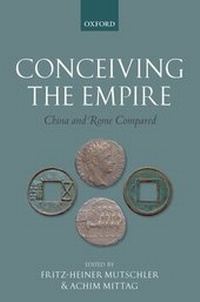
Conceiving the Empire
China and Rome Compared
Published on 13. November 2008
Book
Hardback
512 pages
978-0-19-921464-8 (ISBN)
Description
The essays in Conceiving the Empire explore the mental images, ideas, and symbolical representations of `empire' which developed in the two most powerful political entities of antiquity: China and Rome. While the central focus is on historiography, other related fields are also explored: geography and cartography, epigraphy, art and architecture, and, more generally, political thought and the history of ideas. Written by a collaborative team of experts in Sinology and Classical Studies, the volume focuses the attention of the emerging discipline of East-West cross-cultural studies on an essential feature of the ancient Mediterranean and Chinese worlds: the emergence of `empire' and the enduring influence of the `imperial' order.
Reviews / Votes
This remarkably rich book represents a highly valuable contribution to cross-cultural studies of Rome and China * Jinyu Liu, The Classical Review * The book is an admirable demonstration of the great potential that lies in comparative analysis of the Greco-Roman world Ancient China. * Hyun Jin Kim, Bryn Mawr Classical Review * This is not only a matter of ancient history, but of history with a sharp contemporary relevance. * Christopher Kelly, Times Literary Supplement *More details
Language
English
Place of publication
Oxford
United Kingdom
Target group
College/higher education
Professional and scholarly
Illustrations
35 in-text illustrations
Dimensions
Height: 240 mm
Width: 161 mm
Thickness: 32 mm
Weight
922 gr
ISBN-13
978-0-19-921464-8 (9780199214648)
Copyright in bibliographic data and cover images is held by Nielsen Book Services Limited or by the publishers or by their respective licensors: all rights reserved.
Schweitzer Classification
Persons
Fritz-Heiner Mutschler is Professor of Classics at Dresden University.
Achim Mittag is Professor of Chinese Studies at Tuebingen University.
Achim Mittag is Professor of Chinese Studies at Tuebingen University.
Content
I. THE BIRTH OF THE IMPERIAL ORDER; A. THE IDEA OF 'EMPIRE': ITS GENESIS BEFORE AND ITS UNFOLDING AFTER THE EMERGENCE OF THE EMPIRE; B. HISTORIOGRAPHY AND THE EMERGING EMPIRE; II.THE FIRMLY ESTABLISHED EMPIRE; A. IMPERIAL GRANDEUR AND HISTORIOGRAPHY A LA GRANDE; B.THE SPATIAL DIMENSION OF THE UNIFIED WORLD: IMPERIAL GEOGRAPHY AND CARTOGRAPHICAL REPRESENTATIONS; C. SELF-IMAGE AND THE FORMATION OF IMPERIAL RHETORICS; D. THE POWER OF IMAGES: IMPERIAL ORDER AND IMPERIAL AURA AS REPRESENTED IN ART AND ARCHITECTURE; III. THE WANING OF THE IMPERIAL ORDER; A. HISTORY-WRITING IN THE FACE OF CRISIS; B. WHEN THE IMPERIAL ORDER DISINTEGRATES: RETHINKING THE 'EMPIRE' UNDER RELIGIOUS AUSPICES